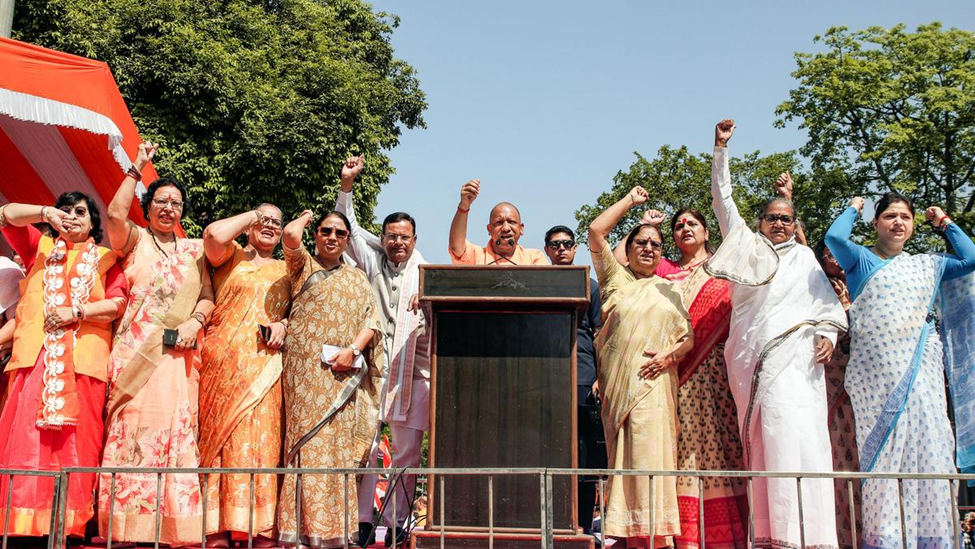
Political Showdown Intensifies in Uttar Pradesh
A fresh political confrontation has unfolded in Uttar Pradesh as Chief Minister Yogi Adityanath led a high-profile protest march targeting the opposition, while Samajwadi Party chief Akhilesh Yadav countered with a strong claim that the ruling Bharatiya Janata Party (BJP) is heading toward defeat in the upcoming elections. The development signals an early escalation of campaign rhetoric as political parties sharpen their strategies ahead of crucial electoral contests in the state.
The protest march led by Yogi Adityanath was positioned as a response to what the BJP describes as “misleading narratives” and “anti-development politics” by opposition parties. The demonstration saw significant participation from party workers and supporters, reflecting an attempt to consolidate grassroots momentum and project political strength.
Yogi Adityanath’s Strategy and Messaging
During the march, Yogi Adityanath emphasized the achievements of his government, particularly in areas such as infrastructure development, law and order, and welfare schemes. He accused opposition parties of spreading misinformation and attempting to undermine governance initiatives. The protest was not merely symbolic but also strategic, aiming to reinforce the BJP’s narrative of stability and progress in Uttar Pradesh.
The Chief Minister highlighted projects related to expressways, industrial investment, and employment generation, asserting that these initiatives have transformed the state’s economic landscape. By taking to the streets, Yogi Adityanath sought to connect directly with the public and energize party cadres, a move often seen as critical in pre-election mobilization.
Akhilesh Yadav’s Counterattack
In response, Akhilesh Yadav dismissed the protest march as a “political drama” and reiterated his confidence that the BJP would face defeat in the upcoming polls. He accused the ruling government of failing to address key issues such as unemployment, inflation, and farmers’ concerns.
Akhilesh Yadav’s remarks indicate a clear attempt to shift the narrative toward governance gaps and socio-economic challenges. By projecting confidence in an electoral victory, he aims to boost the morale of Samajwadi Party workers and position himself as a credible alternative to the BJP.
The Samajwadi Party has been focusing on grassroots outreach and coalition-building, strategies that could play a significant role in shaping electoral outcomes. Akhilesh Yadav’s statements reflect a broader opposition effort to consolidate anti-incumbency sentiment.
Electoral Context and Political Stakes
Uttar Pradesh remains one of the most politically significant states in India, often influencing national political dynamics. The ongoing exchange between Yogi Adityanath and Akhilesh Yadav underscores the high stakes involved in the upcoming elections.
The BJP, which has maintained a strong presence in the state, is likely to emphasize governance achievements and development projects as key campaign themes. On the other hand, the Samajwadi Party is expected to focus on issues related to livelihoods, social justice, and economic challenges.
The political landscape is further complicated by the presence of other regional and national parties, which could influence vote shares and alliances. As campaigning intensifies, both sides are expected to adopt aggressive strategies to secure voter support.
Public Response and Ground Reality
The protest march and subsequent political statements have generated considerable public attention. Supporters of the BJP view the march as a demonstration of strong leadership, while opposition supporters see it as an attempt to divert attention from pressing issues.
Public sentiment in Uttar Pradesh is shaped by a complex interplay of factors, including caste dynamics, economic conditions, and local governance. While large-scale political events such as protest marches can influence perception, the final electoral outcome often depends on grassroots-level engagement and voter priorities.
Implications for Future Campaigns
The current political exchange sets the tone for what is likely to be a highly competitive election season in Uttar Pradesh. Both Yogi Adityanath and Akhilesh Yadav are leveraging public platforms to articulate their visions and critique each other’s approaches.
The BJP’s focus on development and governance is expected to remain central to its campaign, while the Samajwadi Party will likely intensify its critique of the government’s performance. The interplay between these narratives will shape voter perception in the coming months.
Political analysts suggest that early mobilization efforts, such as the protest march, are crucial for building momentum. At the same time, opposition strategies aimed at highlighting socio-economic issues could resonate with specific voter segments.
The protest march led by Yogi Adityanath and the sharp response from Akhilesh Yadav highlight the beginning of a politically charged phase in Uttar Pradesh. With both leaders projecting confidence and adopting assertive positions, the stage is set for a closely contested electoral battle.
As political activities gain momentum, the focus will remain on how effectively each party communicates its message and connects with voters. The developments in Uttar Pradesh will not only influence state politics but could also have broader implications for the national political landscape.
Follow for more updates regarding business related news on newsnownation.com
