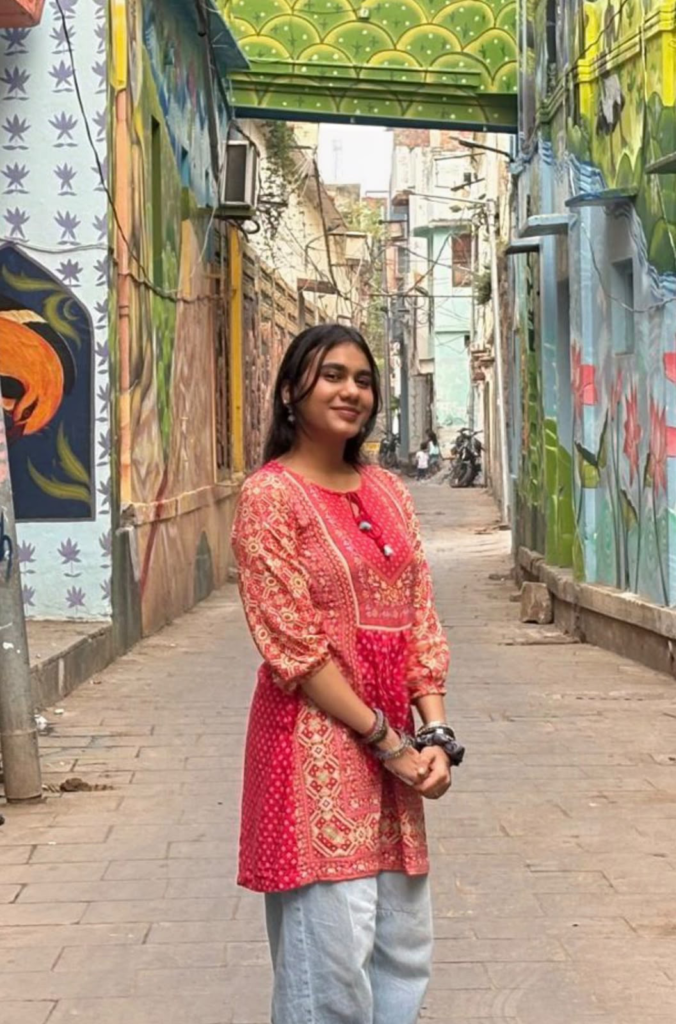
Author: Snehal Gupta
As a Class 12 student preparing for the IIT-JEE, I spend most of my day solving Physics numericals, practising Mathematics, and trying to understand difficult concepts in Chemistry. Like many students, I often wonder what life after school will look like. But lately, another question has been on my mind: Will Artificial Intelligence change the future of the careers we are working so hard for?
The question became even more real when I started using AI in my own studies. Sometimes it explains a concept better than a textbook. It can solve problems, summarise chapters, and answer questions within seconds. While I find this fascinating, it also makes me wonder, if AI can do so much already, what will engineers like us do ten or fifteen years from now?
As students preparing for competitive exams, we often measure success through ranks, marks and college admissions. But AI has made me realise that in the future, qualities like curiosity, adaptability and creativity may matter just as much.
Initially, the thought was unsettling. But the more I read about AI, the more I realised that perhaps we are asking the wrong question. Instead of asking whether AI will replace us, maybe we should ask how we can become the kind of people AI can never replace.
That change in perspective became even stronger after I attended the Summer School at Plaksha University last year. Being surrounded by students, researchers and entrepreneurs showed me how technology is not just about writing better code or building smarter machines, it is about solving meaningful problems. I realised that the future will not belong only to people who understand technology, but to those who know how to use it to improve lives.
This is where I believe AI changes the conversation. According to the World Economic Forum’s Future of Jobs Report 2025, nearly 170 million new jobs are expected to be created globally by 2030, while around 92 million existing jobs may disappear. Rather than eliminating opportunities, AI is transforming them. New careers in artificial intelligence, robotics, renewable energy, biotechnology and cybersecurity are already emerging faster than ever before.
Of course, routine work is becoming automated. AI can process data, write reports and even generate computer code. But can it truly inspire a team, comfort someone going through a difficult time, motivate an athlete after a defeat, or negotiate peace between nations? These are deeply human abilities that no algorithm can fully replicate.
Ironically, the more intelligent machines become, the more valuable human qualities become. Creativity, empathy, leadership, teamwork, communication and curiosity are turning into the skills that matter most.
Preparing for the IIT-JEE has taught me that success isn’t just about intelligence; it is equally about perseverance. Solving one difficult problem after another builds patience. Sports have taught me resilience, music has taught me discipline, and art has reminded me to think creatively. Together, these experiences have shown me that education is not only about scoring well in an examination, it is about becoming a person who can adapt to change.
As students, we often worry about choosing the “right” career. But perhaps the better goal is to become lifelong learners. Technology will continue to evolve throughout our lives, and many of the jobs we will eventually do may not even exist today. What will matter is our willingness to keep learning, adapting and growing.
I no longer see AI as a competitor. I see it as a powerful tool, one that can make us more productive, more creative and perhaps even better engineers. But it will always need human values to guide it.
As I stand on the threshold of college and the professional world, I don’t know exactly what the future will look like and perhaps no one does. But that uncertainty no longer worries me. AI will undoubtedly change the way we work, yet I believe our imagination, compassion, resilience and ability to dream will always remain uniquely human.
The future will not belong to those who compete with AI. It will belong to those who keep learning, think creatively, and use AI to make the world a little better than they found it!
