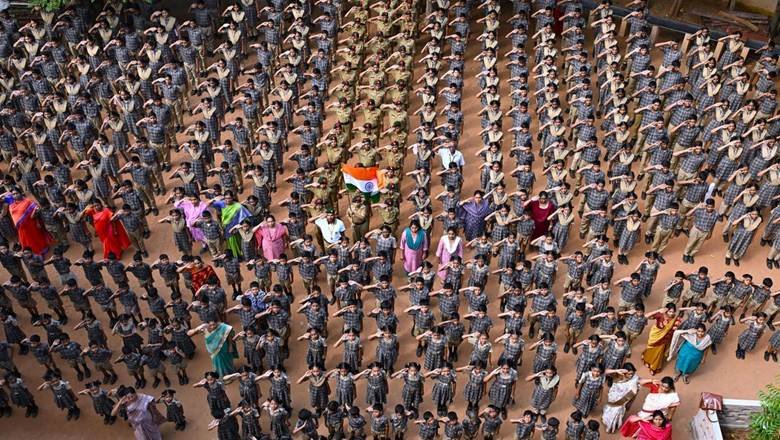
The national song “Vande Mataram” has once again returned to the center of India’s political and cultural conversation. Originally written by Bankim Chandra Chattopadhyay in the late nineteenth century and later included in his novel Anandamath, the song played an emotional and symbolic role during India’s freedom movement. For generations, it represented resistance against colonial rule and inspired nationalist sentiment across the country. However, in contemporary India, the discussion surrounding “Vande Mataram” is no longer limited to patriotism alone. It has evolved into a larger debate about multicultural nationalism, religious identity, constitutional values, and the meaning of inclusivity in a diverse democracy.
The renewed debate gained momentum after recent political discussions and policy proposals regarding the compulsory recitation of the full six stanzas of the song in educational and government institutions. While supporters describe the move as an effort to strengthen cultural nationalism and reconnect citizens with India’s historical heritage, critics argue that forcing symbolic expressions of patriotism may undermine the pluralistic foundations of the country. Several religious organizations and constitutional scholars have raised concerns about whether compulsory participation respects the freedom of belief guaranteed under the Constitution.
The roots of the controversy can be traced back to the song’s literary and historical origins. “Vande Mataram” was first published in Bankim Chandra Chattopadhyay’s novel Anandamath in 1882. The novel portrayed a fictionalized rebellion against oppressive rule and used the imagery of the motherland as a divine feminine force. Over time, the song became deeply associated with India’s anti-colonial movement and emerged as a slogan of resistance during the partition of Bengal in 1905. Freedom fighters, political leaders, and revolutionaries often used the song during public demonstrations against British rule.
Despite its historic significance, the song also became a subject of disagreement because of certain verses that invoke Hindu goddess imagery, particularly references to Durga and other divine forms. Many Muslim groups historically argued that such depictions conflicted with Islamic monotheistic beliefs. This disagreement led the Indian National Congress in 1937 to adopt only the first two stanzas for official use, as those verses focus primarily on the beauty of the motherland rather than religious symbolism. Leaders such as Rabindranath Tagore and Jawaharlal Nehru supported a balanced approach that respected both national pride and religious diversity.
The larger issue today is not merely about a song but about the interpretation of nationalism in a multicultural society. India is home to people belonging to multiple religions, languages, ethnicities, and cultural traditions. The Constitution of India defines the nation as a secular democratic republic where citizenship is not tied to any one religious identity. In this context, critics argue that national symbols must remain inclusive and voluntary rather than compulsory. According to constitutional experts, patriotism cannot be measured solely through participation in cultural rituals or symbolic acts.
At the same time, supporters of “Vande Mataram” emphasize its historical role in uniting Indians during the freedom struggle. They argue that the song symbolizes sacrifice, resistance, and emotional attachment to the motherland. Many believe that opposition to the song overlooks its importance in shaping India’s nationalist movement. Political leaders supporting the song often present it as a unifying cultural force that transcends religion and represents devotion to the nation.
The controversy also reflects a broader global challenge faced by multicultural democracies: how to balance majority cultural traditions with minority rights. Across the world, nations continue to debate the relationship between national identity and cultural diversity. In India, this challenge becomes even more significant because of the country’s vast social and religious diversity. The debate surrounding “Vande Mataram” highlights the tension between cultural nationalism and constitutional pluralism. One side views national identity through shared cultural heritage, while the other emphasizes civic nationalism rooted in equal rights and inclusive citizenship.
Political analysts believe the issue has gained renewed attention because symbolic nationalism often becomes influential during periods of social and political change. National songs, flags, and cultural symbols carry emotional power and can influence public discourse in powerful ways. However, when these symbols become linked to political agendas, debates over identity and belonging often intensify. Recent political developments have once again transformed “Vande Mataram” into a central symbol in discussions about nationalism and cultural identity in India.
Another important aspect of the debate involves the distinction between respect and compulsion. Many constitutional scholars argue that love for one’s country should emerge naturally through democratic participation, civic responsibility, and social harmony rather than mandatory rituals. Critics warn that enforcing cultural expressions may create divisions instead of unity. They emphasize that India’s strength lies in its diversity and its ability to accommodate different beliefs within a shared democratic framework.
On the other hand, advocates of stronger cultural nationalism argue that shared symbols help build national unity and collective consciousness. They believe countries require emotional and cultural anchors to maintain social cohesion, especially in times of political polarization and globalization. For them, “Vande Mataram” is not simply a song but a reminder of India’s freedom struggle and civilizational heritage.
The ongoing discussion around “Vande Mataram” ultimately reflects the evolving nature of Indian democracy. It demonstrates how historical symbols continue to shape present-day debates about identity, citizenship, secularism, and national belonging. The challenge for modern India lies in preserving both cultural heritage and constitutional inclusivity without allowing either to overshadow the other. A multicultural democracy succeeds not by enforcing uniformity but by creating space for diverse voices to coexist respectfully within a shared national framework.
As India continues to grow as a global democracy, debates like these will remain important in defining the country’s social and political future. The conversation around “Vande Mataram” is therefore not only about a national song but also about the larger vision of India itself — whether nationalism can remain inclusive while still honoring cultural traditions and historical memory.
For more updates on business, society, culture, and trending national developments, follow News Now Nation for daily insights and verified news coverage.

