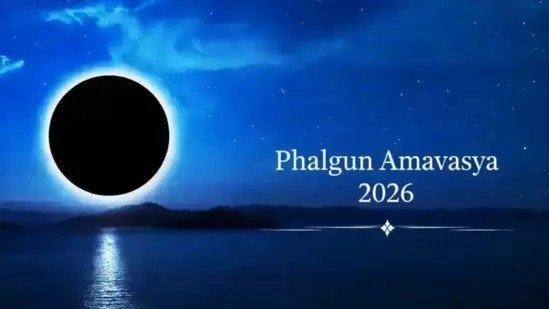
The cosmos is putting on a spectacular show today, February 17, 2026, as the first Solar Eclipse of the year takes place. Known scientifically as an Annular Solar Eclipse and popularly as the “Ring of Fire,” this celestial event has captured the imagination of millions across the globe. Occurring on the auspicious day of Phalguna Amavasya, the eclipse is not just a scientific phenomenon but also a significant day for spiritual and religious observances in India.
An Annular Solar Eclipse happens when the Moon passes between the Sun and Earth but is at or near its farthest point from Earth. Because the Moon appears smaller than the Sun, it does not completely cover the solar disk, leaving a bright, fiery ring visible around the edges. This creates the breathtaking “Ring of Fire” effect that astronomers and skywatchers eagerly wait for.
While the global excitement is palpable, Indian skywatchers will have to rely on virtual platforms. The path of this eclipse is primarily over Antarctica and parts of the Southern Hemisphere, meaning it will not be visible to the naked eye from the Indian subcontinent.
According to Indian Standard Time (IST), the eclipse is scheduled to begin at 3:26 PM and will conclude by 7:57 PM. Despite its invisibility in India, the “Sutak” or the shadow period is being discussed widely due to its alignment with the lunar calendar.
In India, the day coincides with Phalguna Amavasya. Traditionally, an eclipse during Amavasya is considered a powerful time for spiritual cleansing. Since early morning, thousands of devotees have gathered at holy ghats in cities like Varanasi, Haridwar, and Prayagraj for the ritual “Ganga Snan” (holy dip). Daan-Punya (charity) is being performed extensively, as it is believed that the merits of good deeds are multiplied during such cosmic alignments.
While scientists view this as a perfect opportunity to study the Sun’s corona and the Moon’s orbit, many in India continue to follow traditional precautions. From avoiding food during the eclipse window to chanting special mantras, the blend of science and tradition remains a unique aspect of how India experiences such events.
Though the “Ring of Fire” remains hidden from the Indian sky, the digital age has ensured that no one misses out. Live streams from NASA and other space agencies are trending across social media, bringing the wonders of the universe to our fingertips. Whether you view it as a scientific marvel or a spiritual milestone, the first Solar Eclipse of 2026 is undoubtedly a day to remember.
Keep following NewsNowNation.com for more live updates on celestial events.
