Why artist Khushboo Mattoo believes the future of mental wellness may begin with a handwritten letter.
There was a time when waiting was an ordinary part of life.
We waited for film rolls to be developed, for postcards from cousins on summer vacations, for the newspaper every morning, and for the neighborhood postman whose bicycle bell often carried stories from faraway places. We stood by landline telephones, circled dates on calendars, and treasured handwritten letters enough to tuck them inside books for decades.
Somewhere between the late 1990s and today, waiting became inefficiency.
The internet shortened distances. Smartphones compressed time. Social media taught us to document moments before we had fully lived them. Artificial intelligence is now beginning to compress creativity itself, capable of generating paintings, essays, music, and photographs in seconds.
Human history has rarely moved this fast.
While technology has undoubtedly made us more connected, informed, and productive, it has also quietly introduced a different kind of exhaustion. Notifications replaced pauses. Algorithms replaced wandering. Our attention became fragmented into hundreds of moments that disappear almost as quickly as they arrive.
It is within this landscape that artist Khushboo Mattoo Bhardwaj, known professionally as mattLaemon, has built something unexpectedly radical: slowness.
Not as nostalgia.
Not as resistance to technology.
But as a practice of healing.
The process is the destination
Before becoming a full-time artist, Khushboo spent over a decade in journalism and media, living in the relentless rhythm of deadlines, breaking news, and constant connectivity. The work taught her the value of information, but art taught her the value of attention.
“I realized that somewhere along the way we had become obsessed with outcomes,” she says. “We wanted the finished painting, the perfect photograph, the viral reel. We stopped falling in love with the process of making.”
That observation became the foundation of her artistic philosophy.
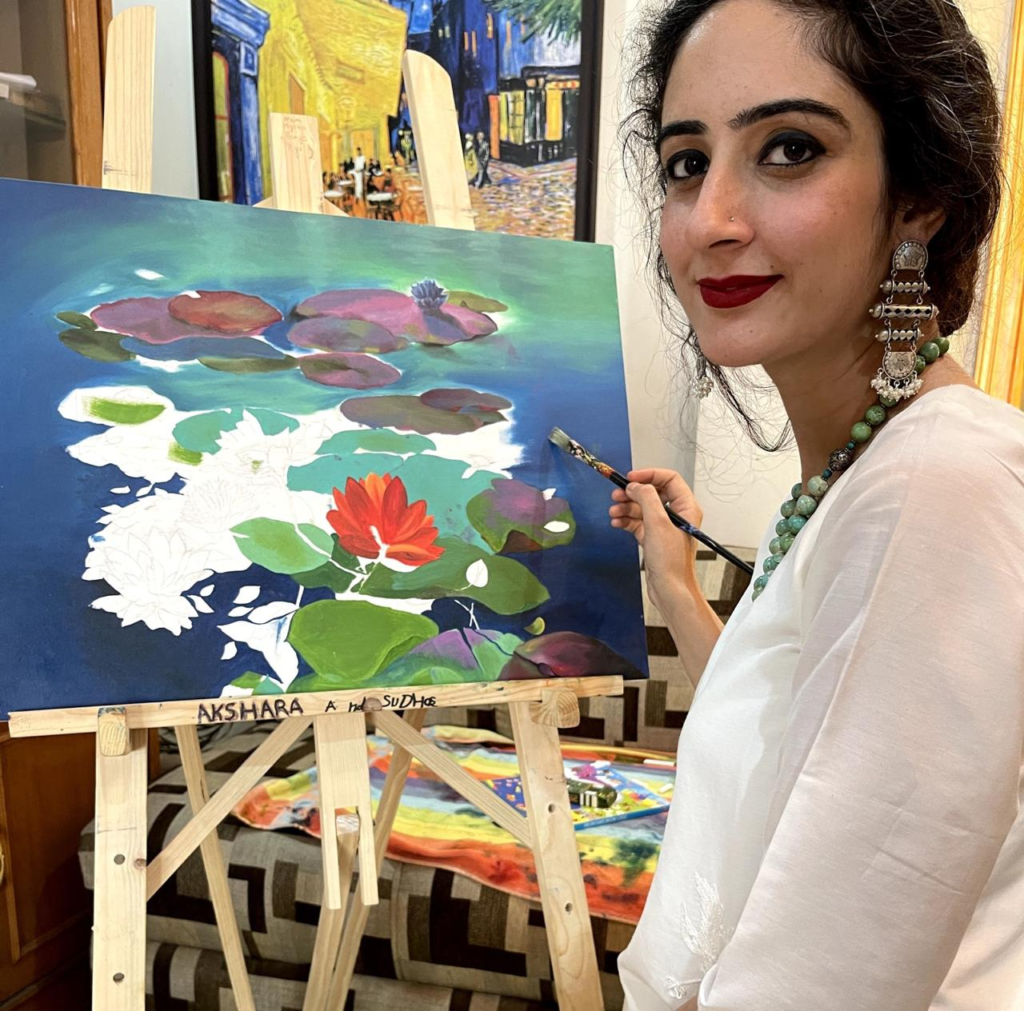
Her studio practice is built around repetition, texture, brushstrokes, handwritten notes, and quiet observation. Rather than treating art as something reserved for galleries, she sees it as a daily ritual that gently slows the nervous system.
“Art is not only something you hang on a wall,” she says. “It is something that rearranges your breathing.”
A generation that grew up in two worlds
Few generations have witnessed change as dramatically as those born in the late 1980s and early 1990s.
They grew up writing essays in notebooks and now brainstorm with AI.
They borrowed library books and now consume endless digital feeds.
They collected stamps before collecting followers.
Their childhoods belonged to analog; their adulthood belongs to algorithms.
For Khushboo, this transition has created a unique emotional challenge.
“We are perhaps the last generation that remembers what it felt like to be unreachable,” she reflects. “Silence wasn’t uncomfortable. Boredom wasn’t something to escape from. It was often where imagination quietly began.”
Today, she believes, creativity risks becoming another form of consumption unless we consciously create space for reflection.
“The speed of life sometimes feels like it’s crashing into us. We aren’t built to process information at the pace we’re receiving it.”
The mountain that arrives by post
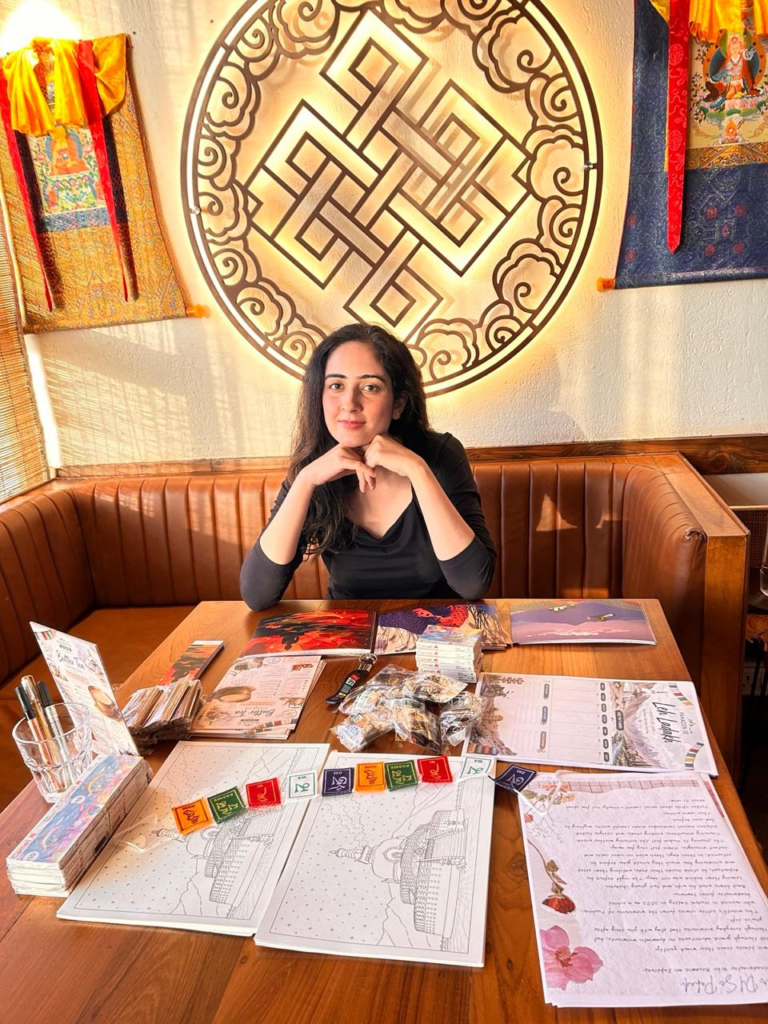
Her response to this acceleration is one of India’s most thoughtful independent creative projects: Pahadon Se.
More than a subscription box, it is a traveling snail mail club inspired by India’s hill stations.
Every month, Khushboo travels to a different mountain destination, gathering fragments of its story. Subscribers receive a carefully assembled package containing a personalized letter, original art prints, pressed flowers, bookmarks, recipe cards, itinerary planners, laptop stickers, magnets, coloring sheets, and small keepsakes collected from the region.
The experience begins not on a screen, but at the front door.
A doorbell rings.
A package arrives.
Someone pauses their day.
The paper is unfolded.
The letter is read slowly.
The flowers are touched.
The artwork is pinned to a wall.
For a few precious minutes, time feels different.
“I wanted to recreate that feeling of the postman arriving with something meaningful,” Khushboo says. “Not another delivery you ordered five minutes ago, but something that has travelled through mountains, through someone’s hands and heart before reaching yours.”
Subscribers now span countries and continents, united by a shared affection for mountains. Some grew up in Himalayan towns before moving abroad. Others are trekkers, mountaineers, photographers, or simply people who find peace in mist, pine forests, and winding roads.
Together they form a community bound less by geography than by memory.
The analogue revolution
In many ways, projects like Pahadon Se represent a quiet cultural shift.
Luxury today is no longer defined solely by rarity or price. Increasingly, it is measured by attention.
To read without multitasking.
To paint without posting.
To write without editing for an algorithm.
To travel without documenting every meal.
To create something whose greatest reward is not public validation but private joy.
“Not everything beautiful has to become content,” Khushboo says. “Some memories deserve to remain yours. Some sunsets don’t need captions. Some paintings don’t need analytics.”
It is an idea that resonates deeply in an era where even leisure often becomes performance.
AI and humanity can coexist
Despite her commitment to analog practices, Khushboo is not anti-technology.
She embraces artificial intelligence as a remarkable creative assistant, believing it has enormous potential to democratise learning, design, and innovation.
But she is equally convinced that technology should never replace the emotional rituals that keep us human.
“I don’t think the future is AI versus people,” she says. “The future is AI alongside people who still know how to observe, feel, write letters, paint badly, walk slowly, and make things with their own hands.”
She believes that emotional intelligence will become one of the defining skills of the next generation.
“We’re teaching machines to think. We must also remember to teach ourselves how to feel.”
Studio Pambach: a slower future
Khushboo’s vision extends beyond paintings and snail mail.
Through Studio Pambach, she hopes to build a collaborative creative space where artists, writers, makers, and travelers come together to celebrate process over perfection.
Future plans include immersive mountain retreats where participants paint, journal, forage, cook, read, and create together with minimal dependence on phones.
The intention is simple but profound: to remind people that the most meaningful conversations often happen when screens are put away.
“I want people to leave with dirty hands from paint, tired legs from walking, a notebook full of thoughts, and a heart that feels lighter than when they arrived.”
The luxury of enough
Perhaps what makes Khushboo Mattoo’s work so resonant is that it doesn’t promise productivity.
It doesn’t promise optimization.
It doesn’t promise transformation in seven easy steps.
Instead, it offers something increasingly rare.
Permission.
Permission to read slowly.
To write by hand.
To sit beside a window while it rains.
To color outside the lines.
To travel for wonder rather than content.
To remember that life isn’t measured only by how quickly we move, but by how deeply we notice.
As the world races toward an ever-faster future, her work quietly suggests another possibility.
That healing may not always arrive through a breakthrough.
Sometimes, it arrives in a brown paper package from the mountains.
With a handwritten letter inside.
And enough silence to finally hear yourself think.
