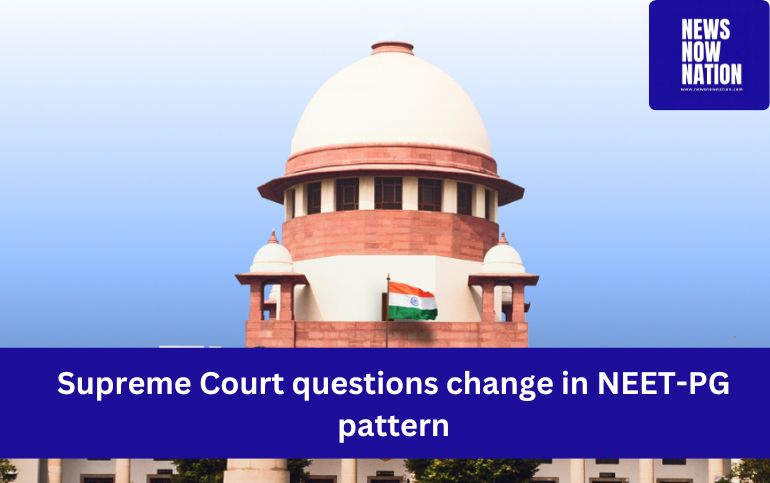
In a significant development, the Supreme Court questions change in NEET-PG pattern, raising concerns about the sudden modifications made by the National Board of Education (NBE) just days before the NEET-PG 2024 exam. On Friday, the court described the changes as “very unusual,” cautioning that such abrupt alterations could lead to a “meltdown” for students already under immense pressure.
A bench led by Chief Justice DY Chandrachud took note of the grievances raised by senior advocate Vibha Datta Makhija and lawyer Tanvi Dubey, who represented the students in the hearing. The court has directed the NBE and the Centre to provide their responses within a week, setting the next hearing for September 27, 2024.
The issue surfaced when students voiced concerns over the abrupt shift in the exam pattern, which included the splitting of the exam into two parts just three days before it was conducted on August 11, 2024. The petition filed by Ishika Jain and others seeks the disclosure of answer keys, question papers, and the standardization of marks to ensure transparency in the selection process.
During the hearing, the advocate representing the students pointed out the lack of transparency and clarity regarding the exam. She emphasized that the sudden changes, without any predefined rules or regulations, created confusion and anxiety among the test-takers. “There needs to be a standardized approach,” Makhija argued, referring to the inconsistency in exam procedures, which were governed solely by an information bulletin that could be altered at will by the authorities.
Chief Justice Chandrachud expressed concern, stating, “It is very unusual… Changing the exam pattern three days before the examination could cause a meltdown for students.” The bench also noted the significance of this case, considering the upcoming counselling process for postgraduate medical admissions.
The NBE counsel defended their actions, asserting that nothing new or unusual was introduced. However, students remained dissatisfied, raising further concerns over the normalization of marks and discrepancies in the ranking process. Many students compared their scores with unofficial answer keys and found unexpected variations in rankings, leading to suspicions of irregularities in the evaluation.
The plea also highlights the lack of transparency, as the NBE did not release the question papers or answer keys, preventing students from properly assessing their performance. Makhija reiterated that candidates cannot gauge their true scores without access to these essential documents.
As the Supreme Court questions the change in NEET-PG pattern, the legal battle continues, with students hopeful for a fair and transparent resolution. The results of NEET-PG 2024, announced on August 23, have already sparked widespread concerns over unexpectedly low rankings, making this a crucial case for thousands of aspiring medical professionals across the country.
Stay tuned to News Now Nation for updates and more news.
Follow us on social media for real-time news updates:

