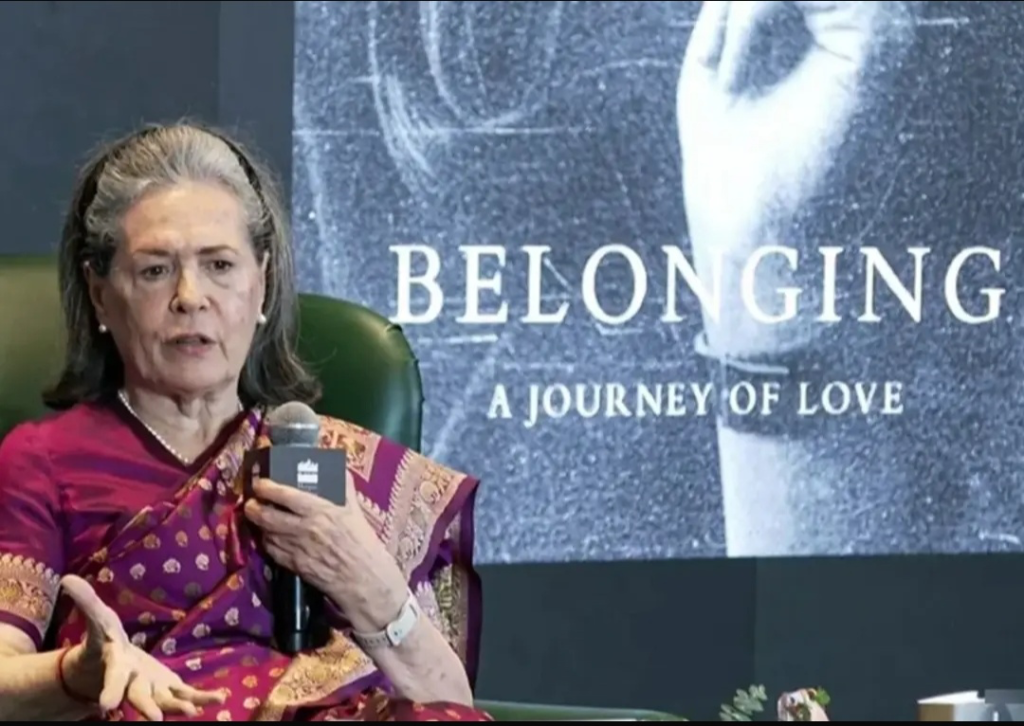
Congress Parliamentary Party chairperson Sonia Gandhi has explained the meaning behind the title of her memoir, Belonging: A Journey of Love, sharing how her personal experiences, family relationships and journey from Italy to India shaped the book. Speaking at the official launch event in New Delhi on November 16, 2026, Gandhi said the word ‘belonging’ represents the feeling of being accepted and finding a place where one feels at home.
During the event, she reflected on the challenges of being an outsider in an unfamiliar country and how acceptance gradually became an important part of her life. She explained that when someone is new to a society, there can be a constant feeling of being watched, judged or not fully accepted. Her explanation offered a glimpse into the personal experiences that influenced the title of the memoir.
The book has attracted attention because it presents Sonia Gandhi’s personal perspective on her life, family and experiences, many of which have remained outside the public conversation for years.
Why Sonia Gandhi Chose the Title ‘Belonging’
Explaining the thought behind the title, Sonia Gandhi said that belonging is closely connected with the experience of acceptance. According to her, an outsider may often feel that people do not like them and that their actions are constantly being observed. This feeling can make it difficult to become comfortable in a new environment.
For Gandhi, the word represents more than simply living in a particular country or becoming part of a family. It reflects the emotional journey of adjusting to a different culture, understanding new traditions and gradually developing a sense of connection with the people around her.
Her journey from Italy to India brought significant personal and cultural changes. After marrying former Prime Minister Rajiv Gandhi, she became part of a family that was already closely associated with India’s political and public life. Adjusting to a different country and its social environment was an important experience that influenced her understanding of identity and acceptance.
At the memoir launch, Gandhi also connected her experiences with those of many Indian women who move into a new household after marriage. She explained that adjusting to unfamiliar traditions, expectations and family relationships can be challenging for women, regardless of where they come from. This broader perspective gives the title a meaning that extends beyond her individual journey.
She also recalled experiencing acceptance when she visited Rajiv Gandhi’s constituency in Amethi. The way local people interacted with her helped her feel that she was being treated as one of their own. Her remarks highlighted how everyday interactions and personal relationships can influence a person’s sense of belonging.
Sonia Gandhi Explains Why She Decided to Write Her Memoir
Apart from explaining the title, Sonia Gandhi discussed the reasons that encouraged her to write about her life. She said that a considerable amount had been written and spoken about her family over the years, but much of it did not reflect their actual experiences or personalities.
According to Gandhi, stories and assumptions about her mother-in-law, husband, children and herself had often been presented in ways she considered unrealistic. She felt that writing a memoir would give her an opportunity to share her own understanding of her family and express feelings that she had generally kept private.
She explained that she had been reluctant to discuss her personal emotions publicly. However, she eventually decided that putting her experiences into writing could help readers understand the people behind the widely discussed public image of the Gandhi family.
The memoir therefore provides an opportunity to look at her experiences from a personal perspective rather than viewing every aspect of her life through the lens of politics. While the Gandhi family has remained a significant subject in Indian public life, the book attempts to bring attention to relationships, memories, personal struggles and family experiences.
Writing about certain periods of her life was not easy. Gandhi acknowledged that revisiting painful memories, particularly the assassinations of former Prime Minister Indira Gandhi and former Prime Minister Rajiv Gandhi, was emotionally difficult. These events had a profound impact on her personal life, and putting those experiences into words required considerable emotional effort.
She also spoke about the importance of her children, Rahul Gandhi and Priyanka Gandhi Vadra, during difficult periods. Recalling the time following Rajiv Gandhi’s death, she described how her children supported her when she was struggling to cope with the loss.
A Personal Journey Through Family, Relationships and Life in India
Belonging: A Journey of Love explores different stages of Sonia Gandhi’s life, including her early years in Italy, her time in England, her relationship with Rajiv Gandhi and her experiences after moving to India.
Her relationship with Rajiv Gandhi is an important part of the memoir. Gandhi recalled their romance as a special experience and reflected on how their relationship eventually brought her into a new country and family. What began as a personal relationship gradually became a journey involving new responsibilities, relationships and significant changes in her life.
The memoir also revisits her relationship with Indira Gandhi. Sonia Gandhi recalled initially feeling intimidated by her mother-in-law, who was a prominent political figure and a strong personality. Over time, their relationship developed into a close family bond. These personal memories provide another dimension to the story of a family that has been widely discussed in Indian politics.
The book also addresses the difficult periods that followed the deaths of Indira Gandhi in 1984 and Rajiv Gandhi in 1991. These tragedies brought significant changes to Sonia Gandhi’s family life. Her reflections on these events highlight the personal consequences of losses that were also major moments in India’s political history.
Although her life became closely connected with public affairs, the memoir places considerable emphasis on the experiences behind that public identity. It offers readers an opportunity to understand how family relationships, personal decisions and changing circumstances influenced her journey over several decades.
Memoir Launch Draws Attention from Political Leaders
The official launch of Belonging: A Journey of Love took place in New Delhi on November 16, 2026. Sonia Gandhi attended the event with her children, Rahul Gandhi and Priyanka Gandhi Vadra. Several prominent political leaders and members of the opposition INDIA bloc were also present.
The gathering brought together leaders from different political backgrounds, making the launch an important public event. Among those attending were Congress president Mallikarjun Kharge, Samajwadi Party chief Akhilesh Yadav, National Conference leader Farooq Abdullah and other senior political figures. Former Punjab Chief Minister Amarinder Singh was also present.
Published by HarperCollins India, the memoir had already generated considerable interest before its formal launch. According to reports, the publisher said that approximately two lakh copies had been sold during the first week after its release.
The book has also attracted political discussion and different responses from political parties. While Gandhi has described it as a way of sharing her personal experiences and correcting what she considers inaccurate accounts of her family, the memoir has also become part of a wider public debate.
Despite the political attention surrounding its release, Gandhi’s explanation of the title brings the discussion back to the central theme of the book. Her account focuses on acceptance, relationships, personal identity and the experience of finding a place in an unfamiliar environment.
For readers interested in Indian public life, the memoir offers a perspective on the personal experiences of a prominent political figure. It also highlights how individual memories can provide another way of understanding people whose lives are frequently discussed in the public domain.
Sonia Gandhi’s explanation of ‘Belonging’ suggests that the idea is not limited to nationality, family background or social identity. It is also about feeling accepted, building relationships and developing an emotional connection with the people and places that become part of one’s life.
For more updates on business, markets, companies and the latest developments, follow NewsNowNation and visit newsnownation.com.
