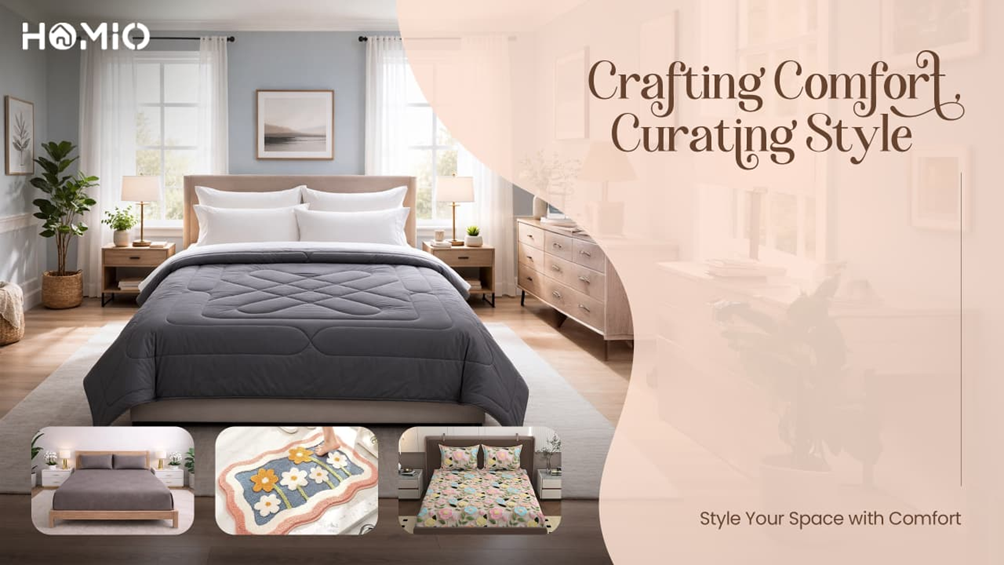
The Indian home furnishings market is experiencing a massive transformation. Today, buyers are no longer satisfied with standard options; they want their living spaces to reflect their personal style while providing ultimate relaxation. Whether it is upgrading an apartment in a bustling city or redecorating a family house, the demand for high quality decor is at an all time high. This is where Homio steps in, redefining comfort and contemporary living. Based in Model Town, Panipat, a city widely known as the textile capital of India, this modern brand was established with a very clear and practical belief. The company operates on the principle that comfort, aesthetics, and affordability should coexist seamlessly in every Indian home. By focusing on what consumers truly need, the company has positioned itself as a key player in the evolving landscape of interior styling and premium bedroom accessories.
The Post Pandemic Shift in Consumer Behavior
The home furnishings industry underwent a dramatic transformation following the pandemic. As our homes evolved into workspaces, relaxation zones, and social hubs, consumers began investing much more consciously in their living environments. People realized the importance of curating spaces that bring them peace and productivity. Three major shifts became highly visible during this period:
- There was an increased digital adoption in home shopping.
- Buyers showed a greater awareness of interior design aesthetics.
- Customers placed a higher emphasis on comfort and product durability.
Responding to these exact needs, the company developed a thoughtfully curated range of premium bedding essentials. These collections include bedsheets, comforters, blankets, and quilted bedding sets designed specifically for modern Indian households. Providing coordinated bedroom collections, the company ensures that styling a room becomes an effortless and enjoyable experience for the buyer.
A Unique Direct to Consumer Approach
In the middle of this highly competitive retail landscape, the leadership behind the brand makes all the difference. Founded by Vardaan Kalra and Kuber Kalra, Homio brings together traditional textile manufacturing expertise and a digital first retail mindset. The founders recognized early on that legacy players in the market rely heavily on multi layer distribution networks. This traditional approach often inflates costs and dilutes the connection with the end buyer.
To counter this, the company operates exclusively on a direct to consumer model. This innovative structure allows the brand to maintain tight control over design, sourcing, quality checks, pricing, and the overall customer experience. Operating from Panipat gives Homio access to deep rooted textile knowledge. However, the company culture resembles that of a fast moving startup. By cutting out the middlemen, Vardaan Kalra and Kuber Kalra have successfully built an organization that encourages ownership driven work ethics and agile decision making. Their culture also promotes creative experimentation and continuous improvement systems. This combination of manufacturing heritage and digital adaptability gives Homio a structural advantage in scaling operations while maintaining product integrity.
Technology as a Core Growth Engine
For this modern furnishings company, technology is not an afterthought. Instead, it is central to its operating strategy. The brand capitalized on the shift toward online shopping through strong digital momentum. During its growth phase, the brand reportedly achieved nearly threefold year on year online sales growth. This impressive milestone was driven by targeted performance marketing and highly optimized digital funnels.
The company seamlessly integrates several advanced technological tools into its daily operations:
- Performance marketing analytics to measure campaign success.
- AI supported creative testing for better ad delivery.
- Customer behavior tracking to understand shopping habits.
- Demand forecasting tools to anticipate inventory needs.
These robust systems allow the founders to make data backed decisions rather than relying solely on intuition. By deeply analyzing customer purchase patterns and engagement behavior, the brand continuously refines product positioning, pricing, and campaign strategies. This technology first approach also greatly improves operational efficiency. It helps the team manage inventory cycles, reduce overproduction, and align manufacturing more accurately with actual demand signals.
Navigating Market Challenges with Customer Trust
Despite the rapid growth opportunities available today, the home furnishings sector presents several structural challenges. Companies frequently struggle with product commoditization and intense price competition. They also have to navigate fragmented manufacturing networks, rising digital advertising costs, and significant consumer trust barriers in online purchases.
The brand effectively addresses these complex issues through careful differentiation and complete transparency. Instead of competing purely on price, the brand focuses on offering premium quality products at accessible pricing. To overcome hesitation during online checkout, they offer a 14 day no questions asked return policy, which strongly reinforces customer confidence. This customer first approach aligns Homio with leading marketplace service standards while maintaining its independent brand identity. You can explore their extensive catalog, learn more about their journey, and view their customer friendly policies directly at https://homio.in/.
Their marketing strategy further reflects a balanced blend of creativity and measurable performance. Key pillars of their marketing include structured Meta advertising campaigns and retargeting funnels to optimize customer acquisition cost. They also leverage influencer collaborations, strong visual storytelling across social media, and dedicated retention marketing initiatives. Rather than chasing vanity metrics, the brand prioritizes repeat purchase rates and customer lifetime value. Building long term relationships is considered more sustainable than short term campaign spikes. The founders understand that trust, especially in home related purchases, determines brand longevity.
India’s Digital Brand Revolution and Global Expansion
India is currently witnessing a significant shift in brand creation. Digital first companies are no longer limited to metropolitan cities. Emerging hubs like Panipat are producing brands capable of competing on a national and global scale. The company represents a new generation where local manufacturing excellence meets global retail ambition.
Homio’s long term ambition extends far beyond regional success. The company envisions becoming a globally trusted home lifestyle brand from India. They want to be known globally for refined design sensibilities, reliable product quality, and technology led customer engagement. With focused plans to expand into broader home furnishing categories, the brand is actively preparing for international markets such as the United States and the United Kingdom. By leveraging e commerce infrastructure and cross border logistics models, the company aims to position Indian craftsmanship on a global retail map.
Looking ahead, the brand plans to implement several strategic initiatives:
- Expand into wider home furnishing categories.
- Strengthen repeat purchase ecosystems.
- Enter international markets through e commerce channels.
- Integrate advanced AI powered commerce tools.
- Enhance personalization within the shopping journey.
Personalization is expected to become a major differentiator in the home decor space. By thoroughly studying customer preferences and purchase histories, the brand aims to recommend curated collections tailored to individual taste profiles. As Indian consumers become more design conscious and digitally active, the opportunity lies not just in selling products, but in building trusted lifestyle brands that resonate internationally.
At its core, the philosophy of the company emphasizes execution over ideation. The founders believe that strong systems, consistent product improvement, and close listening to customers create sustainable growth. In a highly saturated landscape where many brands are launched every year, survival depends less on marketing hype and much more on operational discipline and brand authenticity. Homio’s journey to potentially global markets reflects this transformation. It is a journey that combines comfort, technology, and strategic execution into a cohesive brand narrative.
For more updates regarding business, governance and national developments, follow the latest news at https://newsnownation.com/
