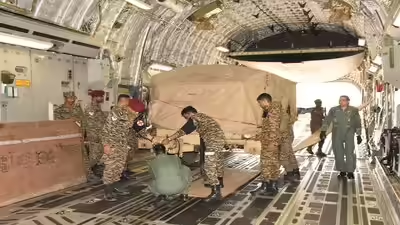
As devastating earthquakes struck northern Venezuela, India once again demonstrated its growing role as a trusted global humanitarian partner by launching Operation Amistad, a large-scale relief mission delivering emergency medical assistance and humanitarian aid to the affected nation.
The operation, named “Amistad”—the Spanish word for friendship—reflects India’s commitment to standing with countries in times of crisis. Through the Indian Air Force and the Indian Army, New Delhi has dispatched one of its fastest international disaster response missions, reinforcing its reputation as a reliable first responder on the global stage.
India Responds with Speed and Solidarity
Under Operation Amistad, the Indian Air Force deployed two C-17 Globemaster strategic transport aircraft carrying a specialised 41-member Indian Army medical contingent, a fully equipped field hospital, and more than 35 tonnes of relief supplies for earthquake-affected communities in Venezuela.
The humanitarian cargo includes emergency medicines, surgical equipment, medical shelters, food supplies, and other essential relief materials designed to support immediate rescue and medical operations.
Indian Army officials described the mission with a message of solidarity:
“We share your pain.”
The operation highlights India’s long-standing philosophy of humanitarian assistance and disaster relief (HADR), extending support well beyond its immediate neighbourhood.
A Growing Global First Responder
Over the past decade, India has increasingly emerged as one of the world’s fastest humanitarian responders.
From Operation Maitri in Nepal and Operation Dost in Türkiye and Syria to Operation Brahma in Myanmar, India has consistently mobilised military aircraft, medical teams, engineering units, and disaster relief supplies within hours of major global emergencies.
Operation Amistad continues that tradition, demonstrating India’s expanding capability to conduct rapid humanitarian missions across continents.
The deployment also showcases the strategic importance of the Indian Air Force’s C-17 Globemaster fleet, capable of transporting heavy equipment, field hospitals, rescue personnel, and large volumes of humanitarian cargo over intercontinental distances.
Supporting Venezuela During Crisis
Northern Venezuela has suffered extensive damage following powerful earthquakes that claimed hundreds of lives and left thousands injured and displaced.
Hospitals, transportation networks, and public infrastructure have been severely affected, creating an urgent need for international medical assistance.
India’s deployment of a field hospital and specialised medical personnel will help provide emergency treatment, trauma care, and essential healthcare services while supporting local relief agencies.
Beyond humanitarian aid, the mission strengthens diplomatic goodwill between India and Latin America, reinforcing India’s commitment to responsible global leadership.
Humanitarian Diplomacy in Action
Operation Amistad is more than an emergency relief exercise—it reflects India’s growing emphasis on humanitarian diplomacy.
By combining military logistics, medical expertise, and international cooperation, India is increasingly viewed as a nation capable of delivering meaningful assistance wherever disaster strikes.
Such missions also strengthen India’s international partnerships while demonstrating the country’s readiness to contribute to global stability through compassion rather than conflict.
As climate-related disasters and natural calamities become more frequent worldwide, rapid-response capabilities like Operation Amistad will continue to play a critical role in saving lives and supporting affected communities.
Conclusion
Operation Amistad stands as another example of India’s expanding humanitarian leadership. By swiftly dispatching Indian Air Force C-17 Globemasters, specialised medical teams, and critical relief supplies to earthquake-hit Venezuela, India has reaffirmed its position as a dependable global first responder. The mission reflects not only operational capability but also the values of friendship, solidarity, and international cooperation that increasingly define India’s role on the world stage.
For more updates on business, startups, technology, innovation, sustainability, and global developments, visit NewsNowNation at https://newsnownation.com/.
Operation Amistad, India Venezuela relief mission, IAF C-17 Globemaster, Venezuela earthquake, India humanitarian aid, Indian Army medical team, global first responder, humanitarian assistance, disaster relief India, India international relations, earthquake relief mission, Operation Amistad Venezuela, HADR India, Indian Air Force, global humanitarian leadership

