Historic Lunar Flyby Marks New Era in Space Exploration
The Artemis II mission by NASA has reached a defining moment in modern space exploration, as astronauts prepare for a historic lunar flyby on April 6, 2026. This mission is particularly significant as it marks the first time in more than five decades that humans have traveled toward the Moon, reviving ambitions that were last seen during the Apollo era.
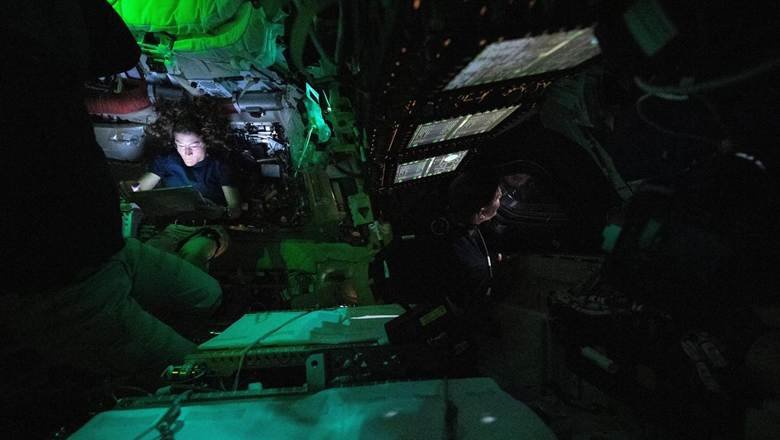
Launched on April 1, the Artemis II mission is a 10-day journey designed to test critical systems and capabilities required for future deep space exploration. The mission carries four astronauts aboard the Orion spacecraft, making it the first crewed mission of NASA’s Artemis program aimed at returning humans to the Moon and eventually enabling missions to Mars.
As of April 6, the spacecraft has entered the Moon’s “sphere of influence,” a region where the Moon’s gravitational pull becomes stronger than Earth’s. This marks a crucial milestone in the journey, as the spacecraft transitions into lunar space and prepares for its closest approach to the Moon.
The upcoming flyby is not just a symbolic achievement but a highly technical maneuver. During this phase, the Orion spacecraft will pass approximately 4,000 miles above the lunar surface, allowing astronauts to observe and study areas of the Moon that have not been seen directly by humans before.
One of the most important aspects of the flyby is the gravitational “slingshot” maneuver. This technique uses the Moon’s gravity to redirect the spacecraft back toward Earth, ensuring a safe return trajectory without the need for excessive fuel consumption. This method was also used during earlier missions, but its execution with modern technology marks a new level of precision and reliability.
The Artemis II mission is also expected to break historical records. Astronauts onboard are set to travel farther from Earth than any humans before, surpassing the distance achieved during the Apollo 13 mission in 1970. This milestone highlights the advancements in space travel technology and mission planning over the past decades.
In addition to navigation and engineering objectives, the mission includes a range of scientific activities. Astronauts are tasked with capturing high-resolution images of the Moon’s surface, including the far side, which remains one of the least explored regions. These observations will help scientists better understand lunar geology and prepare for future landing missions.
The mission also provides an opportunity to study the effects of deep space travel on the human body. Data collected during the journey will contribute to research on radiation exposure, physical endurance and psychological factors associated with long-duration space missions. Such insights are critical for planning future missions beyond the Moon.
Another notable feature of the flyby is the communication blackout that will occur when the spacecraft passes behind the Moon. During this period, astronauts will be temporarily out of contact with Earth, a phenomenon that adds both technical complexity and symbolic significance to the mission. It reflects the challenges of deep space exploration, where communication delays and interruptions are inevitable.
Astronauts will also witness rare celestial events during the mission, including a solar eclipse from space and a recreation of the iconic “Earthrise” view. These moments not only hold scientific value but also serve as powerful reminders of humanity’s place in the universe.
The Artemis II mission is part of a broader strategy by NASA to establish a sustainable human presence on the Moon. Future missions under the Artemis program aim to land astronauts on the lunar surface, particularly near the South Pole, where resources such as water ice are believed to exist. These resources could play a crucial role in supporting long-term exploration and habitation.
The mission also carries geopolitical significance, as countries around the world are increasingly investing in space exploration. The success of Artemis II reinforces NASA’s leadership in the field while also encouraging international collaboration in future missions.
Public interest in the mission has been significant, with millions of people following updates and viewing images shared by the astronauts. The mission has inspired a renewed sense of curiosity and excitement about space exploration, particularly among younger generations.
Despite its achievements, the mission has not been without challenges. Minor technical issues, such as equipment malfunctions, have been reported, but they have not significantly impacted the overall progress of the mission. The crew continues to operate in good health and high spirits, demonstrating the resilience and adaptability required for space travel.
The Artemis II mission represents a critical step forward in humanity’s journey beyond Earth. By testing systems, gathering data and demonstrating capabilities, it lays the foundation for future missions that will take humans deeper into space than ever before.
As the spacecraft completes its flyby and begins its return journey, the world watches closely, recognizing the mission as a milestone in the ongoing exploration of the cosmos.
Follow for more updates regarding business related news in newsnownation.com.
