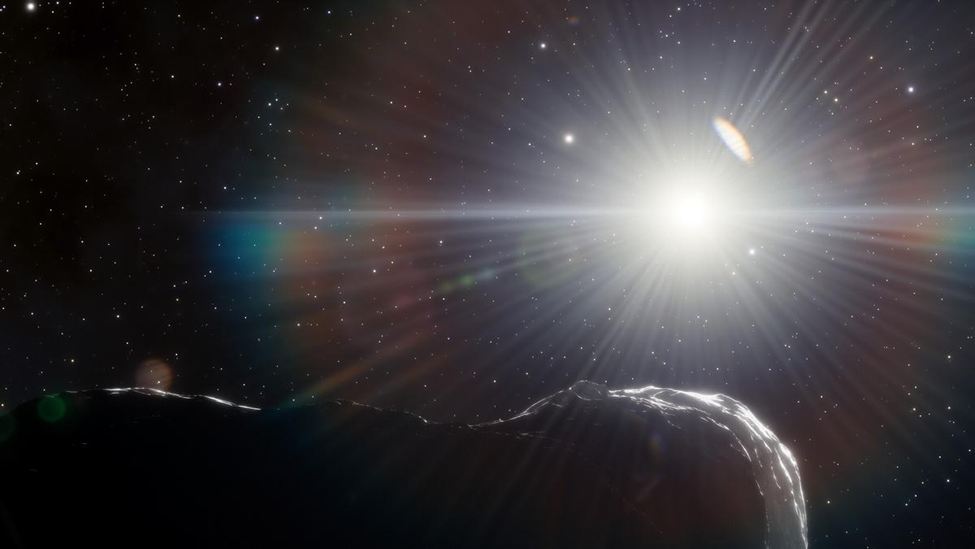
Astronomers and space agencies have provided reassuring news regarding asteroid 2024 YR4, a near-Earth object that had earlier raised concerns among scientists. Recent observations by NASA confirm that the asteroid will safely pass the Moon in 2032, eliminating earlier fears of a possible lunar collision.
The update comes after new observations collected by the James Webb Space Telescope, which helped scientists refine the asteroid’s trajectory with greater accuracy. With these latest calculations, experts have confirmed that there is now no possibility of the asteroid striking either the Moon or Earth during its upcoming close approach.
Discovery of Asteroid 2024 YR4
Asteroid 2024 YR4 was first detected in late 2024 by the Asteroid Terrestrial-impact Last Alert System (ATLAS) observatory in Chile. After its discovery, astronomers began tracking its orbit closely to determine whether the object could pose any risk to Earth or other celestial bodies.
Initial calculations suggested that the asteroid could pass unusually close to Earth’s cosmic neighborhood in December 2032. Due to limited data at the time, scientists briefly considered a small possibility that it might collide with the Moon.
Asteroids regularly pass near Earth without posing any danger, but when a newly discovered object appears to approach within a close distance, space agencies conduct detailed observations to assess potential risks.
Early Concerns About a Possible Lunar Impact
For a period of time, researchers estimated that asteroid 2024 YR4 had around a 4% chance of striking the Moon during its approach in December 2032. While this probability was relatively low, it was enough to attract attention from the global planetary defense community.
Scientists monitored the asteroid using multiple telescopes across the world to improve the accuracy of its orbital calculations. As more observational data was collected, astronomers were able to refine their predictions about its path.
These improved measurements eventually revealed that the asteroid would not collide with the Moon after all.
James Webb Telescope Provides Critical Data
The turning point in the analysis came from observations made by the James Webb Space Telescope, which provided highly detailed infrared measurements of the asteroid.
These observations allowed scientists to calculate the asteroid’s trajectory with greater precision. Using the new data, experts determined that the asteroid’s orbit does not intersect with the Moon’s path.
NASA’s latest analysis shows that asteroid 2024 YR4 will pass the Moon at a distance of approximately 13,200 miles (21,200 kilometers) on December 22, 2032.
Although this distance is relatively close in astronomical terms, it is far enough to ensure that no collision will occur.
Size and Characteristics of the Asteroid
Asteroid 2024 YR4 is estimated to be between 174 and 220 feet (about 60 meters) in diameter. Objects of this size are considered significant but are not large enough to pose a global threat.
If an asteroid of this scale were to strike Earth, it could potentially cause severe local damage similar to the impact of a powerful explosion. However, scientists have already ruled out any Earth impact from this object within the foreseeable future.
Despite the lack of danger, researchers continue to monitor the asteroid closely because studying such objects helps improve planetary defense strategies.
Importance of Planetary Defense Programs
The monitoring of asteroid 2024 YR4 highlights the growing importance of planetary defense initiatives. Organizations like NASA’s Center for Near-Earth Object Studies (CNEOS) continuously track thousands of asteroids to identify any potential threats to Earth.
Early detection systems and advanced telescopes enable scientists to calculate asteroid trajectories years or even decades in advance. This allows space agencies to develop possible mitigation strategies if a dangerous object is ever identified.
Programs such as NASA’s Planetary Defense Coordination Office are designed specifically to track and study near-Earth objects, ensuring that potential risks are identified early.
Why Close Approaches Still Matter
Even though asteroid 2024 YR4 will safely miss both Earth and the Moon, close approaches like this provide valuable scientific opportunities.
Astronomers can study the composition, structure and orbital behavior of asteroids in greater detail during such encounters. These observations help scientists understand how these objects form and evolve over time.
Additionally, analyzing asteroid trajectories helps improve future predictions and strengthens global preparedness for any potential asteroid hazards.
Looking Ahead
Asteroid 2024 YR4 will continue to be monitored by astronomers as it travels through space. Scientists expect to collect additional observations during future passes, including another opportunity to observe the object when it approaches Earth again in the coming years.
For now, however, NASA’s latest update provides reassurance that there is no danger from this asteroid during its 2032 approach.
The case of asteroid 2024 YR4 serves as a reminder of the importance of continuous monitoring and international collaboration in protecting our planet from potential cosmic threats.
Follow for more updates regarding business related news in newsnownation.com.
