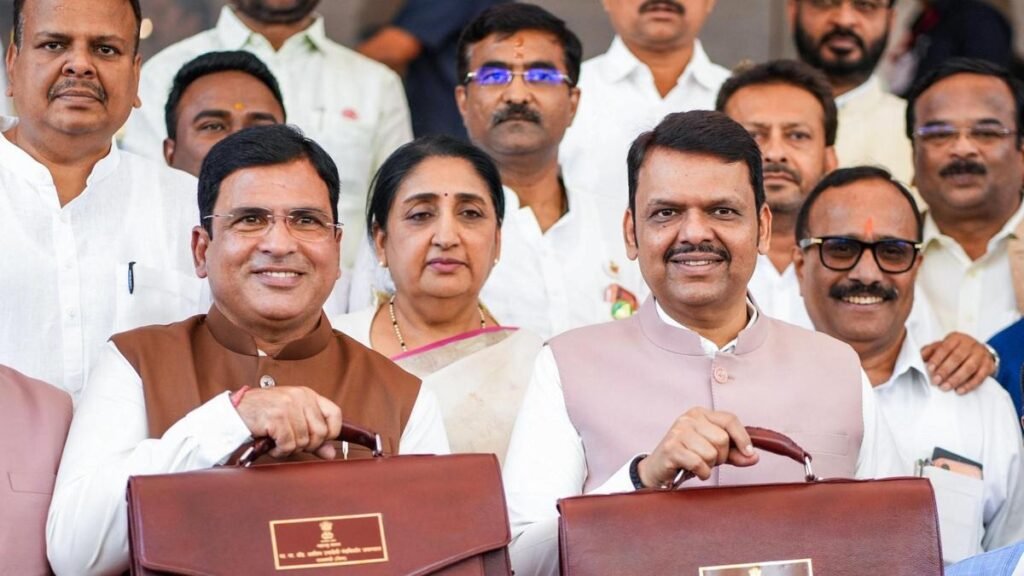
The Maharashtra government presented its Budget for the financial year 2026-27 in the state legislative assembly, outlining a broad roadmap for economic growth, infrastructure expansion and social welfare programmes. The budget was presented by Chief Minister Devendra Fadnavis, who also holds the finance portfolio. It marked a significant moment as he became the first Chief Minister in the state’s history to present the budget himself.
The budget reflects the government’s long-term vision to position Maharashtra as a major economic powerhouse while addressing key concerns such as agriculture, rural development, infrastructure expansion and digital governance. The government has emphasised that the fiscal strategy is aligned with the larger objective of transforming the state into a multi-trillion-dollar economy over the coming decades.
One of the major highlights of the budget is the announcement of a farm loan waiver scheme aimed at providing relief to financially stressed farmers. Under the Punyashlok Ahilyadevi Holkar Shetkari Karjmafi Yojana, crop loans of up to ₹2 lakh taken before September 2025 will be waived for eligible farmers. The scheme is expected to benefit a large number of farmers across the state who have been struggling with rising input costs and fluctuating agricultural income.
The government has also introduced incentives for farmers who have maintained regular loan repayments. Such farmers will receive a financial encouragement benefit of up to ₹50,000 as recognition of their financial discipline. Officials say this approach aims to balance financial relief with responsible borrowing behaviour within the agricultural sector.
Another important aspect of the budget is the continuation of key welfare schemes targeted at social development. The Mukhyamantri Majhi Ladki Bahin Yojana, which provides financial assistance to eligible women in the state, will continue to receive funding in the upcoming financial year. The programme currently provides monthly financial support to women beneficiaries and is considered one of the major welfare initiatives of the state government.
Infrastructure development forms a central pillar of the 2026-27 budget. The government has proposed major investments in transportation, road networks and urban mobility projects. Several new initiatives have been announced to strengthen rail connectivity, including a ₹5,100-crore project to build additional railway lines between Pune and Lonavala. The project aims to reduce travel congestion and improve regional connectivity in one of the state’s fastest-growing corridors.
In addition to railway expansion, the budget includes proposals for major urban infrastructure upgrades. Plans have been announced for a large underground road tunnel project in Pune designed to reduce travel time and ease traffic congestion in the city. The proposed tunnel network will connect key routes and improve transportation efficiency for commuters and businesses.
The government has also highlighted rural development as a key priority. Under the new proposals, villages with populations exceeding 1,000 will be connected through concrete road networks. Officials believe this initiative will improve rural connectivity, facilitate access to markets and strengthen the economic prospects of smaller towns and villages across the state.
Digital governance and technology adoption also feature prominently in the budget. The state government plans to digitise all citizen and business services while moving toward a fully paperless administration system. Land transactions will be fully computerised and government departments will gradually adopt electronic office systems to improve transparency and efficiency in public administration.
The budget has been framed within a broader long-term development vision. According to the state government, Maharashtra aims to become a $5 trillion economy by 2047 through sustained investments in infrastructure, industry, agriculture and digital transformation. Policymakers believe that strategic spending in these sectors will create employment opportunities and accelerate economic growth across the state.
However, the budget has also drawn political responses from various opposition leaders who have raised questions about fiscal priorities and implementation timelines. Critics have argued that some announcements may take longer to materialise and have called for stronger focus on immediate economic challenges. Despite these criticisms, the government maintains that the budget presents a balanced roadmap for growth while maintaining fiscal discipline.
Overall, the Maharashtra Budget 2026-27 outlines a comprehensive strategy that combines welfare initiatives, infrastructure expansion and administrative reforms. With significant investments planned in agriculture, transportation and digital governance, the government aims to strengthen the state’s economic foundation and support long-term development.
For more updates regarding business and economic developments, follow the latest news at https://newsnownation.com/
