India’s push for self-reliance in defence manufacturing has achieved another important milestone with the indigenous UGRAM 7.62×51 mm battle rifle successfully clearing key trials conducted for the Indian Army and the Ministry of Home Affairs. Developed through collaboration between the Defence Research and Development Organisation’s Armament Research and Development Establishment and Hyderabad-based Dvipa Defence, the rifle is now moving towards possible procurement by several Central Armed Police Forces.
The development has attracted attention not only because the UGRAM is an Indian-designed weapon system but also because its functional prototypes were produced within a remarkably short period. Five prototypes were developed in around 100 days and passed initial testing at ARDE, according to a government release. The programme reflects the growing role of collaboration between public research institutions and private defence manufacturers in accelerating the development of equipment for India’s security requirements.
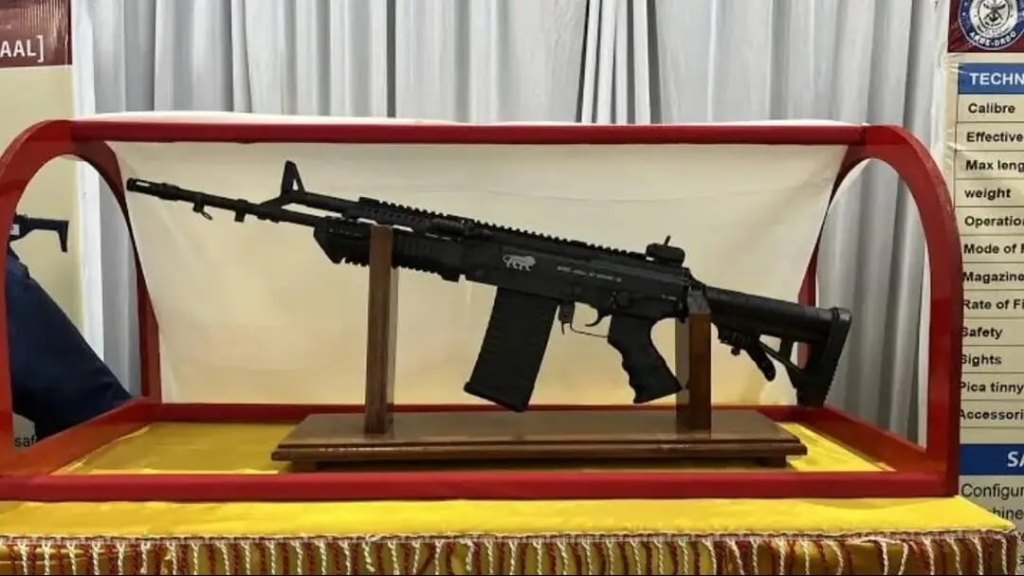
Indigenous Defence Development Reaches a New Milestone
The UGRAM, whose name is associated with the Sanskrit word for “ferocious,” is chambered for the 7.62×51 mm cartridge. It was developed with the operational needs of military, paramilitary and other security forces in mind. The latest reported progress indicates that the rifle has cleared Army General Staff Qualitative Requirement trials, field evaluations under different climatic conditions and Ministry of Home Affairs Board trials.
This achievement is significant because a weapon intended for operational use must demonstrate far more than basic firing capability. Reliability, endurance, handling and performance across challenging environments are important parts of the evaluation process. The UGRAM’s progress through key trials suggests that the project has moved beyond the prototype stage and closer to possible procurement and deployment.
When the rifle was first unveiled in 2024, it was expected to undergo multiple stages of testing before being considered for operational adoption. At that time, the project had already drawn attention for the speed of prototype development. The latest trial results show how the programme has progressed from an ambitious indigenous development initiative to a platform being considered for use by Indian security forces.
Developed Through DRDO and Private Industry Collaboration
The UGRAM project represents a model of cooperation between government research expertise and private-sector manufacturing capability. The rifle was developed jointly with the Armament Research and Development Establishment, a laboratory under DRDO, and Dvipa Defence.
This partnership is important for India’s wider defence manufacturing strategy. Traditionally, the development of major defence equipment can involve long design, testing and production cycles. By involving a private industry partner during the development and manufacturing process, the UGRAM programme demonstrated how coordinated work can potentially shorten the journey from design to functional prototype.
The government’s 2025 account of the programme stated that five prototypes were developed within 100 days and successfully passed initial testing at ARDE. This rapid execution became one of the defining features of the UGRAM project and highlighted the potential of public-private collaboration in indigenous defence production.
The rifle’s development also supports the broader objective of reducing dependence on imported small arms. India has historically relied on a combination of domestically manufactured and foreign-origin rifles for different operational requirements. Developing an indigenous platform that can successfully complete demanding trials can strengthen domestic manufacturing capacity while creating opportunities for future upgrades, maintenance and production within the country.
Key Features and Operational Capabilities of UGRAM
The UGRAM is a 7.62×51 mm rifle designed for demanding security operations. According to reports, the weapon weighs less than four kilograms and has an effective range of approximately 500 metres. Its design uses a gas-operated rotating bolt system, a widely established operating mechanism for modern service rifles.
The combination of a full-power 7.62×51 mm cartridge and a 500-metre effective range makes the rifle relevant for situations where security personnel may require greater reach and performance. Earlier reporting on the weapon also noted that it was designed around the Indian Army’s General Staff Qualitative Requirements, which define important operational and performance expectations for equipment.
For security forces operating in varied terrain, a rifle must remain dependable across different climatic and operational environments. India’s security personnel may be deployed in high-altitude regions, forests, urban environments, deserts and areas facing extreme weather. The reported completion of extensive field evaluations therefore represents an important stage in determining whether the platform can meet practical requirements.
CAPF Procurement Could Be the Next Major Step
With key trials completed, attention is now focused on procurement. Reports indicate that the UGRAM is moving towards acquisition by Central Armed Police Forces, including the Central Reserve Police Force, Indo-Tibetan Border Police, Sashastra Seema Bal and National Security Guard.
Possible procurement by these forces would represent a major commercial and operational breakthrough for the indigenous rifle. These organisations perform a wide range of duties, from internal security and border management to specialised counter-terrorism operations. Their requirements can vary considerably, making reliability and adaptability essential considerations in weapon selection.
The move towards procurement also reflects a broader change in India’s defence ecosystem. Domestic private companies are increasingly participating in the development of equipment that was once largely associated with government establishments or overseas suppliers. Successful projects can help build a stronger national supply chain involving design, engineering, testing, production and long-term maintenance.
A Boost for Make in India and Defence Self-Reliance
The UGRAM programme has wider importance beyond a single rifle. It demonstrates how indigenous research, private manufacturing and structured testing can work together to create equipment for Indian security forces.
Domestic defence production can offer several strategic advantages. It can reduce dependence on overseas supply chains, improve access to spare parts and maintenance, support faster product upgrades and create opportunities for Indian engineering and manufacturing companies. A successful indigenous platform can also generate valuable experience that supports the development of future weapon systems.
Dvipa Defence is reportedly expanding its work into other categories, including assault rifles, carbines, sub-machine guns, light machine guns and anti-drone systems. The development of a broader family of indigenous products could contribute to a more capable domestic small-arms and security technology industry.
The UGRAM rifle’s journey from rapid prototype development to the successful completion of key Army and Home Ministry trials marks an important chapter in India’s defence manufacturing story. Its reported progress towards procurement by Central Armed Police Forces will now be closely watched.
If procurement advances as expected, the project could become an important example of how Indian research institutions and private manufacturers can work together to deliver modern equipment within shorter development timelines. The UGRAM’s progress also underlines the growing confidence in domestically developed defence technology and the expanding role of Indian companies in meeting the country’s security requirements.
Follow for more updates regarding business-related news on News Now Nation.
