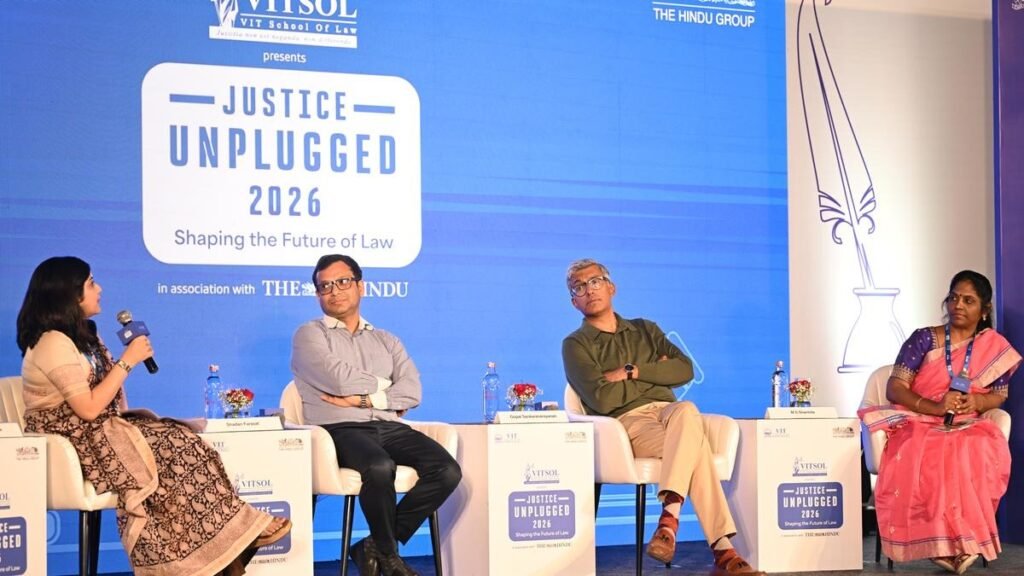
The legal profession in India continues to evolve in response to technological change, constitutional challenges, and the expanding role of law in society. In this context, Justice Unplugged 2026—a flagship event co-hosted by The Hindu and VIT School of Law (VITSOL), VIT Chennai—emerged as a significant forum for dialogue on the future of legal education and practice. The conclave was held on February 28, 2026, in New Delhi and brought together distinguished jurists, senior advocates, academicians, and young law aspirants to delve into contemporary issues in law, justice, and governance.
The event was inaugurated with addresses by senior legal thought leaders, including Justice Ujjal Bhuyan as Guest of Honour and Senior Advocate Abhishek Manu Singhvi, who offered insights into foundational legal principles and the evolving demands of the profession. Suresh Nambath, editor of The Hindu, and G Viswanathan, founder and Chancellor of VIT, set the tone for a day dedicated to reflective inquiry and practical guidance for emerging professionals.
One of the key focuses of the discussions was legal education in India, highlighting both its strengths and the need for adaptation in a rapidly changing global environment. The conversation underscored that law schools must equip students not only with doctrinal knowledge but also with skills attuned to technology, ethics, and leadership. VIT’s Vice President G V Selvam and the CEO of The Hindu Group L V Navaneeth engaged in a candid dialogue that emphasized flexibility in curricula to address real-world legal challenges.
Another session addressed the impact of Gen AI-induced technological transformation on legal practice. With the rapid rise of artificial intelligence tools reshaping workflows across industries, the panel—including Neha Rathi and faculty members from VITSOL—examined how future lawyers must adapt to automation while maintaining professional competence and ethical standards. This discussion resonated with students and young practitioners alike as they prepare for careers where technology and law intersect more than ever before.
A major highlight was the panel on Fundamental Rights in the Digital Age, which considered constitutional responses to emerging challenges related to privacy, data protection, and digital freedoms. Senior advocates such as Shadan Farasat and Gopal Sankaranarayanan offered nuanced perspectives on how India’s constitutional framework continues to address the complexities of an increasingly digitally connected society.
Sessions on the art of constitutional thinking and improving access to justice further enriched the discourse. Senior advocate S Muralidhar discussed how rigorous discipline and philosophical depth contribute to the making of great lawyers. Meanwhile, debates on accessibility highlighted the pressing need to make justice systems more inclusive and responsive to citizens’ needs, with insights from Shreya Arora Mehta, Karuna Nundy, and other legal experts.
The closing dialogue, featuring Senior Advocate Kapil Sibal and N Ram, Director of The Hindu Group, explored constitutional morality and the role of the Supreme Court in contemporary India—questioning whether jurisprudence is shifting from pure constitutionalism towards pragmatic interpretations. This conversation offered thoughtful critique relevant to both seasoned professionals and law students, deepening understanding of the judiciary’s evolving role.
Justice Unplugged 2026 served as more than a conference; it was a dynamic learning platform that encouraged participants to reflect on the purpose and promise of legal education in a world marked by technological, social, and constitutional transformation. Students and practitioners left the event with broader perspectives on career trajectories, ethical practice, and the intellectual rigour that underpins the rule of law.
As India’s legal landscape continues to shift, platforms like Justice Unplugged play a vital role in fostering dialogue between thought leaders and the next generation of legal professionals—ensuring that the legal community remains adaptive, thoughtful, and engaged with the challenges of tomorrow.
Follow for more updates regarding the latest and upcoming AI-related news at newsnownation.com.
