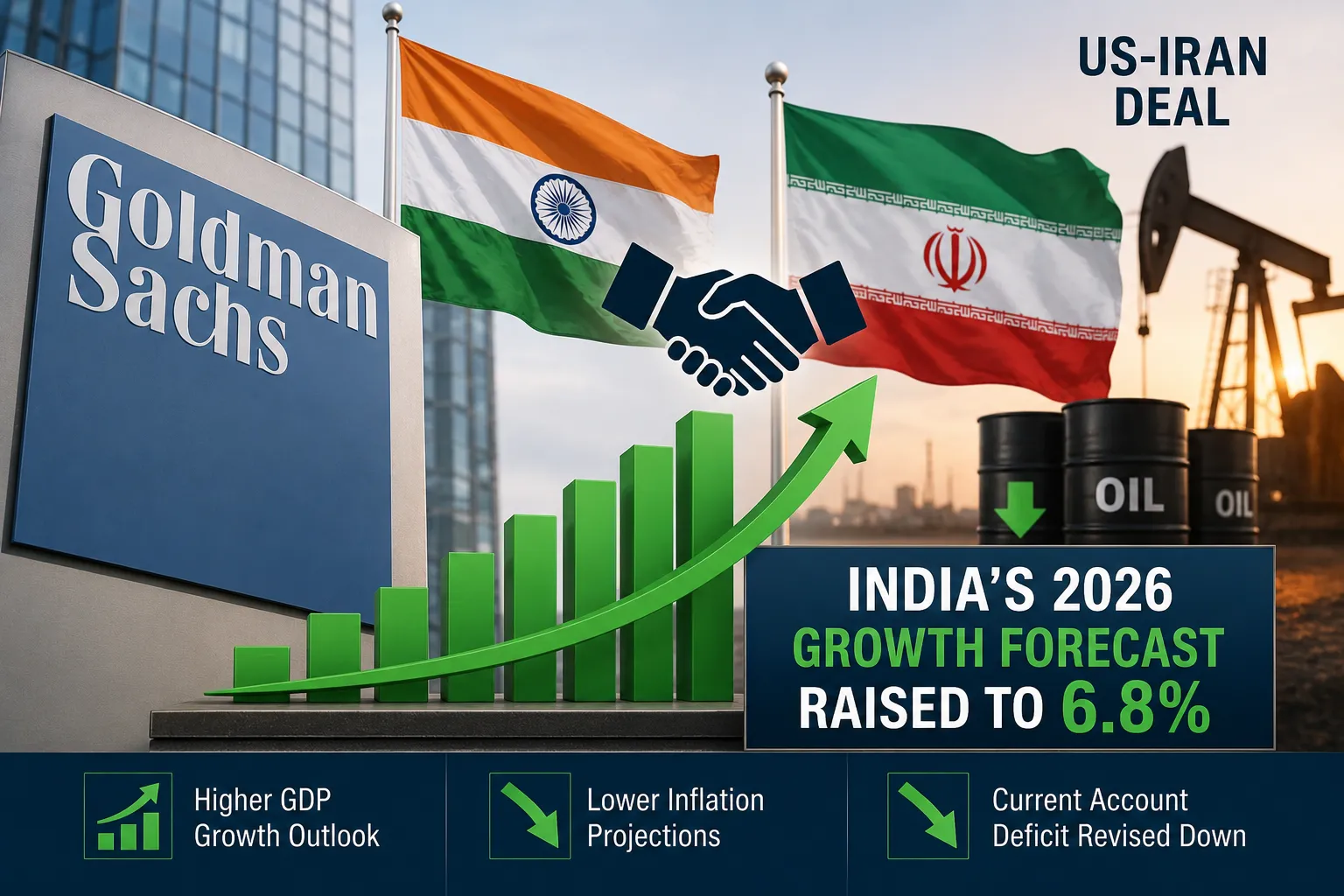
India’s inflation outlook has received a welcome boost after global investment bank Goldman Sachs lowered its forecast for the country’s Consumer Price Index (CPI) inflation to 4.9%, citing easing global crude oil prices and improving supply-side conditions. The revised projection comes at a time when policymakers, businesses, and consumers are closely monitoring inflation trends amid global economic uncertainty.
The downgrade reflects growing confidence that lower energy costs could help moderate price pressures across several sectors of the Indian economy. For businesses, it may ease operating costs, while for households, it signals the possibility of greater price stability in the months ahead.
Why Goldman Sachs Revised Its Forecast
Goldman Sachs attributed the lower inflation projection primarily to the recent decline in international crude oil prices. Energy prices play a significant role in India’s inflation dynamics because the country imports nearly 85% of its crude oil requirements.
Lower crude prices reduce transportation costs, manufacturing expenses, logistics charges, and input costs across industries. Over time, these savings can filter into retail prices, helping moderate headline inflation.
The investment bank also noted that improving food supply conditions and stable domestic demand are contributing to a more balanced inflation outlook.
Relief for Consumers and Businesses
Inflation affects almost every aspect of the economy—from grocery bills and fuel prices to housing, transportation, and manufacturing.
A softer inflation trajectory could benefit Indian households through relatively stable prices while helping businesses manage production costs more efficiently.
Lower inflation also improves consumer confidence, encourages spending, and creates a more predictable business environment for investment and expansion.
For small and medium enterprises, easing input costs can improve margins while supporting long-term growth.
Implications for RBI Policy
The Reserve Bank of India has consistently maintained its focus on keeping inflation within its target range while supporting sustainable economic growth.
A moderation in inflation could provide policymakers with greater flexibility in future monetary policy decisions.
While the RBI continues to monitor global risks—including geopolitical developments, commodity prices, and weather-related uncertainties—a softer inflation forecast strengthens expectations that India’s macroeconomic fundamentals remain resilient.
Economists caution, however, that inflation remains sensitive to fluctuations in global energy markets and food prices, making continued vigilance essential.
Global Oil Prices Remain a Key Variable
Crude oil remains one of the most influential factors affecting India’s economy.
Any sustained decline in global oil prices benefits India’s import bill, current account balance, fiscal position, and inflation outlook.
Conversely, unexpected geopolitical tensions or supply disruptions could reverse recent gains.
Market analysts therefore view the current easing as positive but continue to monitor international developments closely.
Positive Outlook for India’s Economy
India continues to remain one of the world’s fastest-growing major economies.
Combined with strong domestic consumption, expanding manufacturing, rising infrastructure investment, and improving digital adoption, lower inflation could further strengthen economic momentum.
International financial institutions continue to project robust long-term growth for India, supported by structural reforms, demographic advantages, and increasing investor confidence.
The revised Goldman Sachs forecast reinforces optimism that India can sustain growth while maintaining macroeconomic stability.
Conclusion
Goldman Sachs’ decision to lower India’s inflation forecast to 4.9% reflects improving economic conditions driven largely by easing global crude oil prices. While inflation risks remain, the revision offers encouraging signals for consumers, businesses, investors, and policymakers alike. As India balances growth with price stability, lower inflation could support stronger consumption, investment, and long-term economic resilience.
For more updates on business, startups, technology, innovation, sustainability, and global developments, visit NewsNowNation at https://newsnownation.com/.
Goldman Sachs India, India inflation, CPI inflation India, crude oil prices, RBI inflation, Indian economy, inflation forecast, oil prices, Consumer Price Index, Reserve Bank of India, economic outlook India, inflation news, business news India, global crude prices, NewsNowNation

