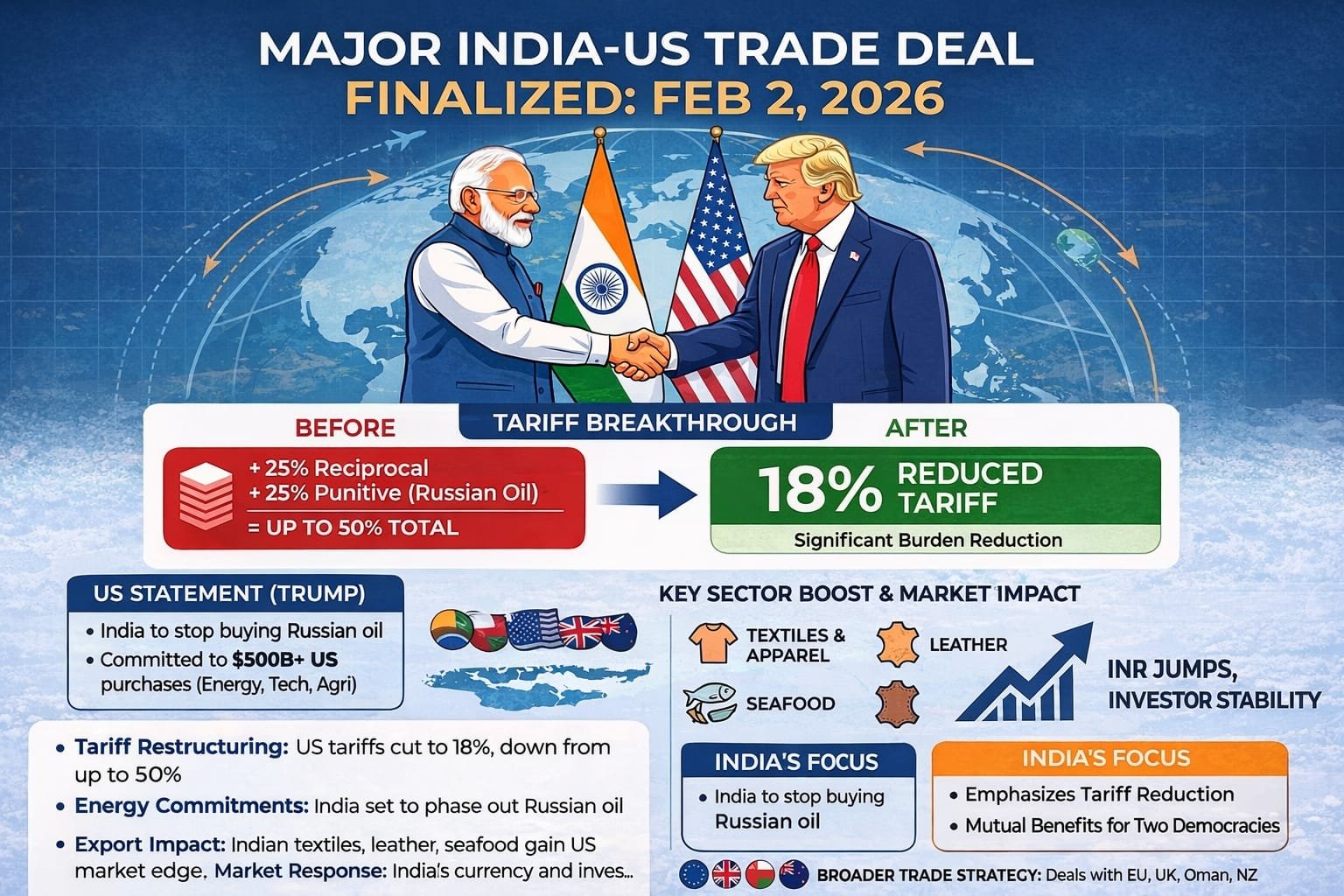
India and the United States have formally finalized a major trade agreement on February 2, marking a significant shift in bilateral economic engagement. The deal is being positioned as a structural reset in trade relations, aimed at reducing tariff friction, improving market access, and providing long-term predictability for businesses on both sides.
What the Deal Changes
At the core of the agreement is a major tariff rationalization. The United States has reduced its effective tariff on a wide range of Indian exports to 18%, down from a combined structure that earlier touched nearly 50%, including reciprocal and punitive components. This rollback substantially lowers the cost burden on Indian exporters and restores competitiveness in the US market.
In return, India has committed to rebalancing its import basket, particularly in the energy sector, alongside expanded purchases from the US across energy, technology, agriculture, and industrial goods. The total value of these commitments is estimated to cross $500 billion over the medium term, according to official indications.
Key Sectors Likely to Benefit
- The tariff reduction is expected to deliver immediate and medium-term gains across several export-intensive sectors:
- Textiles and apparel, where India competes directly with Bangladesh, Vietnam, and Indonesia
- Leather and footwear, benefiting from lower landed costs
- Seafood and agri-exports, which are highly price-sensitive
- Carpets and handicrafts, supporting MSME-heavy supply chains
- With US tariffs on Indian goods now lower than those faced by some competing Asian exporters, India gains a relative pricing advantage, particularly in labor-intensive manufacturing.
Impact on Markets and Currency
Market participants have responded positively to the announcement, viewing the deal as a signal of policy stability and improved trade visibility. Reduced tariff uncertainty is expected to support export volumes, foreign investment sentiment, and medium-term earnings outlooks for export-oriented firms.
Currency markets are also tracking the development closely. Higher dollar inflows from exports and capital investment could provide support to the rupee, even as global factors such as interest rates and dollar strength remain in play.
Strategic and Geopolitical Context
Beyond economics, the agreement carries strategic weight. It aligns with a broader effort by both countries to deepen supply chain cooperation, reduce over-dependence on a single geography, and strengthen partnerships among like-minded democracies.
The trade deal also fits into India’s wider global trade strategy, complementing ongoing or completed agreements with the EU, UK, Oman, New Zealand, and other partners. For the US, it reinforces India’s role as a key economic and strategic partner in the Indo-Pacific region.
What Comes Next
Detailed tariff schedules, sector-specific concessions, and implementation timelines are expected to be released through joint notifications and follow-up statements. Businesses will be closely watching how quickly the revised tariff regime is operationalized and whether additional non-tariff barriers are addressed in subsequent phases.
For exporters, investors, and policymakers, the agreement represents more than a tariff cut. It signals a move toward predictable, rules-based trade, with potential long-term gains for manufacturing, employment, and cross-border investment.
Read the complete analysis and sector-wise breakdown here:
https://www.reuters.com/world/india/trump-says-agreed-trade-deal-with-india-2026-02-02
Stay updated with verified business and policy news on NewsNowNation.

