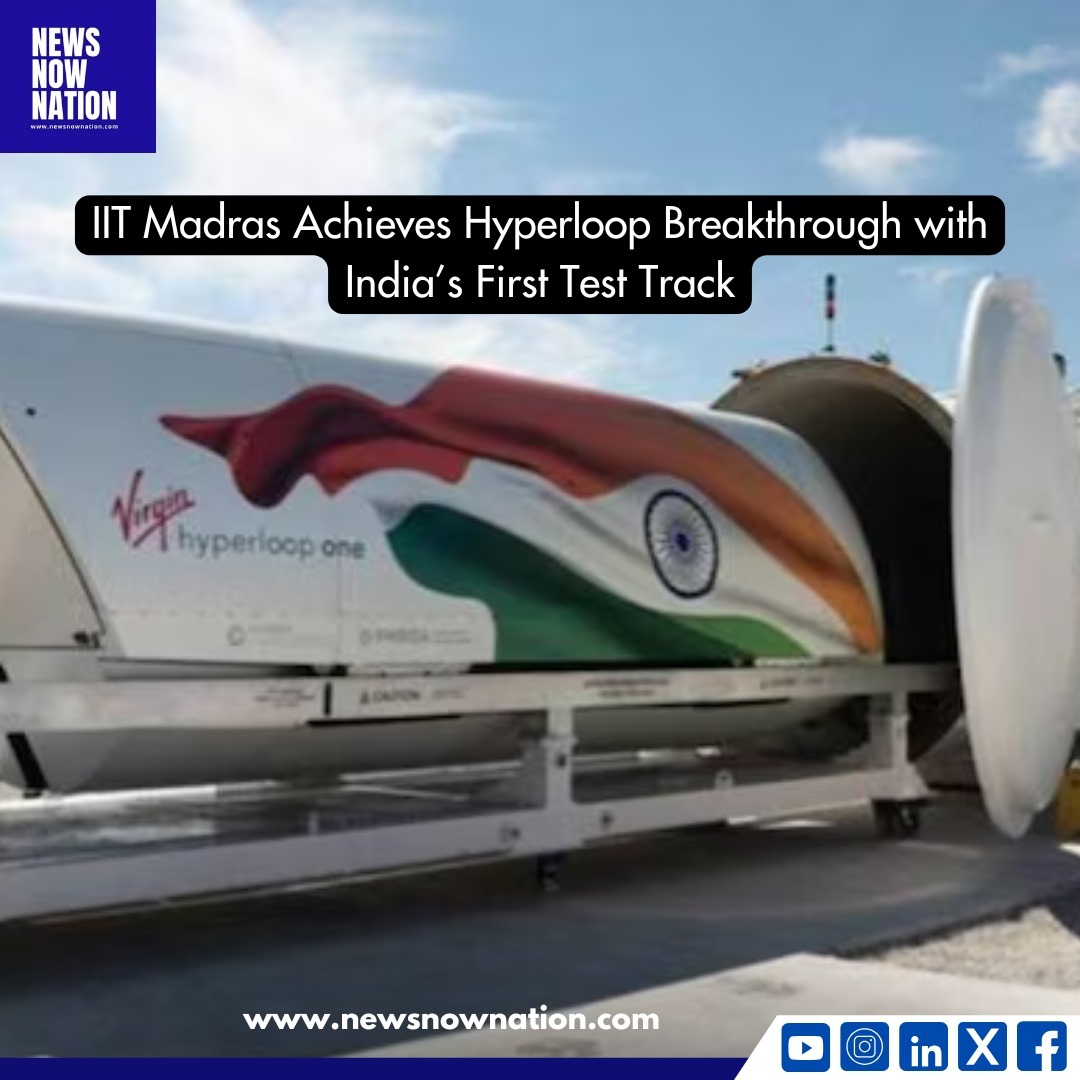
Indian Institute of Technology Madras (IIT Madras) has developed India’s first Hyperloop test track. The 410-meter-long facility, located at the institute’s Discovery Campus in Thaiyur, Tamil Nadu, aims to demonstrate the potential of Hyperloop technology, which promises travel speeds of up to 1,100 km/h.
With this breakthrough, IIT Madras joins an exclusive global league of institutions pioneering this next-generation transport system. The test track is expected to accelerate research and development, bringing India closer to implementing Hyperloop travel for commercial use.
How Hyperloop Technology Works
The Hyperloop is a cutting-edge transportation system in which pressurized pods travel through a near-vacuum tube at extremely high speeds. The concept, originally proposed by Elon Musk, significantly reduces air resistance and friction, enabling rapid transit between cities.
Unlike conventional trains, Hyperloop pods are magnetically levitated and propelled using electric propulsion, making them more energy-efficient and environmentally friendly. This innovation has the potential to drastically cut travel time, making long-distance commuting a matter of minutes instead of hours.
Government and Industry Support for the Project
The development of the test track at IIT Madras is a collaborative effort between the institute’s Avishkar Hyperloop team, the startup TuTr Hyperloop, and the Indian Railways. The project also received substantial support from ArcelorMittal and AM/NS India, who supplied around 400 tons of high-strength steel for the test track’s construction.
Union Railway Minister Ashwini Vaishnaw has extended strong support for the initiative, announcing an additional $1 million in funding to IIT Madras to further advance Hyperloop research. The government is also exploring locations for a 40-50 km Hyperloop route as part of India’s first commercial deployment.
Potential Impact on Travel in India
If successfully implemented, Hyperloop technology could revolutionize India’s transportation network. Journeys that currently take hours could be reduced to mere minutes. For example, a 350-km route such as Delhi to Jaipur or Bengaluru to Chennai could be completed in just 30 minutes.
Such advancements could not only enhance connectivity but also provide a faster and more sustainable alternative to air and rail travel. The high-speed transit system may reduce congestion on existing infrastructure while lowering travel costs in the long run.
Future Prospects: International Hyperloop Competition in 2025
To further propel research and global collaboration, IIT Madras is set to host Asia’s first international Hyperloop competition from February 21 to 25, 2025. The event will bring together students, researchers, and industry leaders to showcase and develop innovative Hyperloop pod designs.
With this initiative, IIT Madras aims to position India as a global leader in Hyperloop research and attract investment in cutting-edge transport technologies.

