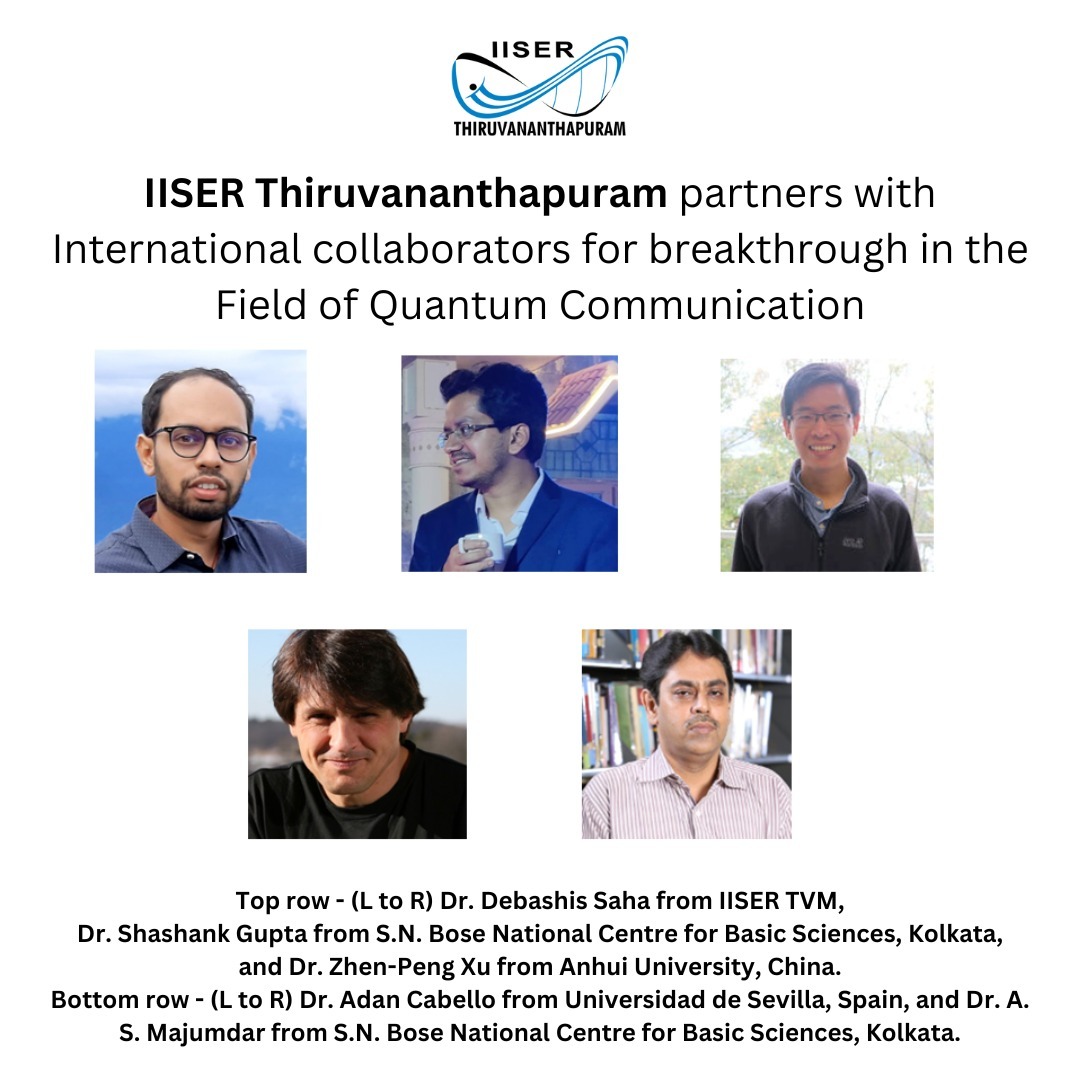
The Institute has collaborated with S. N. Bose National Centre for Basic Sciences, Kolkata; Anhui University, China, and Universidad de Sevilla, Spain, for the research
Thiruvananthapuram, 10th April 2023: Scientists at the Indian Institute of Science Education and Research (IISER) Thiruvananthapuram in collaboration with an international team consisting of scientists from S. N. Bose National Centre for Basic Sciences, Kolkata, Anhui University, China, and Universidad de Sevilla, Spain, are working at the cutting-edge field of quantum theory and quantum communication and have recently made a breakthrough discovery.
The microscopic world of atoms and subatomic particles is best explained by quantum theory. One of the tenets of quantum theory is that the physical properties of subatomic particles cannot pre-exist until they are observed.
This counter-intuitive feature of quantum theory is called Quantum Contextuality, which radically changes our worldview of fundamental physics. Despite the conceptual importance of contextuality in quantum theory, any direct application of contextuality has hitherto been unknown.
The researchers have shown one use for quantum contextuality – quantum communication. Quantum communication is the transmission of information using quantum systems, such as photons (light particles), instead of electrical signals used now. So far, it was thought that quantum communication is caused by a phenomenon called “quantum entanglement”, famously described by Einstein as “spooky action at a distance”. Quantum entanglement is a property that endows the quantum particles (like photons) to interact with each other regardless of the distance between them, potentially enabling instantaneous communication.
Explaining their breakthrough, Dr. Debashis Saha, Assistant Professor, Department of Physics, IISER TVM said, “We have shown that a large class of communication tasks that cannot be achieved using classical communication can be accomplished using quantum contextuality, rather than quantum entanglement.”
Using techniques of graph theory, the scientists have shown that quantum contextuality can provide a quantum advantage (the ways in which a quantum system performs better than a classical system) in distributed computation and in various communication protocols without requiring entanglement. They have, in fact, shown a two-way link between quantum contextuality and quantum advantage.
Quantum advantage does not mean that all computers will be replaced by quantum computers tomorrow, the authors caution us. They say that work such as theirs can help in developing quantum computers and communication devices in future. The authors believe that quantum contextuality can potentially enable quantum communication-based applications such as quantum teleportation, distributed quantum computation, and secure quantum secret key generation or quantum cryptography, all of which are impossible using classical communication.
The team’s research has been published in the prestigious journal, Physical Review Letters, in a paper co-authored by Dr. Debashis Saha from IISER-TVM; Dr. Shashank Gupta and Dr. A. S. Majumdar from S.N. Bose National Centre for Basic Sciences, Kolkata; Dr. Zhen-Peng Xu from Anhui University, China; Dr. Adan Cabello from Universidad de Sevilla, Spain.
###
ABOUT IISER THIRUVANANTHAPURAM
Established by the Ministry of Education, Government of India, in 2008, IISER Thiruvananthapuram aims to provide high quality education in modern science, integrating it with outstanding research at the undergraduate level itself, and to develop a spirit of enquiry cutting across disciplines.
IISER Thiruvananthapuram is engaged in research in the frontier areas of basic sciences, with a high degree of autonomy and creativity. The Institute is dedicated to scientific research and science education of international standards. It has state-of-the-art and well-equipped laboratory facilities in Chemistry, Physics, and Biology, and has developed various facilities to promote education with a research aptitude.
Follow IISER Thiruvananthapuram on:
Twitter: @tvmiiser
Facebook: IISER Thiruvananthapuram
________________________________________________________________________________________
MEDIA CONTACT FOR IISER THIRUVANANTHAPURAM
Bhavani Giddu– Footprint Global Communications
Cell: 99995 00262 / Email: bhavani.giddu@footprintglobal.com
Akhil Vaidya – Footprint Global Communications
Cell: 98821 02818 / Email ID: akhil.vaidya@footprintglobal.com
Karuppasamy KS – Footprint Global Communications
Cell: 95787 04419 / Email ID: ks@footprintglobal.com
Puja Panda – Footprint Global Communications
Cell: 8628039359 / Email ID: puja.panda@footprintglobal.com

