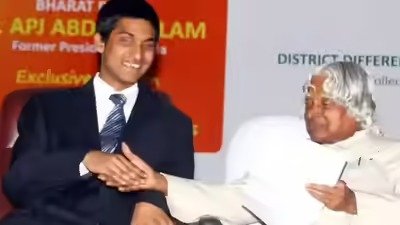
In a small village in Andhra Pradesh, a boy was born who would one day challenge the world’s assumptions about ability. Srikanth Bolla, though visually impaired from birth, was never convinced that lack of sight should limit his ambitions. Surrounded by a society that often viewed disability through the lens of limitation rather than possibility, Srikanth’s journey reflects extraordinary resilience, tenacity, and visionary leadership that extend far beyond personal achievement.
From the start, his parents believed in nurturing his curiosity rather than confining his dreams. Despite scarce resources, they encouraged education and independence, creating the foundation for his future breakthroughs. As Srikanth progressed through school, he encountered systemic barriers: classrooms were not designed for students with visual challenges, textbooks were inaccessible, and the concept of inclusion barely existed in academic settings. But rather than accept the status quo, he saw every hurdle as an invitation to challenge deeply entrenched perceptions.
A pivotal moment came after class 10 when Srikanth expressed his desire to study science. Institutions refused, asserting that his disability made scientific subjects unsuitable for him. For most, such rejection could dim enthusiasm. For Srikanth, it ignited determination. He fought the decision legally — not merely to pursue science, but to affirm a broader principle: that opportunity should never be limited by preconceived notions of ability. When he won the case, it was a breakthrough not just for him, but for every child who had been denied access due to assumptions about disability.
Despite this victory, barriers remained. When applying to top Indian engineering institutes, he faced rejection once again. But in this setback, a new path emerged. His application to the Massachusetts Institute of Technology (MIT) was accepted, and he became one of the first visually impaired international students at the prestigious institution. At MIT, Srikanth found an environment that valued innovation and inclusion — a stark contrast to the exclusionary spaces he had encountered earlier. Here, accessibility was not an add-on, but a central ethos.
This experience reshaped his ambition. Srikanth began to see entrepreneurship not just as a personal pursuit, but as a means to generate systemic change. Upon returning to India, he co-founded Bollant Industries Private Limited, a company that blends environmental sustainability with social inclusion. Bollant focuses on eco-friendly packaging and manufacturing, but its true heart lies in its workforce: a large proportion of its employees are people with disabilities or from marginalized communities. Workspaces are designed for accessibility, not comfort, and careers are built on capability rather than sympathy.
Srikanth rejected the outdated narrative that inclusion should be treated as charity. Instead, he built a business where employment for the differently-abled was normal, expected, and economically meaningful. The philosophy was simple yet revolutionary — inclusion is not a cost; it is smart leadership and good business. As Bollant grew, it disproved skeptics who doubted whether a socially driven enterprise could thrive commercially. Investors began to take notice, and the company’s trajectory reflected that purpose and profitability could coexist.
Today, Srikanth’s journey resonates far beyond India’s entrepreneurial circles. His life was adapted into a biographical film, bringing his story of courage and conviction to a wider audience. Through public talks, leadership forums, and mentorship roles, he continues to inspire individuals and organizations alike to rethink how they define ability and success.
What makes Srikanth’s story truly remarkable is not just the obstacles he overcame, but how he transformed each into opportunity — for himself and for many others. He did not merely adapt to the world as it was; he helped reshape it. In doing so, he redefined what it means to lead with vision.
In a society where visible success is often measured by numbers and status, Srikanth’s life reminds us that the most important vision is not what the eyes can see, but what the mind dares to imagine and the heart commits to achieve. His story teaches that barriers often exist not because something is impossible, but because no one has yet been brave enough to challenge them.
