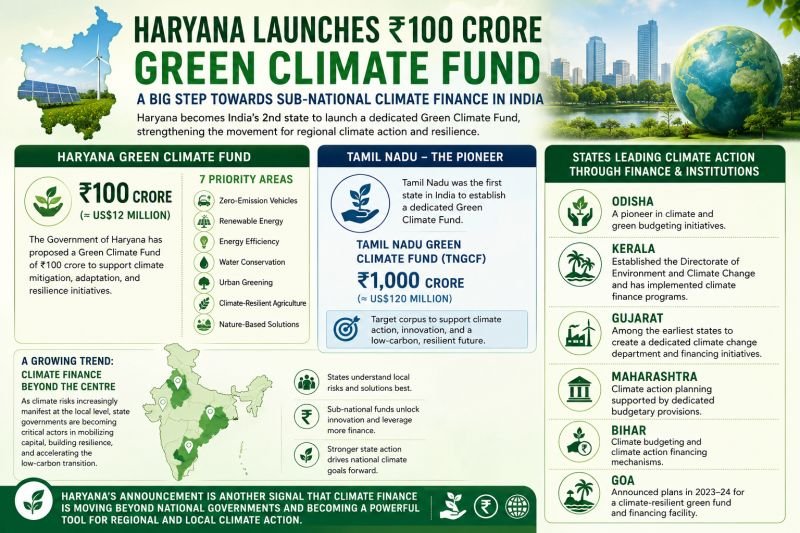
Haryana has announced a significant step toward strengthening climate resilience and sustainable development with a proposal to establish a ₹100 crore Green Climate Fund. The initiative aims to support environmental projects, renewable energy adoption, water conservation efforts, urban greening, and climate adaptation programs across the state. As climate-related challenges continue to affect economies and communities worldwide, the move signals Haryana’s intent to position sustainability as a central pillar of future development.
The proposed fund arrives at a time when Indian states are increasingly investing in long-term climate solutions to balance economic growth with environmental responsibility. Experts believe such initiatives will play a critical role in preparing cities, industries, and rural communities for the challenges posed by rising temperatures, water stress, and extreme weather events.
A Strategic Investment in Sustainable Growth
Climate resilience is no longer viewed solely as an environmental concern. Governments around the world increasingly recognize it as an economic necessity.
Haryana’s proposed Green Climate Fund seeks to support projects that enhance environmental sustainability while also creating long-term economic and social benefits. Planned focus areas include renewable energy, water resource management, sustainable agriculture, biodiversity conservation, urban infrastructure, and climate adaptation measures.
The initiative reflects a broader shift in development thinking, where sustainability is becoming integrated into economic planning rather than treated as a separate policy objective.
Officials believe targeted investments today can help reduce future environmental risks while supporting innovation, employment, and infrastructure development.
Addressing Water and Environmental Challenges
Water conservation is expected to be one of the key priorities supported by the fund.
Like many regions across India, Haryana faces growing concerns related to groundwater depletion, changing rainfall patterns, and increasing pressure on water resources. Investments in rainwater harvesting, watershed management, efficient irrigation systems, and water recycling projects could help improve long-term resource security.
Environmental experts frequently emphasize that water resilience will be one of the most important development challenges of the coming decades.
By prioritizing conservation and sustainable resource management, Haryana aims to strengthen both environmental protection and economic stability.
In addition to water initiatives, the fund may support afforestation programs, ecosystem restoration projects, and urban green infrastructure designed to improve air quality and climate resilience.
Supporting India’s Renewable Energy Transition
Renewable energy remains a critical component of India’s climate strategy.
The country has made significant progress in expanding solar and wind energy capacity while pursuing ambitious clean energy targets. Haryana’s proposed climate fund could help accelerate local adoption of renewable technologies, particularly in sectors where sustainability investments can generate long-term economic returns.
Experts note that investments in clean energy not only reduce carbon emissions but also improve energy security and create opportunities for technological innovation.
As businesses increasingly prioritize sustainability, supportive policy frameworks can help attract investment and encourage the adoption of greener technologies.
The fund’s focus on renewable energy aligns closely with India’s broader commitment to achieving a more sustainable and diversified energy future.
Climate Resilience as an Economic Opportunity
The conversation around climate action has evolved considerably over recent years.
Rather than viewing environmental investments solely as regulatory obligations, many governments and businesses now see sustainability as a driver of innovation and economic growth.
Green infrastructure projects often create employment opportunities while improving community resilience. Sustainable agriculture programs can enhance productivity while protecting natural resources. Renewable energy investments can stimulate technological development and attract private-sector participation.
Haryana’s initiative reflects this emerging perspective.
The proposed fund has the potential to support projects that deliver both environmental and economic benefits, demonstrating how climate action can contribute to long-term prosperity.
Why States Are Taking the Lead
While national climate policies provide an overarching framework, state-level initiatives are increasingly becoming important drivers of environmental progress.
Local governments are often best positioned to identify region-specific challenges and implement targeted solutions. Climate impacts vary significantly across geographies, requiring customized approaches to resilience and adaptation.
Haryana’s proposal highlights the growing role states are playing in shaping India’s sustainability agenda.
By creating dedicated funding mechanisms, regional governments can accelerate implementation, encourage innovation, and support projects tailored to local needs.
Experts believe this decentralized approach will be essential for achieving meaningful climate outcomes across a country as large and diverse as India.
A Positive Signal for Sustainable Development
The announcement of the Green Climate Fund comes amid increasing global focus on climate adaptation and resilience.
International organizations, investors, and policymakers continue to emphasize the importance of proactive environmental planning as economies adapt to changing climate conditions.
Initiatives such as Haryana’s proposed fund demonstrate how governments can integrate sustainability into broader development strategies. They also provide opportunities to encourage collaboration between public institutions, private enterprises, researchers, and local communities.
By supporting projects that strengthen resilience while promoting innovation, the fund could become an important model for sustainable development at the state level.
Conclusion
Haryana’s proposal to establish a ₹100 crore Green Climate Fund represents a significant step toward building a more resilient and sustainable future. By focusing on renewable energy, water conservation, environmental protection, and climate adaptation, the initiative reflects a growing recognition that sustainability and economic development must move forward together.
As India continues to address environmental challenges while pursuing rapid growth, investments in climate resilience are likely to become increasingly important. Haryana’s approach highlights how proactive planning, strategic funding, and long-term thinking can help create lasting benefits for communities, businesses, and future generations.
For more updates on business, startups, technology, innovation, sustainability, and global developments, visit NewsNowNation at https://newsnownation.com/.
Haryana Green Climate Fund, Climate Resilience India, Sustainable Development Haryana, Green Infrastructure, Renewable Energy India, Water Conservation, Climate Adaptation, Environmental Sustainability, Green Growth, Sustainable Agriculture, Clean Energy Transition, Climate Action India, Urban Greening, Environmental Innovation, Haryana Development

