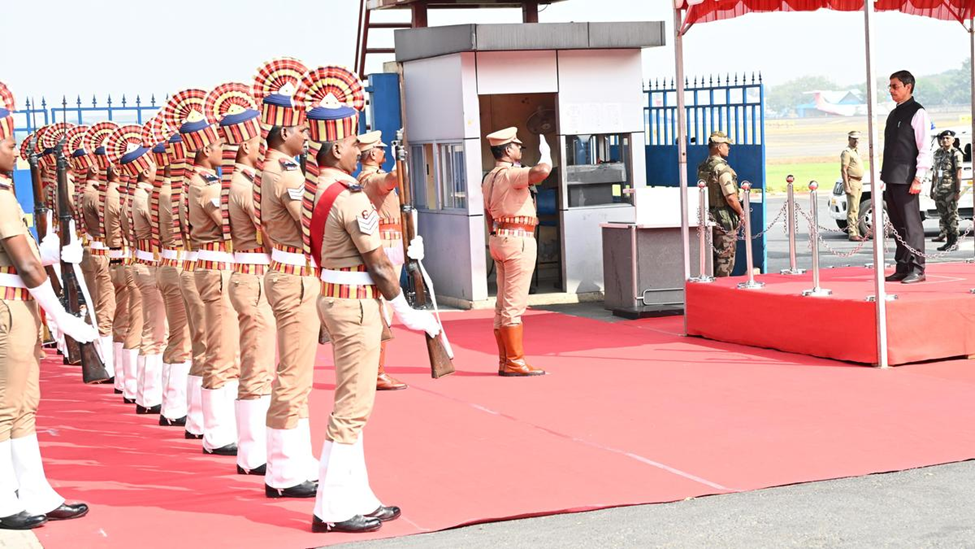
Tamil Nadu witnessed a notable political moment as outgoing Governor R. N. Ravi bid farewell to the state before leaving to take charge as the Governor of West Bengal. The farewell ceremony, held at the Chennai airport, drew attention not only because it marked the end of his tenure but also due to the absence of members from the Tamil Nadu state cabinet.
The departure highlighted the strained relationship that had developed between the Governor’s office and the state government during his tenure. While the farewell ceremony followed constitutional tradition with a guard of honour by the Tamil Nadu Police, the absence of ministers from the state government became a key point of political discussion.
Guard of Honour at Chennai Airport
Before leaving for his new assignment, Governor Ravi was accorded a ceremonial guard of honour at the airport in Chennai. Such ceremonial gestures are customary when a constitutional authority completes a tenure or moves to another gubernatorial role.
Senior officials from the state administration and staff from the Governor’s residence were present during the ceremony. However, ministers from the Tamil Nadu cabinet were notably absent during the send-off.
The absence of cabinet members was widely interpreted as a reflection of the political tensions that characterised much of Ravi’s time as governor.
Transition to West Bengal
Governor Ravi has been transferred to serve as the Governor of West Bengal as part of a broader gubernatorial reshuffle. His tenure in Tamil Nadu officially concluded after more than four years in office.
Ravi first assumed office as the Governor of Tamil Nadu in September 2021 and served until March 2026. During this period, he worked alongside the state government led by Chief Minister M. K. Stalin.
Following Ravi’s departure, Rajendra Arlekar, the Governor of Kerala, has been given additional charge of the Tamil Nadu Governor’s post until a full-time appointment is made.
A Tenure Marked by Political Differences
Ravi’s tenure in Tamil Nadu often witnessed disagreements between the Governor’s office and the ruling state government. Differences emerged on several policy matters and legislative procedures.
One of the key areas of disagreement involved the approval of bills passed by the Tamil Nadu Legislative Assembly. Delays and disagreements over legislative assent frequently led to political debates between the Governor’s office and the state leadership.
There were also public disagreements regarding educational policy, particularly around issues related to the National Education Policy and university administration. These differences occasionally led to political tensions within the state.
The relationship between the Raj Bhavan and the elected government became a recurring topic in Tamil Nadu’s political discourse during this period.
Assembly Controversies During His Tenure
Another major episode that drew national attention occurred when the Governor declined to read parts of the government-prepared address during a legislative session and later walked out of the assembly. The move triggered criticism from political leaders and sparked debates about constitutional conventions.
Such incidents contributed to an increasingly strained relationship between the Governor and the ruling government.
Legal questions regarding the powers of the Governor in relation to state legislation also reached the courts. In 2025, the Supreme Court addressed issues related to delays in approving state legislation and clarified constitutional expectations regarding gubernatorial actions.
These developments underscored the complex dynamics between constitutional authorities and elected governments within India’s federal system.
Farewell Message to the People
Despite the political tensions, Ravi expressed gratitude to the people of Tamil Nadu as he concluded his tenure. In a farewell message, he described his time in the state as one of the most memorable phases of his public life.
He highlighted the warmth, cultural richness and hospitality of the people he encountered during his travels across the state.
Ravi stated that the experience of living and working among the people of Tamil Nadu had left a lasting impression on him and that the memories of the state would remain close to his heart.
What Lies Ahead for Tamil Nadu
With Ravi’s transfer to West Bengal, Tamil Nadu now enters a transition phase regarding the governor’s office. Until a permanent appointment is made, the responsibilities will be handled by Rajendra Arlekar under additional charge.
Administrative functions of the Governor’s office will continue without interruption as constitutional processes remain in place.
Meanwhile, political observers believe that the appointment of a new governor could shape the future working relationship between Raj Bhavan and the Tamil Nadu government.
Significance of the Transition
Changes in gubernatorial leadership often influence the dynamics between state governments and the Governor’s office. While governors serve as constitutional heads of states, their interactions with elected governments can sometimes become politically sensitive.
The departure of Ravi marks the end of a chapter that saw significant political debates and constitutional discussions in Tamil Nadu.
As he moves on to assume his new role in West Bengal, attention will now turn to how the next phase of leadership unfolds at Raj Bhavan in Tamil Nadu.
Follow for more updates regarding business related news in newsnownation.com.
