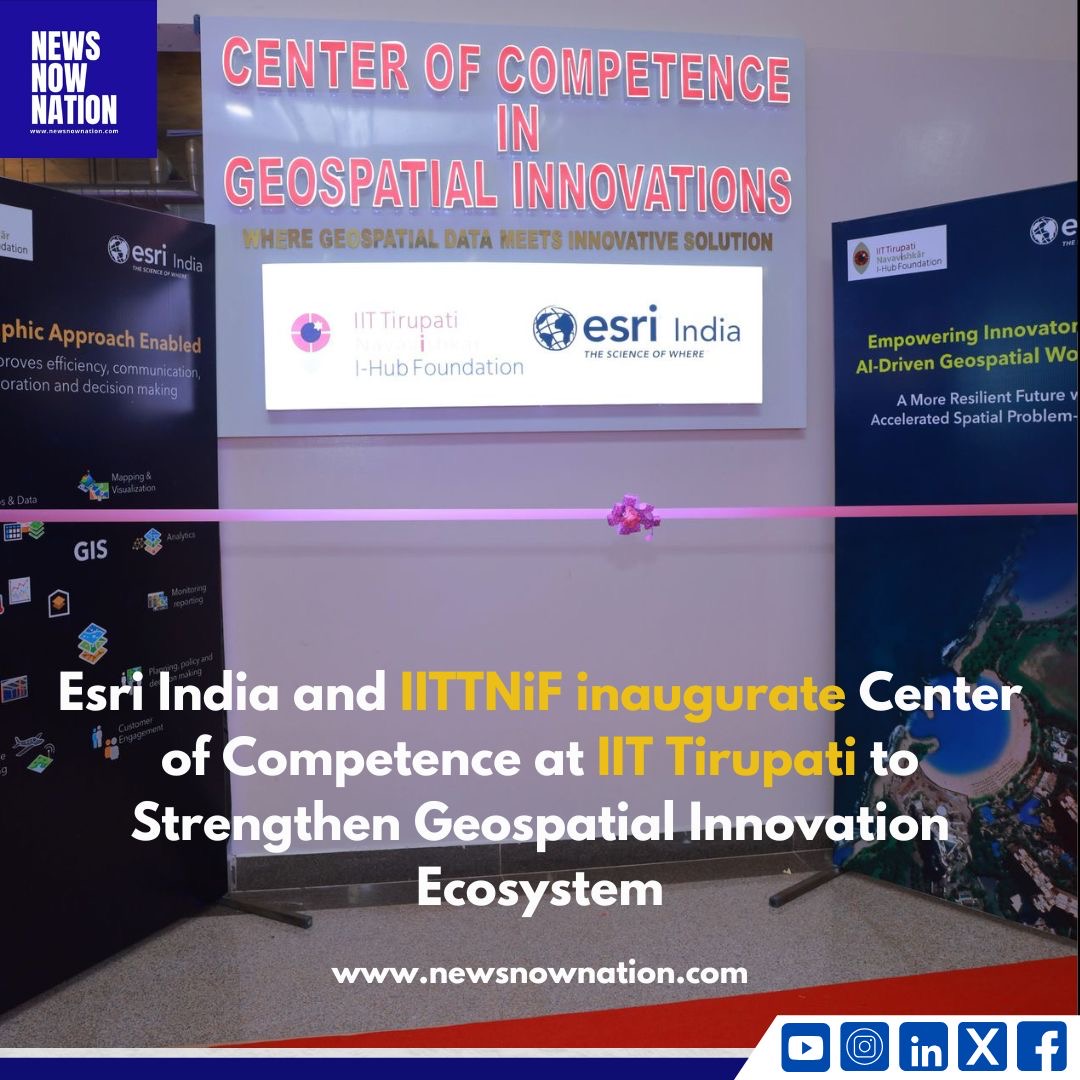
A Center of Competence was officially inaugurated by Chief Guest Prof. Abhay Karandikar, DST Secretary, Prof. K. N. Satyanarayana, Director, IIT Tirupati, and Mr. Agendra Kumar, Managing Director, Esri India at IIT Tirupati on 17th March 2025. Esri India and IIT Tirupati Navavishkar I-Hub Foundation (IITTNiF) had earlier signed a Memorandum of Understanding (MoU) to establish the Center of Competence (CoC) to drive geospatial education, research, and industry applications, reinforcing India’s position as a global leader in GIS innovation.
The CoC will provide students, researchers, and startups access to advanced GIS tools, training modules, and real-world applications. This collaboration is expected to foster breakthrough developments in land management, urban planning, transportation, and drone-based geospatial analytics.
Prof. Abhay Karandikar, DST Secretary, said at the occasion, “Strengthening the collaboration between academia and industry is essential for building a skilled geospatial workforce in the country. Initiatives like the Center of Competence at IIT Tirupati can not only equip the students with the right skillsets for better job opportunities but also help them gain spatial intelligence and develop solutions that can solve the challenges of the country.”
Prof. K. N. Satyanarayana, Director, IIT Tirupati, said, “We are excited to collaborate with Esri India to establish a Center of Competence at IIT Tirupati. This collaboration will empower students, startups, and professionals with access to state-of-the-art geospatial technologies, fostering innovation and addressing real-world challenges. Through tailored training and strong industry-academia connections, we aim to cultivate a skilled generation of geospatial experts ready to drive technological and economic progress.”
Agendra Kumar, Managing Director, Esri India, said, “Our partnership with IIT Tirupati through the Center of Competence is a key step in developing the next generation of geospatial professionals. With the rise of geospatial technologies, including satellite and drone data, AI/ML integration, and advanced analytics, this initiative will equip students and professionals with cutting-edge GIS skills. These capabilities will drive innovation across industries, offering vast career opportunities. This collaboration reflects our commitment to building a skilled geospatial workforce for the future.”
The event further highlighted key industry partnerships, startup advancements, and cutting-edge research. It also featured a showcase of startups in the area of geospatial technologies.

