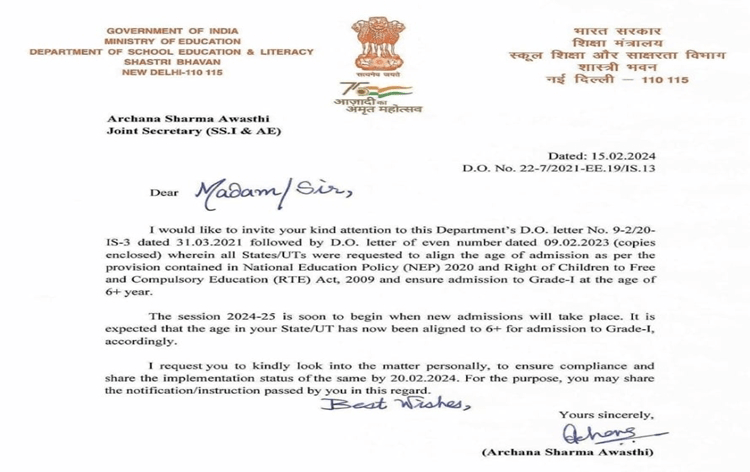
In a significant development, the Ministry of Education, as announced by AIR, has urged all states and Union Territories (UTs) to align the age of admission to Grade 1 with the age of 6 years, starting from the academic session 2024-25. This directive is in accordance with the provisions outlined in the National Education Policy (NEP) 2020 and the Right of Children to Free and Compulsory Education Act, 2009.
The Department of School Education and Literacy conveyed this directive through an official letter dated the 15th of this month. The letter emphasizes the imminent commencement of the academic session 2024-25 and underscores the expectation that states and UTs would have adjusted the age criteria for Grade 1 admissions to 6 years in adherence to the prescribed norms.
Context and Legal Framework
The move to standardize the age of admission to Grade 1 at 6 years is a strategic alignment with the educational reforms introduced by the NEP 2020 and the established guidelines of the Right to Education Act, 2009. These legislative frameworks aim to ensure a consistent and equitable educational foundation for children across the country.
National Education Policy (NEP) 2020 Impact
The NEP 2020, a comprehensive policy overhaul aimed at transforming the education system, envisions a more flexible and holistic approach to learning. Aligning the age of Grade 1 admission with the NEP recommendations is a proactive step towards achieving the policy’s objectives, fostering a more developmentally appropriate and inclusive learning environment.
Right of Children to Free and Compulsory Education Act, 2009
The Right to Education Act, enacted in 2009, guarantees free and compulsory education to every child in the age group of 6 to 14 years. By aligning Grade 1 admission age with the age of 6 years, the Ministry of Education reinforces its commitment to fulfilling the rights of children to quality education, ensuring that learning begins at an age conducive to their cognitive and socio-emotional development.
Rationale and Benefits
Setting a uniform age for Grade 1 admission across states and UTs brings several benefits. It establishes a level playing field, promoting educational consistency and continuity. A standardized age criterion for admission aids in creating a cohesive and well-structured foundation for students, enhancing the overall quality of primary education.
Preparing for the Academic Session 2024-25
With the academic session for 2024-25 looming, the directive emphasizes the urgency for states and UTs to realign their admission procedures promptly. This proactive approach ensures a seamless transition for students entering Grade 1, setting the stage for a more harmonized and effective learning experience.
Collaboration and Communication
The Ministry of Education encourages collaborative efforts between the central government, states, and UTs to facilitate the successful implementation of this directive. Transparent communication channels are vital to ensure that educational institutions, parents, and relevant stakeholders are well-informed about the revised admission criteria.
Inclusive Education and Future Implications
Aligning Grade 1 admission age with the age of 6 years reflects a commitment to inclusive education practices. This move has implications not only for the immediate academic session but also for the long-term educational journey of students. It signals a broader shift towards prioritizing the developmental needs of children and fostering an environment conducive to optimal learning outcomes.
Ministry of Education’s directive to standardize the age of admission to Grade 1 at 6 years is a pivotal step towards realizing the goals set by the NEP 2020 and the Right to Education Act, 2009. This strategic alignment positions the education system on a path that prioritizes inclusivity, consistency, and the holistic development of every child. As states and UTs work towards implementing these changes, the educational landscape in India is poised for a positive transformation that resonates throughout the academic journey of future generations.

