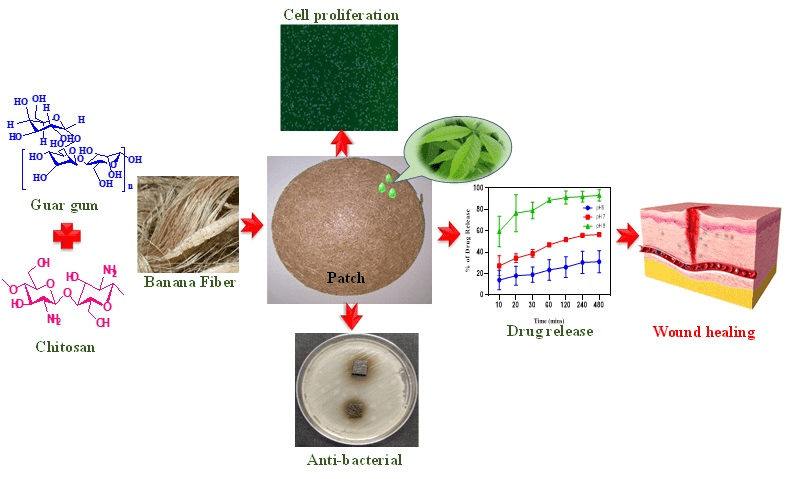
India, the world’s leading banana-farming nation, has found a novel use for its abundance of banana pseudo stems. Scientists at the Institute of Advanced Study in Science and Technology (IASST), operating under the Department of Science and Technology, have successfully transformed these often-discarded stems into an eco-friendly wound dressing material, offering a sustainable solution for wound care.*
In a groundbreaking effort led by Prof. Devasish Chowdhury and Prof. (Retd) Rajlakshmi Devi, the research team at IASST ingeniously combined banana fibers with biopolymers such as chitosan and guar gum. The result is a multifunctional patch with remarkable mechanical strength and antioxidant properties, showcasing the potential of agricultural waste in creating high-value medical solutions.
Banana pseudo stems, considered agricultural waste after the harvest, were turned into a valuable resource for wound care. Mridusmita Barman, a research scholar in the IASST-Deakin University Joint PhD program, played a crucial role in the research, contributing to the development of this innovative dressing material.
Taking the innovation a step further, the researchers loaded the patch with an extract from the Vitex negundo L. plant. This addition demonstrated the patch’s capabilities in in vitro drug release and as an antibacterial agent. The infusion of natural and locally available materials ensures that the manufacturing process is not only simple and cost-effective but also non-toxic, marking a significant leap towards sustainable healthcare solutions.
“This investigation opens the door to a new era in wound healing, offering a low-cost, reliable, and environmentally friendly alternative that holds significant potential in biomedical research,” stated Prof. Chowdhury. The banana fiber-biopolymer composite dressing has the potential to revolutionize wound care, presenting a broad spectrum of applications with positive impacts on both health and the environment.
Elsevier recently published the research in the International Journal of Biological Macromolecules, highlighting its significance in the scientific community. The publication can be accessed through this [link](https://doi.org/10.1016/j.ijbiomac.2024.129653), offering insights into the methodology and potential applications of this eco-friendly wound dressing material.
The research not only provides an innovative solution to wound care but also suggests additional uses for the abundant banana plant, potentially benefiting farmers and minimizing the environmental impact of agricultural waste. The simplicity and cost-effectiveness of the manufacturing process further enhance the feasibility of large-scale adoption, making this breakthrough a beacon of hope for a more sustainable and responsible approach to healthcare.

