
“Exploring the Existence and Implications of ConsumerSovereignty across Different Economic Systems”
In the world of economics, the theory of consumer sovereignty is a cornerstone of capitalist economies. This principle suggests that the consumers, through their spending habits, dictate the production of goods and services. In this system, businesses expend resources to cater to consumer preferences, leading to an abundance of luxury goods while necessities may lag behind. Essentially, the price of goods echoes the demand of consumers, earning consumers the title of ‘Kings of the Capitalistic Economy’.
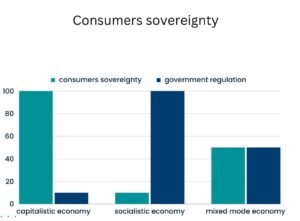
On the other hand, consumer sovereignty is non-existent in a socialist economy. Here, everyone works for the state and earns wages for their labor. A focus on the production of necessities over luxuries prevails, embodying the principle of equitable distribution of income and goods. The government centrally plans and regulates all economic activities, ensuring every citizen has access to basic needs like food, clothing, and shelter. Consumer tastes and preferences hold no sway over production, and the government, not the market forces, determines the prices of goods.
In a mixed economy, consumer sovereignty exists but with considerable government intervention. For instance, governments may regulate products or services like alcohol and gambling, even though they are in high demand by consumers.
This diversity in the application of consumer sovereignty across different economies leads one to question its universality. In my opinion, it can be perceived as both a myth and a reality, contingent on the economic system a country adheres to. As India operates a mixed economy, consumer sovereignty exists to a degree. It plays a crucial role in boosting consumer confidence, provided the produced goods align with their tastes and preferences.
However, consumer sovereignty can also be potentially harmful, as it may drive the production of less essential goods and more harmful products like drugs and alcohol. This economic principle could place an unhealthy amount of power in the hands of consumers, potentially leading to inefficiencies in the country’s operations. This highlights the importance of government regulation, as seen in mixed economies.
In conclusion, consumer sovereignty is a complex concept, neither wholly myth nor reality. In a capitalist economy, where resource allocation is primarily governed by consumer choices, consumer sovereignty is a palpable reality. Conversely, in a socialist economy, where the government controls resource allocation for societal benefit, consumer sovereignty is indeed a myth. The existence and impact of consumer sovereignty vary widely, largely dependent on a nation’s adopted economic system.
Author: Agasthya Baid, St. George’s College, Mussoorie.
