You walk into the supermarket for one product, but you come out with five, and a feeling of guilt. You promised that you’re going to save money this month, but end up ordering food thrice this week. Sounds familiar?
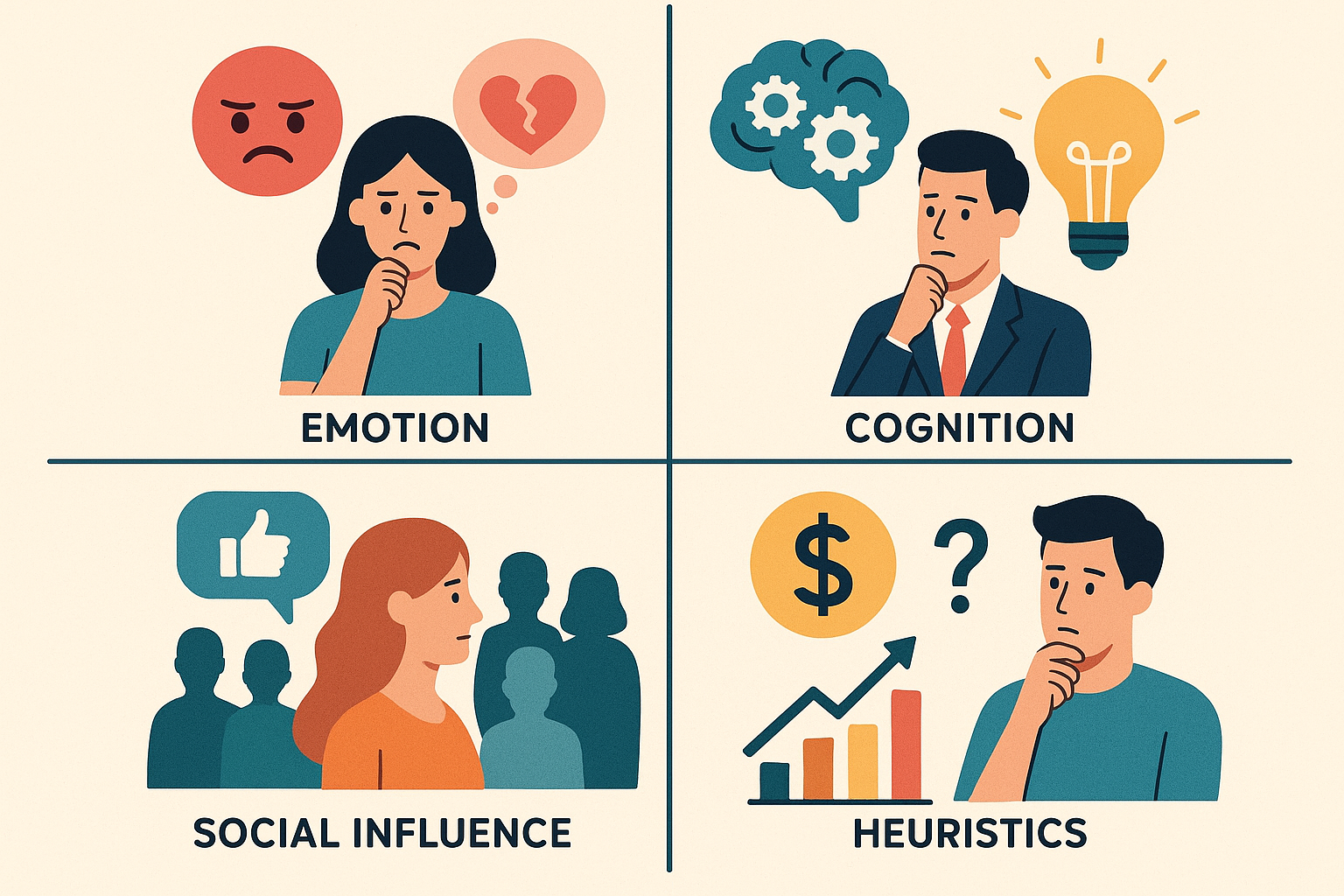
Welcome to the peculiar world of behavioural economics. Behavioural economics is a field that combine economics with psychology to explain why we humans sometimes make decisions that go against logic. It is a study of the psychological factors which influence a person’s decision making.
What is decision making?
Decision making is simply the process of making a choice. But it isn’t always easy, it can be particularly complex too. Humans don’t always decide based on logic. Our decisions are shaped by our past experiences, emotions, habits etc. We may believe that we are sensible to take this decision, but our brain tends to make shortcuts to save time and effort. These shortcuts are called heuristics.
What is an economic decision?
Imagine you have ₹100, and two options, either you spend the money on your favourite snack, or to buy a journaling kit with fancy pens that you’ve been eyeing on. You can’t have both of them so you decide. You make a choice. That’s an economic decision. An economic choice involves using limited resources, like time, effort or money.
Psychological Factors which Influence economic decisions
Psychological factors play a crucial role in economic decision making, influencing how individuals and organisations make choices about spending and saving.
- Cognitive Biases
These are mental shortcuts that we tent to make which taking economic decisions.
- Anchoring bias: we tend to rely on the first piece of information we see. For example, if a shirt is ₹2000, but later it becomes ₹1000, we think it’s a great deal, even though ₹1000 is still expensive.
- Loss aversion: we fear the pain the loosing, more than the happiness of gaining. For example, people are more afraid to invest in shares because they don’t want to lose money, even if they have a chance to earn it.
- Framing effect: the framing effect is a cognitive bias where people react differently to the same information depending on how it is presented or “framed”. For example, “90% fat-free” sounds better that “10% fat” though they mean the same thing.
- Social Influence
- Herd behaviour: Humans are social beings and our decisions are often influenced by those around us. One common behaviour is known as herd mentality. Herd mentality is the tendency to follow the crowd, often overriding personal judgement. For example, when a certain phone, shoe brand, or clothing style becomes popular, many people wanted to buy it just because others have it.
- Peer pressure: social norms affects how people spend their money. Sometimes people make money choices just because they feel it’s what others expect you to do. For example, people spend a lot of money on big weddings and festivals because it’s a common tradition in their community, even if it puts pressure on the family’s budget.
- Mental Accounting
Mental accounting refers to the different values a person places on the same amount of money based on subjective criteria. It is the tendency of people to treat money differently based on from where it comes or how they plan to use it, even though the money is same regardless of its source. For example, if you receive ₹1000 as a gift, you might spend it on food, clothes or entertainment without thinking twice. But if you earn the same ₹1000 through a part time job, you may save it or spend it more carefully.
- Present bias
Present bias is the tendency to focus more on the present situation that the future to make decisions. This can lead us to prioritize immediate rewards over future payoffs, even if that decision benefits us less overall. For example, people avoid going to the doctor or dentist because it feels uncomfortable or inconvenient now, even though it can cause serious problems in the future.
- Emotions and mood
Our feelings can change how we spend our money. When someone is sad or stressed, they may avoid spending. But when they are happy and excited, they spend money on things they don’t even need. For example, during festivals or sales, people often shop more because they are in a good mood.
Concept of Nudging
According to behavioural economics, nudge theory is the process of influencing consumer behaviour in predictable ways by choice. It is mainly concerned with choices, which influences the decision we make. It aims to understand how people think, behave and make decisions and help people in improving their decisions and thinking. For example, in a school cafeteria, if the school places fruits and healthy snacks at eye level and keep junk food lower down or in less visible spots, students are nudged to choose healthier options without banning unhealthy ones. A nudge is a subtle change in the environment that encourages individuals to make certain choices without actually limiting their freedom to choose. Nudge theory was popularized by the 2008 book, “Nudge: Improving Decisions about Health, Wealth, and Happiness” written by American academics Richard .H. Thaler.
Conclusion
Behavioural economics and nudge theory remind us that human decision-making is far from perfectly rational. By understanding the subtle ways in which our choices are influenced, from framing effects to defaults, policymakers, businesses, and individuals can create environments that encourage better decisions without restricting freedom. Nudges are not about manipulation, they are about aligning decisions with people’s own long-term goals and well-being. As the world becomes increasingly complex, the ability to guide choices with insight and empathy will only grow in importance.
“Economics is about how people make choices. Behavioural economics is about how they sometimes make the wrong ones” — Richard .H. Thaler, Noble laureate and pioneer of behavioural economics.
By – Vamsi Rawat







 fines Zerodha Asset Management and its directors)