
Where classical physics fails, quantum computers come into existence. These are computers that exploit the phenomena of quantum physics for their working.
These Quantum computers are not only substantially faster than generic computers but are also able to solve equations which are almost impossible for generic computers. A Quantum computer works on an atomic level. So, a quantum computer operates by controlling the behaviour of electrons and photons, in a way that is completely different from our regular computers. This allows quantum computers to be exponentially faster and more efficient. In a quantum computer, the information is found in qubits, which interact with one another to yield results.
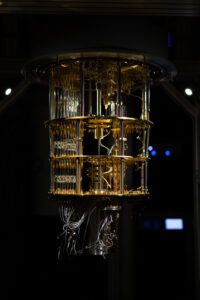
Loosely speaking, quantum computing targets problems that can exploit entanglement(At the quantum level, two particles such as a pair of electrons or photons can form a single entity even when they are separated from each other by a vast distance) to explore correlations in computations and then selects the correct answer through constructive interference(when subatomic particles interact with and influence themselves and other particles). A quantum System is kept at an extremely cold temperature which is near absolute zero. This is done to physically isolate qubits and retain the conducting properties of the superconductor being used. Physically isolating qubits is very important or it suffers from quantum decoherence, introducing noise into calculations. This leads to errors in calculation.
A quantum computer is basically run on qubits. Qubits aren’t like bits on which general computers work. They aren’t a binary system of 0s and 1s. They’re more complex. A quantum computer has a bit more fluid, nonbinary identity. It can exist in a superposition, or a combination of zero and one, with some probability of being zero and some probability of being one. In other words, it can be thought of as a spectrum. It contains all possible combinations of 0 and 1.
The key idea here is that we have to give up on the exact values of zero and one and allow for some uncertainty. In an effort to visualise it, we can think of it as a closed interval between 0 and 1. Quantum computers harness superposition and uncertainty. One of the core fundamentals of Quantum mechanics lies in uncertainty.
Another way to visualise it might be to think of it as a wave. A qubit could likely be zero which means a lower energy wave forms, or it could be one which would mean the formation of a higher energy wave. Every qubit has a probability of simultaneously being one and zero. When a quantum computer is working, multiple qubits interact and they add constructively or destructively just like waves. We can observe similar phenomena as nodes and antinodes found in waves in Qubits.
Another way a quantum computer functions differently from a generic computer is that it does not test every single possibility as a general computer might. On the contrary, it stays in a transitory state where it is simultaneously going through every possibility while also being conscious of uncertainty. We can think of it in this way as in a general computer heads and tails are absolute entities, that is, if you get heads then it’s definite that the other system gets tails. While we find that this logic does not hold for quantum computers. In quantum computers heads and tails are interlinked, it is not certain that if one system gets heads the other will definitely get tails. Since we know that quantum computers work on qubits which are much more than the binary 0 and 1. So the possibilities for quantum computers are not limited to heads and tails but are actually both. This concept is the basis due to which quantum computers get correct answers. This is evident in an experiment conducted by Physicist Shohini Ghose in a sample size of 372 the quantum computer was able to get the correct answer approximately 360 times. The instances where the quantum computer did not get the correct answer were due to operational errors. On a macroscopic level, this might seem impossible; instead, it becomes the structural component of quantum computing.
Quantum physics and quantum computers are complementary. Quantum computers are built on the fundamentals of quantum physics. With that quantum computers help develop a better understanding of quantum physics and the nature of the Universe.
Quantum computing is a vast field which has not yet been explored to its full potential. In fact, we do not even know what applications of it we might discover next. Designing quantum algorithms is very difficult and has been studied for decades. But with the few breakthroughs in quantum algorithms, its theoretical applications in fields such as cybersecurity and search optimization have been possible. Most experts believe that quantum computers are more likely to be useful for studying the structure of our universe. One generally used analogy is that the field of quantum computing is like a bottomless ocean with various layers to it and we are just skimming the surface right now. With advancements in quantum computing, we get immense power and a greater understanding of the universe. We must tread carefully and responsibly as we develop our quantum future.
The largest quantum computer created was created just last year by IBM; it contained a 433 qubits processor. Now, IBM is working on a 100,000 qubits quantum computer which is expected to be completed within 10 years. Their aim is for quantum computers to work together with supercomputers to achieve new technological heights.
Quantum computers have a long way to go to unleash their true potential. At this moment quantum computers are not doing anything current supercomputers can not. There is still potential for extensive development in the field of quantum computing. But many experts believe that there will be substantial development in the field. It is very likely for us to witness great advancements which might stem from the use of these computers in the years to follow which is very exciting news for all of us.

CITATIONS
YouTube. (2019). A beginner’s guide to quantum computing . YouTube. Retrieved July 29, 2023, from https://www.youtube.com/watch?v=QuR969uMICM.
Wikimedia Foundation. (2023, July 25). Quantum computing. Wikipedia. https://en.wikipedia.org/wiki/Quantum_computing
Brooks, M. (2023, May 25). IBM wants to build a 100,000-qubit quantum computer. MIT Technology Review. https://www.technologyreview.com/2023/05/25/1073606/ibm-wants-to-build-a-100000-qubit-quantum-computer/#:~:text=Late%20last%20year%2C%20IBM%20took,blocks%20of%20quantum%20information%20processing.
Gambetta, J. M., Chow, J. M., & Steffen, M. (2017, January 13). Building logical qubits in a superconducting quantum computing system. Nature News. https://www.nature.com/articles/s41534-016-0004-0#Bib1

