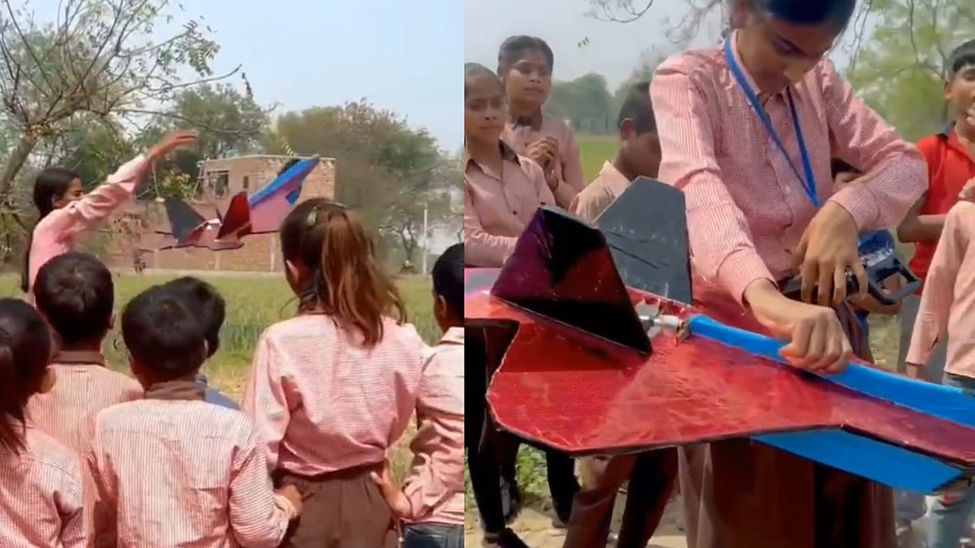
Innovation and Determination from a Government School
In an inspiring story from Uttar Pradesh, students of a government school in Aligarh have captured nationwide attention after successfully building a flying fighter jet model using scrap materials. The achievement has not only gone viral on social media but has also become a powerful example of innovation, creativity and determination among young minds.
The students, studying in a government-run school in Aligarh, worked together to design and construct the model aircraft using discarded materials. What makes the accomplishment remarkable is that the project was completed with minimal resources, highlighting the potential of students when given the opportunity and encouragement to explore their creativity.
The video of the flying model jet has quickly gained traction online, with people praising the students for their ingenuity and hands-on learning approach. The project reflects how practical exposure to science and engineering concepts can inspire innovation even in resource-constrained environments.
The fighter jet model, reportedly built using scrap items such as plastic, metal pieces and other reusable components, demonstrates a basic understanding of aerodynamics and flight principles. The fact that the model was able to fly successfully has made the achievement even more noteworthy.
Teachers at the school played a key role in guiding the students through the process. By encouraging experimentation and teamwork, they helped create an environment where students could transform theoretical knowledge into practical application. The initiative also reflects the growing emphasis on experiential learning in India’s education system.
This development comes at a time when India is focusing heavily on promoting STEM (Science, Technology, Engineering and Mathematics) education among students. Projects like these not only build technical skills but also boost confidence and problem-solving abilities.
The viral video has drawn appreciation from educators, professionals and social media users across the country. Many have highlighted how such initiatives can inspire other schools to adopt similar hands-on learning approaches, especially in government institutions where resources are often limited.
The success of the students also underscores the importance of innovation at the grassroots level. While advanced technology and infrastructure are important, the ability to think creatively and work with available resources is equally valuable.
India has been making significant progress in sectors such as aerospace and defense, and stories like this demonstrate that the foundation for future innovation is being laid at the school level. Encouraging students to experiment and build projects can play a crucial role in developing the next generation of engineers, scientists and innovators.
The Aligarh students’ project also sends a strong message about the power of determination. Despite challenges such as limited access to advanced tools and materials, they were able to achieve something extraordinary through teamwork and persistence.
Such initiatives also align with government programs aimed at promoting innovation and skill development among students. Schemes focusing on practical learning, digital education and scientific temperament are helping create an ecosystem where students can explore their interests beyond textbooks.
The story has also sparked conversations about the potential of government schools. Often perceived as lacking resources, many government institutions are now emerging as centers of creativity and innovation due to the dedication of teachers and students.
Parents and local communities have expressed pride in the achievement, recognizing the effort and dedication that went into the project. The success has not only brought recognition to the students but also to the school and the region.
The viral nature of the video has further amplified the impact of the story. Social media platforms have become a powerful tool for showcasing talent and inspiring others. In this case, the students’ achievement has reached a wide audience, motivating others to pursue creative projects.
Experts believe that such real-life examples can play an important role in changing perceptions about education. When students are given opportunities to experiment and innovate, learning becomes more engaging and meaningful.
The fighter jet model project also highlights the importance of sustainability. By using scrap materials, the students demonstrated how waste can be transformed into something valuable. This approach not only reduces waste but also encourages responsible use of resources.
Looking ahead, initiatives like these could pave the way for more innovation-driven education in India. Schools can incorporate project-based learning into their curriculum, encouraging students to think beyond conventional methods.
The recognition received by the Aligarh students may also open new opportunities for them, including participation in science fairs, competitions and further educational support. Their achievement serves as an example of how talent can emerge from any corner when nurtured properly.
In conclusion, the story of these government school students building a flying fighter jet model from scrap is a testament to the power of creativity, determination and education. It highlights the importance of providing students with the right guidance and opportunities to explore their potential.
Such stories not only inspire but also remind us that innovation is not limited by resources but driven by ideas and effort. As India continues to focus on building a knowledge-driven economy, encouraging young innovators will be key to future progress.
Follow for more updates regarding business related news in newsnownation.com.
