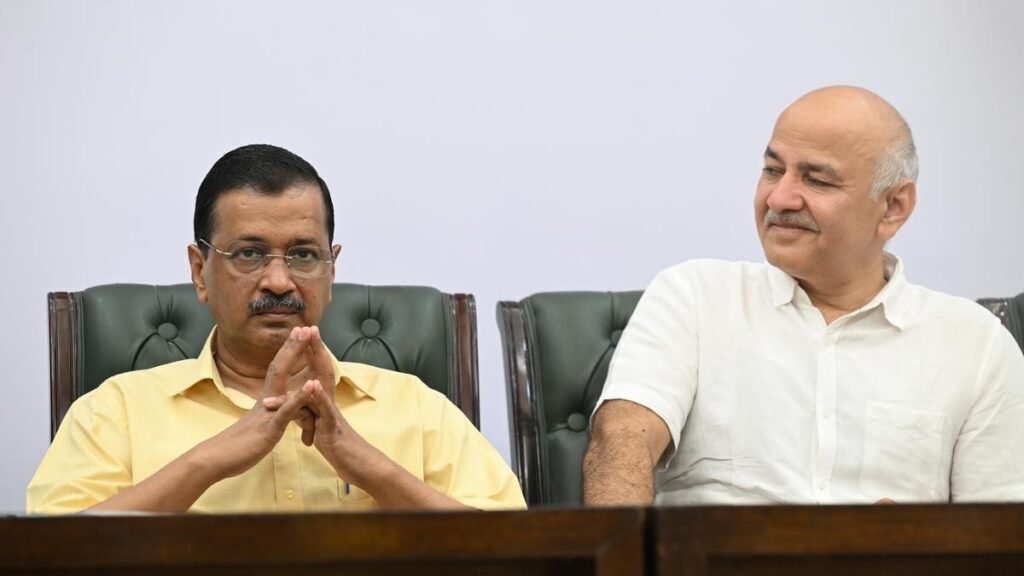
In a significant turn of events for the Aam Aadmi Party (AAP), a Delhi court on Friday discharged former Chief Minister Arvind Kejriwal and former Deputy Chief Minister Manish Sisodia in the 2022 excise policy-related corruption case. The ruling, delivered by Special Judge Jitendra Singh at the Rouse Avenue Court, marks a watershed moment in a case that has dominated Indian political discourse for nearly four years.
The court’s decision was rooted in a lack of substantial evidence. In a stern critique of the Central Bureau of Investigation (CBI), the judge refused to take cognizance of the chargesheet, labeling the allegations “deficient.” The court observed that the “central conspiratorial role” attributed to the leaders could not be substantiated by the material provided. Furthermore, the judge noted that there was no evidence of “criminal intent” on the part of Manish Sisodia, effectively dismantling the prosecution’s theory of a pre-planned scam.
The judgment went beyond the leadership, discharging all 23 accused in the CBI case. Citing a powerful quote by Martin Luther King Jr.—”Injustice anywhere is a threat to justice everywhere”—the judge remarked that the conspiracy theory could not survive against constitutional authorities without concrete proof.
The atmosphere outside the courtroom was charged with emotion. Arvind Kejriwal, who has consistently maintained that the case was a political “witch hunt,” broke down in tears while addressing the media. “I am not corrupt,” he stated, embracing Manish Sisodia. “The court has said that Kejriwal and Manish Sisodia are honest.”
The AAP leadership hailed the verdict as a victory for the “Truth,” with Kejriwal’s wife, Sunita Kejriwal, posting on X (formerly Twitter) that no one can rise above “Shiva Shakti” and that truth always prevails.
The controversy began in 2022 when Delhi Chief Secretary Naresh Kumar submitted a report to Lieutenant Governor V.K. Saxena, alleging procedural lapses in the 2021-22 Excise Policy. The CBI subsequently alleged that a “South Lobby” had paid ₹100 crore in kickbacks to influence the policy. These allegations led to the high-profile arrests of Sisodia in February 2023 and Kejriwal in 2024.
The policy itself aimed to modernize the liquor trade in Delhi by shifting retail from government-run shops to private players. While the government argued it would increase revenue and curb the “liquor mafia,” the opposition and investigative agencies claimed it was a front for money laundering.
While this discharge provides massive relief in the CBI’s corruption case, it is important to note that the parallel money laundering case being investigated by the Enforcement Directorate (ED) still technically stands. However, legal experts suggest that the CBI court’s observation—that no “overarching conspiracy” existed—could significantly weaken the ED’s case, which is built on the same predicate offence.
For the Aam Aadmi Party, this verdict is more than just a legal win; it is a moral restoration. As the party prepares for future electoral battles, the “Kattar Imaandar” (strictly honest) image that defines its brand has received a powerful judicial seal of approval.
