For more than a century, one of Antarctica’s most dramatic natural phenomena has fascinated scientists and the public. A striking red flow emerges from the icy surface of Taylor Glacier, creating the appearance of blood spilling across a frozen white landscape. Known worldwide as Blood Falls, this unusual feature has inspired decades of scientific investigation into the source of its colour, the movement of water beneath the glacier and the possibility of life surviving in one of the most extreme environments on Earth.
Recent attention has brought the phenomenon back into focus, but the scientific explanation has developed through several major discoveries rather than one single breakthrough. Researchers have established that the red liquid is not blood and is not simply ordinary meltwater. It is highly saline, iron-rich brine that has remained isolated beneath Taylor Glacier for an extraordinarily long period. When the liquid reaches the surface and its dissolved iron is exposed to oxygen, chemical changes create the distinctive red and reddish-brown appearance.
Why Does the Water at Blood Falls Turn Red?
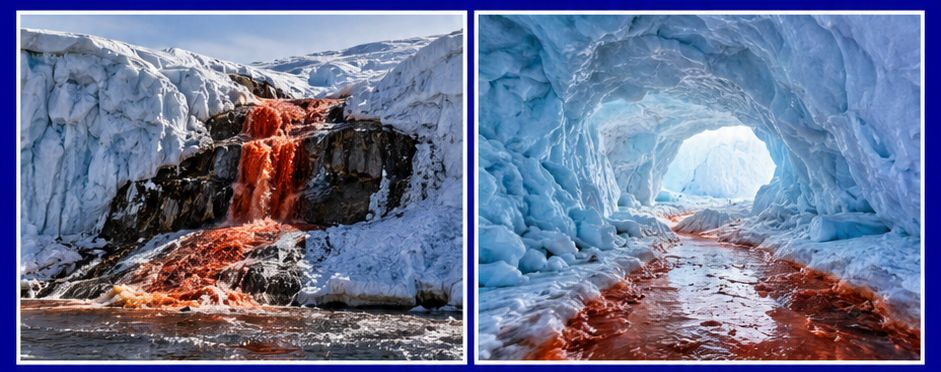
The extraordinary colour of Blood Falls is connected to iron carried by the ancient brine beneath the glacier. The liquid can appear relatively clear before exposure at the surface, but contact with air changes the iron-bearing material and produces the dramatic colour that has made the site famous.
The process is often compared with rusting, although detailed scientific research has shown that the chemistry is more complex than a simple layer of conventional iron oxide. Laboratory analysis found tiny iron-rich, non-crystalline nanospheres in material from Blood Falls. These microscopic particles contain iron along with other elements and help explain why earlier methods did not provide a complete picture of the colour-producing material.
The contrast is visually remarkable. Deep red and orange stains spread across an environment dominated by white ice and blue glacier formations. This unusual appearance is the reason the phenomenon has remained one of Antarctica’s most recognisable natural landmarks.
Blood Falls was observed during the early twentieth-century exploration of the region, and the feature became associated with geologist Thomas Griffith Taylor, after whom Taylor Glacier was named. Early explanations included the possibility that red algae caused the unusual colour. Later investigations demonstrated that the phenomenon was linked instead to iron-rich saline water emerging from beneath the glacier.
The Ancient Brine Hidden Beneath Taylor Glacier
One of the most important parts of the Blood Falls mystery concerns the source of the water. Scientists found evidence connecting the outflow to a reservoir of salty water beneath Taylor Glacier. Research has suggested that this water may have remained trapped under the ice for more than a million years.
The hidden liquid is far saltier than ordinary freshwater. As ice forms, salts can become concentrated in the remaining liquid, producing extremely saline brine. This high salt concentration is essential to understanding another surprising feature of Blood Falls: the water can remain liquid in conditions where ordinary freshwater would freeze.
Salt lowers the freezing point of water. The unusually high salinity of the brine therefore allows it to move through the frozen environment of the glacier. Scientists have described Taylor Glacier as an exceptional example of a cold glacier capable of supporting persistent liquid water within its internal system.
Understanding the source alone, however, did not answer every question. Researchers also wanted to know how the brine travelled from beneath the glacier to the surface. In 2017, scientists used radio-echo sounding, a radar-based technique, to trace the hidden route of the salty water. The research mapped a pathway through the glacier and showed how the brine could move through a network of internal channels before emerging at Blood Falls.
How Blood Falls Can Flow in Extreme Antarctic Cold
The ability of liquid water to move through a freezing glacier initially appeared difficult to explain. Taylor Glacier exists in one of the coldest and driest environments on the planet, yet the brine can still travel beneath and through the ice.
Its extreme salinity provides a major part of the explanation because concentrated salt acts as a natural antifreeze. Researchers studying the glacier’s internal hydrology have also examined the relationship between freezing, heat and the movement of brine through cracks and channels.
This makes Blood Falls more than a colourful surface feature. It is evidence of an active hydrological system hidden inside an apparently frozen landscape. What appears motionless from the outside can contain complex movements of water, ice and dissolved materials beneath the surface.
More recent research has also investigated how episodes of brine discharge may be linked to small changes in the glacier itself. Scientists have observed changes in glacier movement and surface elevation associated with activity beneath the ice, adding another layer to the understanding of how Blood Falls operates.
A Hidden Ecosystem Without Sunlight
The scientific importance of Blood Falls extends beyond its red colour. The isolated brine beneath Taylor Glacier is associated with microorganisms capable of surviving in conditions that would be hostile to most familiar forms of life.
These organisms exist in a dark, cold and highly saline environment without relying on sunlight in the way surface ecosystems do. Instead, the microbial community survives through chemical processes involving materials available in its surroundings. Research into this unusual ecosystem has made Blood Falls valuable to microbiologists studying the limits of life on Earth.
The discovery raises fundamental questions about how long life can survive in isolation and what kinds of biological systems can remain active beneath thick ice. Environments once considered completely lifeless may contain complex microbial communities adapted to extreme conditions.
The ancient brine therefore acts like a natural time capsule. Its isolation offers researchers an opportunity to study a biological environment that has developed under conditions dramatically different from those experienced by most organisms on the surface.
Why the Blood Falls Discovery Matters Beyond Antarctica
Blood Falls has become particularly important in astrobiology, the scientific study of the possibility of life beyond Earth. Icy worlds elsewhere in the Solar System may contain liquid water beneath frozen surfaces, making Antarctica a valuable natural testing ground for ideas about extraterrestrial habitability.
Scientists are especially interested in environments where life can survive without sunlight and under extreme cold, darkness and chemical stress. The ecosystem associated with Blood Falls demonstrates that life can persist under conditions once considered nearly impossible.
Research into the site may therefore help scientists develop better strategies for investigating icy environments on other worlds. The iron-rich materials at Blood Falls are also scientifically significant because similar mineralogical evidence, if discovered elsewhere in the Solar System, could help researchers identify environments that may once have been habitable.
The story of Blood Falls also demonstrates how scientific mysteries are solved. The explanation did not emerge from a single observation. It required field expeditions, radar mapping, chemical analysis, advanced microscopy, microbiology and years of collaboration between researchers from different disciplines.
More than 100 years after the strange red flow first attracted scientific attention, Blood Falls is no longer simply an unexplained stain on an Antarctic glacier. Scientists now understand that its appearance is connected to ancient, iron-rich, highly saline water moving through Taylor Glacier and changing chemically when it reaches the oxygen-rich surface. At the same time, continuing research into the glacier’s internal movement and hidden ecosystem shows that the site still has much to reveal.
Blood Falls remains one of the clearest examples of how a visually dramatic natural mystery can lead to discoveries about glaciology, chemistry, microbial survival and the possibility of life in extreme environments far beyond Earth.
Follow for more updates regarding business-related news on NewsNowNation.com.
s
