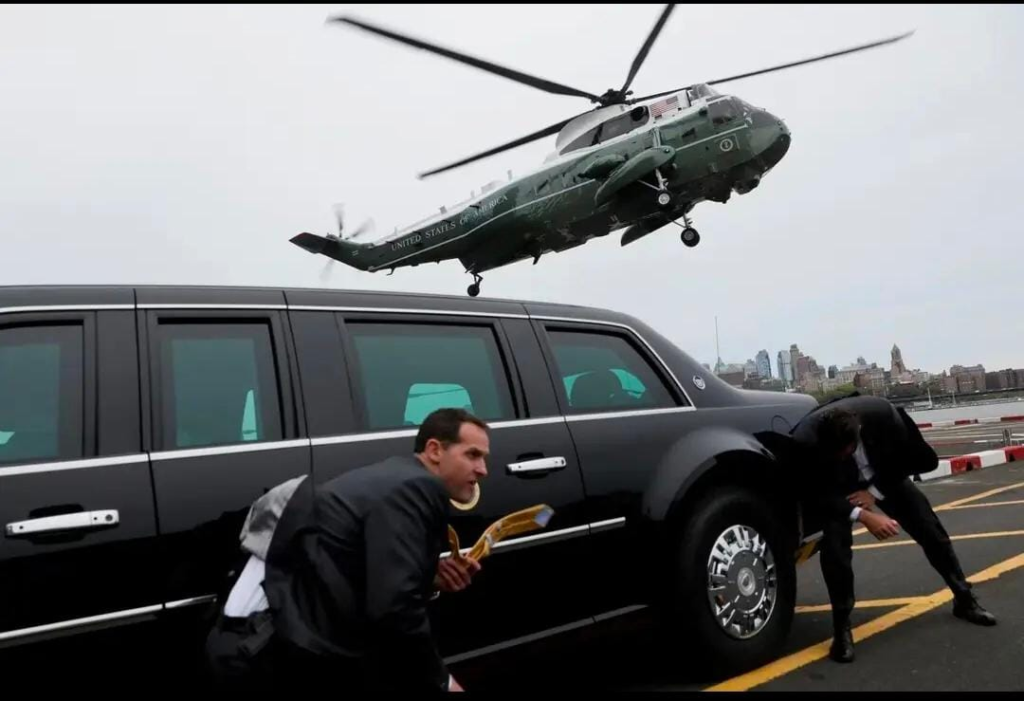
Investigation Begins After Aircraft Departs While Donald Trump’s Helicopter Was Approaching Ronald Reagan Washington National Airport
A fresh aviation safety investigation has been initiated in the United States after an aircraft reportedly departed from Ronald Reagan Washington National Airport while a helicopter carrying former U.S. President Donald Trump was approaching the airport. The incident has drawn significant attention from aviation authorities because of the strict safety procedures that govern aircraft and helicopter movements, especially when high-profile government officials are involved.
According to preliminary reports, the aircraft was permitted to take off even as Marine One, the helicopter transporting Donald Trump, was nearing the airport for landing. Although there was no collision, emergency situation, or reported danger to passengers, the sequence of events has raised serious questions regarding air traffic control procedures and compliance with established aviation safety regulations.
Officials have clarified that Donald Trump was never in immediate danger during the incident. However, aviation experts emphasize that airport operations involving presidential or former presidential aircraft require precise coordination between air traffic controllers, security agencies, and airport management. Any deviation from standard operating procedures, even if it does not result in an accident, is treated with utmost seriousness.
The Federal Aviation Administration (FAA) has reportedly ordered an investigation to determine how the aircraft received takeoff clearance while Marine One was approaching the airport. Investigators will examine communication records, air traffic control instructions, radar data, and operational timelines to establish whether all mandatory protocols were followed.
Ronald Reagan Washington National Airport is one of the busiest airports in the United States, handling thousands of domestic flights each week. Due to its proximity to important government institutions in Washington, D.C., the airport operates under some of the country’s most stringent security and airspace regulations. Special procedures are activated whenever the President, Vice President, or other protected officials travel through the area.
Marine One is not simply another helicopter in controlled airspace. Its movements are coordinated with multiple federal agencies, including the U.S. Secret Service, military authorities, and civilian air traffic controllers. Every takeoff and landing is carefully planned to minimize operational risks and maintain the highest level of security.
While initial information suggests that the aircraft’s departure did not create an immediate safety hazard, aviation professionals note that separation standards exist to eliminate even the smallest possibility of conflict between aircraft. Modern aviation relies on layers of safety, and each operational decision is expected to comply with predefined guidelines.
The ongoing investigation will likely focus on whether the clearance given to the departing aircraft complied with existing FAA regulations. Authorities will also assess whether communication between the control tower and flight crews was accurate and whether any procedural misunderstanding occurred during the sequence of operations.
Experts believe that incidents of this nature offer valuable opportunities to strengthen aviation safety systems. Even when no passengers are injured and no aircraft are damaged, investigations help identify operational gaps, improve controller training, and refine airport procedures for future flights.
The aviation industry has consistently maintained that every reported operational irregularity deserves careful examination. Air traffic control systems are designed with multiple safeguards, but continuous review remains essential to maintaining public confidence and ensuring safe air travel.
Security surrounding presidential transportation remains among the highest priorities for U.S. authorities. Every movement involving Marine One is supported by detailed planning, coordination, and communication among numerous agencies. Because of these extensive arrangements, any unexpected aircraft movement occurring nearby naturally attracts regulatory attention.
Airport officials have not indicated that commercial flight operations were significantly affected by the incident. However, investigators are expected to review whether additional operational safeguards should be introduced during future presidential or high-security aviation movements.
The FAA’s findings may also contribute to updated recommendations for handling simultaneous aircraft departures and protected helicopter arrivals at busy airports. Such reviews are common following operational events and often lead to procedural improvements without necessarily indicating negligence or misconduct.
Passengers and aviation observers continue to monitor developments as authorities collect evidence and analyze flight data. Final conclusions will depend on the investigation’s findings, including recorded communications, controller actions, aircraft positioning, and compliance with federal aviation regulations.
Although this incident concluded without injuries or damage, it highlights the importance of maintaining strict coordination in complex airport environments. Aviation safety depends on disciplined adherence to established procedures, particularly when military, civilian, and government aircraft share controlled airspace.
Regulators are expected to release additional information once the investigation progresses. Until then, officials continue to emphasize that public safety was never compromised and that the inquiry is intended to ensure complete transparency and identify any lessons that can further strengthen aviation operations.
For more business and global news updates, follow NewsNowNation.com.
