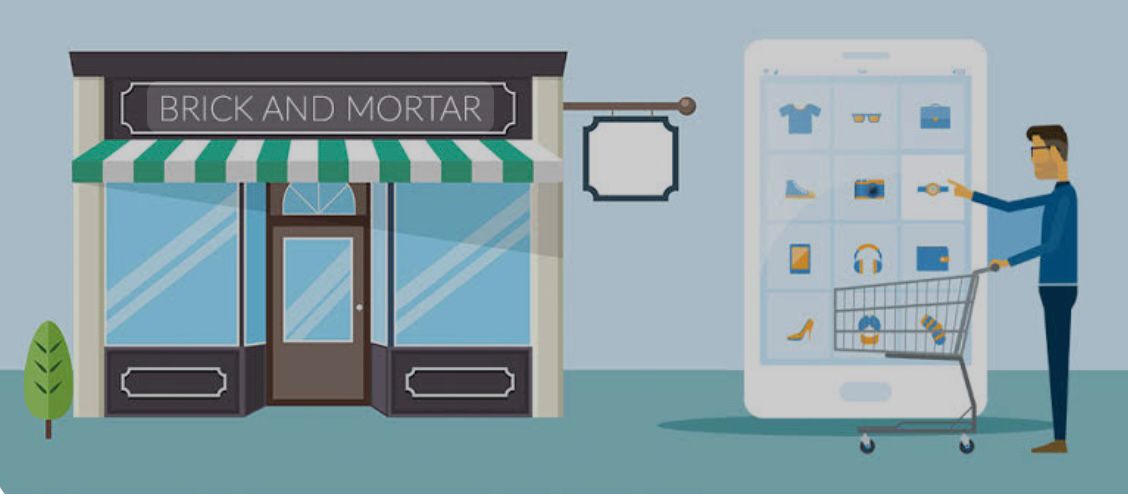
A significant change is taking place in the retail industry, reshaping the way consumers make purchases and how businesses function. E-commerce, which was once considered a new and innovative idea, has gained significant and unstoppable momentum. It poses a threat to traditional brick-and-mortar stores, which have historically been the foundation of the retail industry. The rapid advancement of digital technology is causing a significant shift in consumer behavior due to the convenience, wide range of options, and easy access provided by online shopping. This article examines the compelling factors driving the increase in e-commerce and investigates whether this digital revolution will ultimately result in the disappearance of physical retail locations.
“Brick-and-mortar” pertains to a conventional business situated on a physical street that provides goods and services directly to customers in a physical office or store that is either owned or leased by the business. Brick-and-mortar companies, such as the local grocery store and the corner bank, serve as examples. E-commerce, also known as electronic commerce, refers to the process of purchasing and selling goods and services, as well as transmitting funds or data, through an electronic network, primarily the internet. The e-commerce transactions can be categorized into four main types: business-to-business (B2B), business-to-consumer (B2C), consumer-to-consumer, and consumer-to-business.
The terms e-commerce and e-business are frequently used synonymously. The term e-tail is occasionally employed to describe the transactional procedures involved in online retail shopping.
In addition, e-commerce has transformed supply chain management by providing cost-saving prospects for businesses. The transition from conventional physical stores to digital platforms results in a reduction in the requirement for tangible space, thereby causing a decrease in overhead expenses. This enables businesses to allocate their resources to other areas, such as enhancing product quality or improving customer service. Furthermore, online shopping obviates the necessity for maintaining large inventories, as products can be shipped directly from suppliers. This results in decreased inventory expenses and the possibility of a greater rate of turnover, thereby enhancing a company’s profitability.
Nevertheless, e-commerce is not exempt from criticism. An important issue is the effect it has on employment rates in the retail industry. The proliferation of e-commerce has led to a decline in employment opportunities within brick-and-mortar retail establishments, as technological advancements have rendered certain positions such as cashiers or stock managers redundant. Although e-commerce offers employment prospects in fields such as e-commerce management or logistics, individuals who depend on traditional retail jobs may face difficulties during the transition.
A key advantage of physical retail stores is the opportunity for customers to have hands-on experience with products prior to buying them, providing a concrete and immediate perception of their quality and suitability. Contrary to online shopping, purchasing items in person provides immediate satisfaction by eliminating shipping times and associated expenses. In addition, shopping in physical stores offers the invaluable chance to directly interact with customer service representatives, enabling clearer communication and personalized assistance. Returning items in a physical store is generally easier and faster than shipping returns, as it avoids the complications and delays associated with shipping. Furthermore, the act of shopping in person offers a higher level of interactivity and engagement, as it creates a sensory-rich atmosphere that continues to attract many consumers.
Ultimately, the exponential expansion of online commerce unquestionably poses substantial obstacles for conventional physical stores, fundamentally transforming the retail industry. Consumers are increasingly inclined to prefer digital platforms for shopping due to the convenience, wide range of products, and easy accessibility offered by online shopping. This shift has allowed businesses to optimize operations and decrease fixed expenses, thereby expediting the shift from brick-and-mortar stores to online platforms. Nevertheless, the distinctive benefits of physical retail stores, such as the opportunity to physically engage with products, instant satisfaction, and direct customer support, remain highly valuable to numerous consumers.

Author – Ritav Kedia | Pathways World School