According to officials, the Indian Institute of Technology (IIT) Guwahati has created a 3D printed modular concrete sentry structure for the Indian Army, which can be installed at any location within 24 hours.
The indigenous innovation has been done under the MoU signed between Eastern Army Command and IIT Guwahati on development of cost-effective and sustainable defense infrastructure for the Army.
The prototype showcases the capability of rapid construction using 3D-printing technology which can be utilised in border areas where traditional construction is challenging.
This 3D printed sentry post is completely modular and can be taken to the construction site and assembled on location,” said TG Sitaram, Director, IIT Guwahati. “The innovators have designed the sentry post with curvy wall shape and divided the design into 36 modules of different sizes. These interlocking modules are printed using a custom-developed concrete formulation using local materials.”
The prototype showcases the capability of rapid construction using 3D-printing technology which can be utilised in border areas where traditional construction is challenging due to inclement weather conditions, terrain and altitude limitations.
On-site construction time for an engineering section would be 24 hours only.
3D-printing technology can be an alternative to traditional manufacturing methods, which have several limitations such as longer construction times and availability of materials on site, among others.
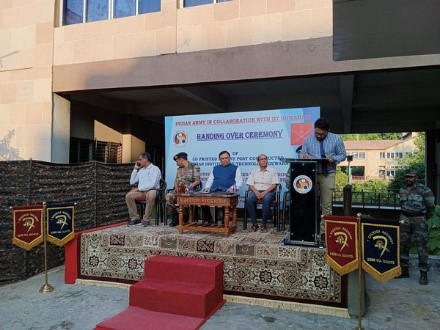
The structure was handed over by Sitharam to Brigadier Deepak Gaur of Red Horns Division, Indian Army, on the IIT Guwahati campus on Thursday. “The developed technology is beneficial for the Army as modular construction is easy to move over the places whenever and wherever needed, as often required by the Indian Army in the forward areas,” he added.
The dimensions of the cube-like sentry post are 2.4 m (length), 2.4 m (width), and 2.4 m (height). The total printing time of all the modules was approximately 42 hours.
The 3D-printed structure, which is the first of its kind in the region, was formally handed over to the Indian Army by IIT authorities on October 6 at a function held in the IIT Campus, thus underlining the Indian Army’s initiative in embracing new technologies for defence infrastructure development in collaboration with premier academic institutions of the country.
This prototype shows off the capacity of 3D printing technology for rapid construction, which can be utilised in border areas where traditional construction is challenging due to inclement weather conditions, terrain and altitude limitations,” said Brigadier Deepak Gaur. The research team is now investigating the thermal performance of the structure using different insulation materials and their first work has been published in the journal Materials Letters.

