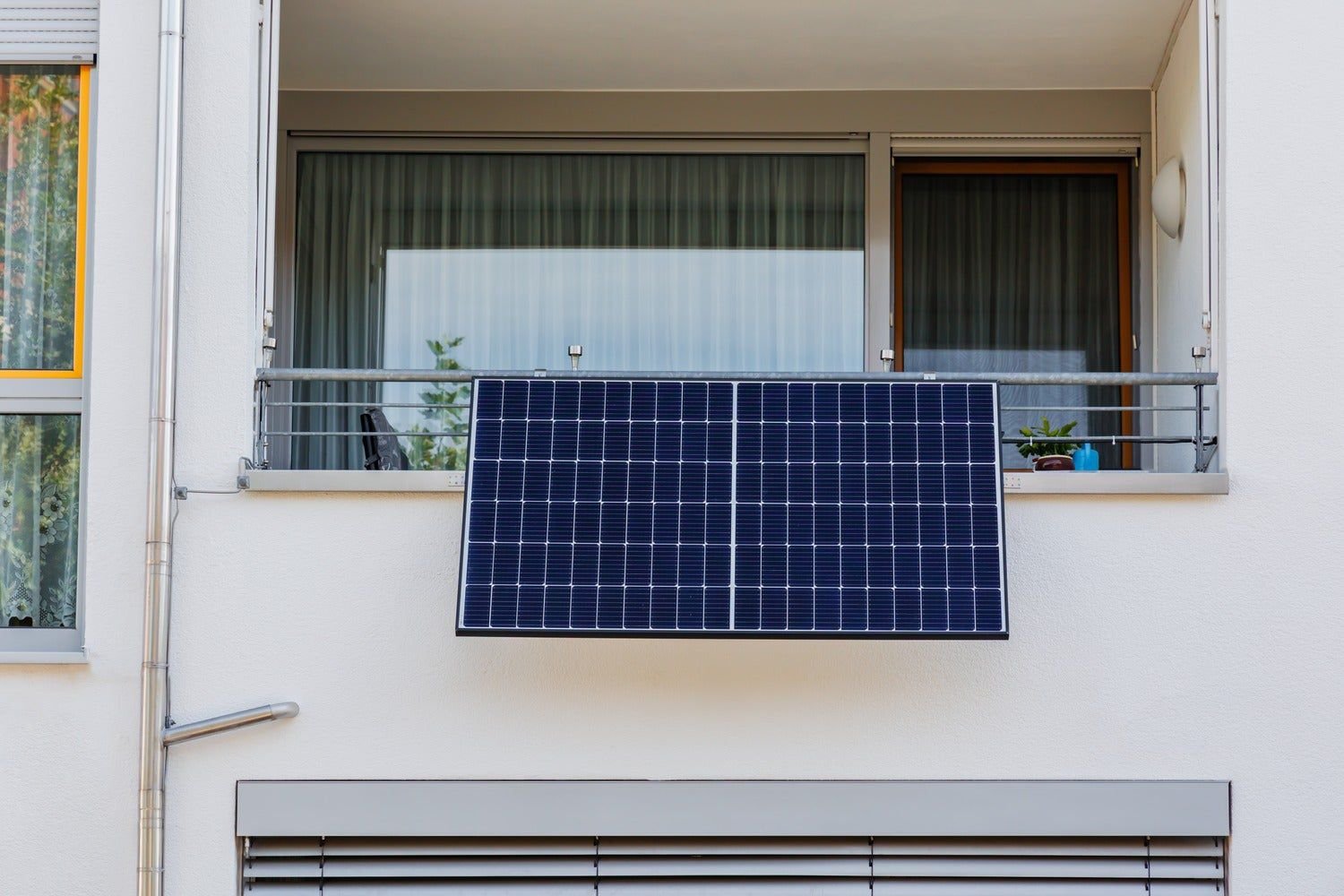
As states across the United States begin legalising compact “balcony solar” systems — plug-in panels that can be mounted on apartments’ balconies or patios and connected to standard electricity sockets — the shift is drawing attention worldwide. The change promises to democratise solar access for renters and low-income households. For India — with its burgeoning urban population and rising electricity costs — this model could offer valuable lessons.
Balcony Solar: A Quiet Revolution Gains Momentum
In 2025, Utah State Legislature became the first U.S. state to formally permit plug-in balcony solar for households, exempting small systems (up to 1.2 kW) from complex utility-interconnection regulations.
Following Utah’s lead, states including New York State Senate and Pennsylvania have introduced bills to legalise similar systems — with advocates in Vermont, Maryland and New Hampshire working toward the same goal.
Often called “plug-and-play” solar, these compact photovoltaic systems consist of small solar modules, a micro-inverter, cable and a standard plug — making installation quick and simple.
These systems already have millions of users in Europe. In Germany, for example, compact balcony power plants — known as “Balkonkraftwerk” — have been installed at scale, highlighting their potential for urban and rental housing.
Why Balcony Solar Is Attracting Attention
Affordable & Accessible Energy
Traditional rooftop solar installations often pose prohibitive upfront costs and are impractical for renters or people living in multi-storey apartments. Balcony solar removes these barriers. A typical system might cost the equivalent of about US $300 (in markets like Germany) and can pay for itself within 4–5 years.
Because the systems are portable and do not require professional installation in many cases, they appeal to tenants, small households and urban dwellers with no rooftop access.
Energy Independence for Renters and Urban Residents
For many Americans — especially in dense cities, apartments or rented homes — balcony solar offers a way to generate clean energy without modifying property structures. According to advocates, this could be a “game-changer for renters and low-income households who previously lacked access to solar.”
One advocate, representing Bright Saver, noted: “This isn’t a silver bullet,” but for a single occupant or small household, plug-in solar can power essentials like a fridge or a Wi-Fi router — and noticeably cut energy bills.
Technical Realities and Regulatory Hurdles
Balcony solar systems, though promising, are not a substitute for full-scale rooftop solar or grid-scale power plants. Typical setups generate between 200–800 watts of peak power, enough for basic appliances but insufficient for heavy loads like air-conditioning or electric-vehicle charging.
Moreover, safety and regulatory concerns remain. Many U.S. states have lacked standards for plug-in solar. For example, certification guidelines under authorities such as Underwriters Laboratories (UL) have only covered individual components — not complete plug-in solar kits.
In some regions, utilities and local codes require interconnection agreements and professional installation — previously making balcony solar impractical. The new legislation in Utah removes these barriers for small systems, but broader adoption will depend on clear standards and safety compliance nationwide.
What Balcony Solar Means — and What It Doesn’t
Balcony solar is not a one-size-fits-all solution. As one commentator observed, for a single person or small household, it can supply essential power — but for larger families or high-energy needs, it won’t replace the main power supply.
Nevertheless, its value lies in accessibility, sustainability and inclusivity — enabling urban renters and apartment dwellers to participate in the clean-energy transition. In aggregate, widespread adoption could reduce residential grid demand and contribute to emissions reduction.
For solar businesses and clean-energy strategists, balcony solar opens a new market segment: compact, plug-in kits tailored for urban apartments, rental housing and space-constrained dwellings.
What India Can Learn from the U.S. Trend
India is witnessing rapid urbanisation, increasing electricity demand in apartment complexes, and rising interest in renewable energy — particularly rooftop solar. However, many urban homes and tenants often lack rooftop access or face structural limitations.
The U.S. push for balcony solar illustrates a feasible path to expand solar adoption beyond traditional rooftop installations. By developing standards for plug-in solar kits — along with safety guidelines and regulatory clarity — Indian policymakers and solar developers could unlock a broad market among renters, small households and high-density urban apartments.
For developers and distributors (in line with your planned Renewable Energy vertical under Panacea People), balcony-solar kits represent a scalable product offering: affordable, easy to install, and capable of incremental clean-energy adoption.
Given India’s growing electricity costs, precarious power supply in many regions, and rising environmental awareness, balcony solar could emerge as a practical, democratic way to spread solar access — without requiring rooftop infrastructure or high upfront investment.
Conclusion
The regulatory shift in the U.S. allowing balcony solar marks a historic step in energy democratisation — bringing clean energy within reach of renters, apartment dwellers, and low-income households. Though not a substitute for comprehensive power solutions, plug-in solar offers a flexible, affordable supplement to grid electricity. For India’s rapidly urbanising cities, the concept holds strong promise. If regulators and market players adapt standards and policy frameworks, balcony solar might just become a silent but powerful tool in the country’s clean-energy transition.
By Gaurav Virendra Agrawal

