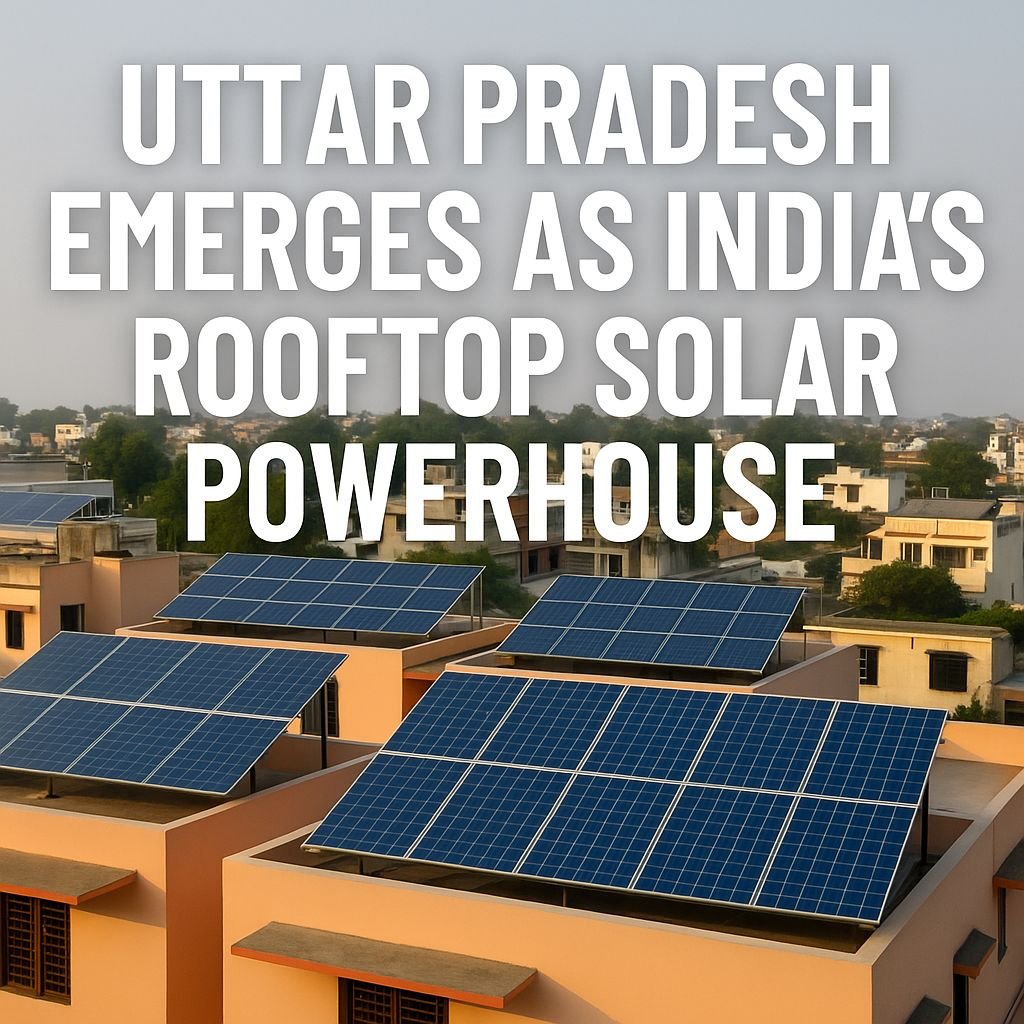
The transformation of India’s energy landscape is unfolding at remarkable speed, and Uttar Pradesh is firmly at its center. Once considered a laggard in renewable adoption, the state has now emerged as the frontrunner in rooftop solar installations under the government’s flagship PM Surya Ghar Muft Bijli Yojana, setting new records month after month.
In July 2025 alone, the state added nearly 27,771 new rooftop solar systems, averaging close to 900 installations every single day. August further strengthened the momentum with 28,029 more systems. By the end of that month, Uttar Pradesh had reached an impressive cumulative figure of over 208,000 rooftop systems. These numbers are not just statistics—they signal a new era of energy independence and a pathway to a greener, more resilient future.
From just 389 megawatts of rooftop capacity in 2017, Uttar Pradesh has now crossed 5,100 megawatts, making it one of the fastest-growing states in distributed solar adoption. Nearly 1.9 lakh households are today producing clean energy from their rooftops, contributing about 700 MW of capacity.
The surge in adoption has been supported by a mix of policy waivers, subsidies, and regulatory support. The Uttar Pradesh Electricity Regulatory Commission (UPERC) has recently approved multiple waivers for rooftop consumers, including relaxation of certain technical and financial barriers. UPNEDA, the state nodal agency, has been directed to streamline processes and coordinate with distribution companies to prepare a clear Standard Operating Protocol.
Central government schemes, particularly PM Surya Ghar, have been game changers. Subsidies and financing support have encouraged middle-class households to consider rooftop systems as both an energy solution and a financial asset. In many parts of UP, families are reporting monthly savings of ₹2,000 to ₹4,000 on electricity bills, while also ensuring stability against rising tariffs.
Yet, the story is not without challenges. Consumers across several districts have voiced concerns about unexpectedly high electricity bills despite solar adoption. Investigations reveal that delays in net-metering, errors in meter configuration, and occasional faulty equipment are undermining confidence. Subsidy disbursement delays and reports of substandard panels from some vendors have also clouded the experience.
Distribution companies, meanwhile, have raised alarms over the long-term financial impact of mass rooftop adoption. With more consumers producing their own power, the revenue models of discoms are under pressure. This tension between rapid rooftop growth and the financial sustainability of utilities will be a defining issue for the next phase of the solar journey.
For India, and particularly for UP, the stakes are high. Rooftop solar not only reduces dependence on coal-based generation but also cuts carbon emissions, stabilizes the grid, and supports the country’s net-zero commitments by 2070. It also fuels job creation—installation teams, O&M providers, and equipment manufacturers are finding new opportunities in the clean energy economy.
Experts argue that the focus now must be on quality assurance, stronger consumer protection, and digital monitoring. Introducing smarter net-metering systems, timely subsidy releases, and vendor accountability mechanisms could safeguard the trust of citizens who are investing their savings into solar energy.
As Uttar Pradesh surges ahead, the broader message for India is clear: the rooftop solar revolution has begun, but its success depends on how quickly we address the hurdles. If the momentum is sustained, the state could soon become the template for other regions aiming to balance growth, affordability, and sustainability in the energy transition.
-Author: Arvind Kumar, Co-founder, Oasis Solar Projects
Contact: 7376794037

