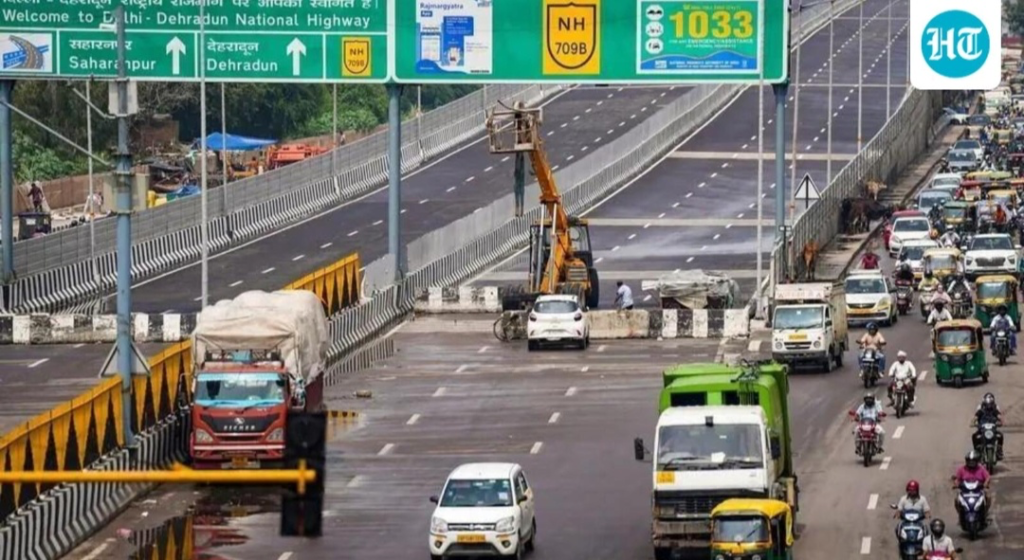
The National Highways Authority of India (NHAI) has tightened plantation and landscaping requirements for national highway projects, making environmental compliance a more important part of highway construction and maintenance. Under the revised guidelines issued on September 9, contractors and concessionaires will have to meet specified plantation and sapling survival targets before receiving provisional completion certification and certain maintenance-related payments.
The new rules require plantation to be completed on at least 80% of the available Right of Way (ROW) earmarked for plantation. In addition, the saplings planted along the highway must have a minimum survival rate of 90% at the time of inspection. The move is intended to ensure that plantation obligations, which are already part of highway contracts, are actually implemented and maintained rather than being treated as a secondary component of infrastructure development.
80% Plantation Now Linked to Highway Completion
Under the revised NHAI guidelines, plantation along the median and avenues of national highways will be considered compliant for the purpose of issuing the Provisional Certificate of Completion (PCC) or Provisional Commercial Operation Date (PCOD) only when plantation has been carried out on at least 80% of the available ROW earmarked for the purpose. The planted saplings must also demonstrate a minimum 90% survival rate during inspection.
The requirement is significant because the completion of a highway project is no longer being viewed only from the perspective of road construction, engineering quality and traffic readiness. Plantation and landscaping are being incorporated more firmly into the overall project completion framework. NHAI has stated that the plantation work must follow the relevant contract or concession agreement, the Green Highways Policy, 2015, IRC specifications and applicable guidelines issued by the Ministry of Road Transport and Highways and NHAI.
If a project falls short of the 80% plantation requirement, the shortfall will have to be clearly recorded along with a specific timeline for completing the remaining plantation work. Financial withholdings provided for under the applicable contract or concession agreement can continue until the outstanding plantation is completed and the prescribed target is achieved.
90% Sapling Survival Rate Becomes a Key Compliance Measure
The revised framework places emphasis not only on planting trees but also on ensuring that those trees survive. A minimum survival rate of 90% is required at the time of inspection for plantation to meet the requirements linked to provisional completion certification.
This distinction is important because plantation targets can lose their environmental value if large numbers of saplings die soon after being planted. By introducing a survival benchmark, NHAI is effectively making contractors and concessionaires more responsible for the condition of plantation along highway corridors.
The guidelines also require timely replacement of plants that die during the maintenance period. Replacement saplings must have a similar age and growth level so that the density, continuity and overall appearance of plantation along the highway corridor can be maintained.
NHAI has also indicated that its environment and plantation experts will provide technical assistance for field-level verification before maintenance or annuity payments are processed and before maintenance compliance is certified. This is expected to strengthen monitoring and make the assessment of plantation performance more structured.
Highway Payments to Depend on Plantation Maintenance
One of the most important aspects of the new NHAI guidelines is the link between plantation maintenance and project payments.
For projects being developed under Engineering, Procurement and Construction (EPC), Hybrid Annuity Mode (HAM) and Build-Operate-Transfer (BOT) Annuity models, the release of O&M or annuity payments will be linked to maintaining the required 90% sapling survival rate throughout the Operations and Maintenance period. For BOT-Toll projects, plantation maintenance compliance will also be considered while assessing performance.
This approach creates a direct financial incentive for contractors and concessionaires to maintain plantation after the initial planting activity. Instead of treating tree plantation as a one-time activity before project completion, the revised system brings it into the long-term maintenance responsibilities associated with highway projects.
The financial implications could be important for companies involved in national highway construction and operation. Contractors will need to plan plantation work carefully, select appropriate species and ensure adequate maintenance so that survival levels remain above the prescribed threshold throughout the relevant period.
A Stronger Focus on Green Highways
The latest decision reflects a broader effort to integrate environmental sustainability into India’s expanding highway infrastructure. National highways often pass through large stretches of land where plantation can help improve the visual environment around road corridors while contributing to long-term green cover.
NHAI has previously identified plantation along highway medians and avenues as a contractual obligation, but the authority observed that this aspect was not always given adequate importance when projects were recommended for completion certification. The revised guidelines are designed to address this implementation gap by making plantation coverage and survival measurable compliance requirements.
The policy also comes at a time when the survival of newly planted trees is receiving greater attention. A recent National Green Tribunal proceeding highlighted concerns over poor survival rates in compensatory afforestation initiatives, underlining the difference between merely planting trees and ensuring that they survive over the long term.
For highway developers, the new NHAI requirements could therefore lead to greater attention to site preparation, irrigation, plant selection, maintenance schedules and regular field inspections. For government authorities, the framework provides a clearer mechanism to assess whether environmental commitments made during highway development are being fulfilled.
What the New NHAI Rules Mean for Highway Projects
The revised guidelines could change the way plantation activities are planned from the early stages of highway construction. Contractors will need to consider the available plantation area, appropriate planting schedules and maintenance requirements while executing the main infrastructure work.
The 80% plantation threshold establishes a clear minimum requirement before provisional completion certification, while the 90% survival requirement adds another layer of accountability. The requirement to replace dead plants with saplings of comparable age and growth also means that maintenance teams will have to continuously monitor plantation conditions rather than waiting for periodic inspections.
For companies operating under EPC, HAM and BOT models, the connection between plantation performance and O&M or annuity payments makes environmental compliance directly relevant to project finances. Any failure to meet the prescribed standards can potentially affect payment processing where the applicable contract provides for such financial consequences.
Overall, NHAI’s revised plantation guidelines represent a shift towards treating greenery as an integral part of highway infrastructure rather than simply an additional landscaping activity. By linking plantation coverage, sapling survival, completion certification and maintenance payments, the authority is seeking to create greater accountability among contractors and concessionaires.
The immediate benchmark is clear: at least 80% of the available plantation-designated ROW must be covered, while planted saplings must achieve a minimum 90% survival rate at the relevant inspection stage. During the O&M period, maintaining that 90% survival standard will remain important for applicable project payment and maintenance assessments.
The move is likely to put greater focus on the environmental performance of India’s national highway projects and could encourage a more sustained approach to plantation, maintenance and green corridor development. As highway construction continues across the country, the success of these guidelines will ultimately depend not only on how many saplings are planted but on how effectively they are maintained and allowed to grow into a lasting green cover.
