A New Chapter in Indian Aviation Connects Smaller Cities to the World
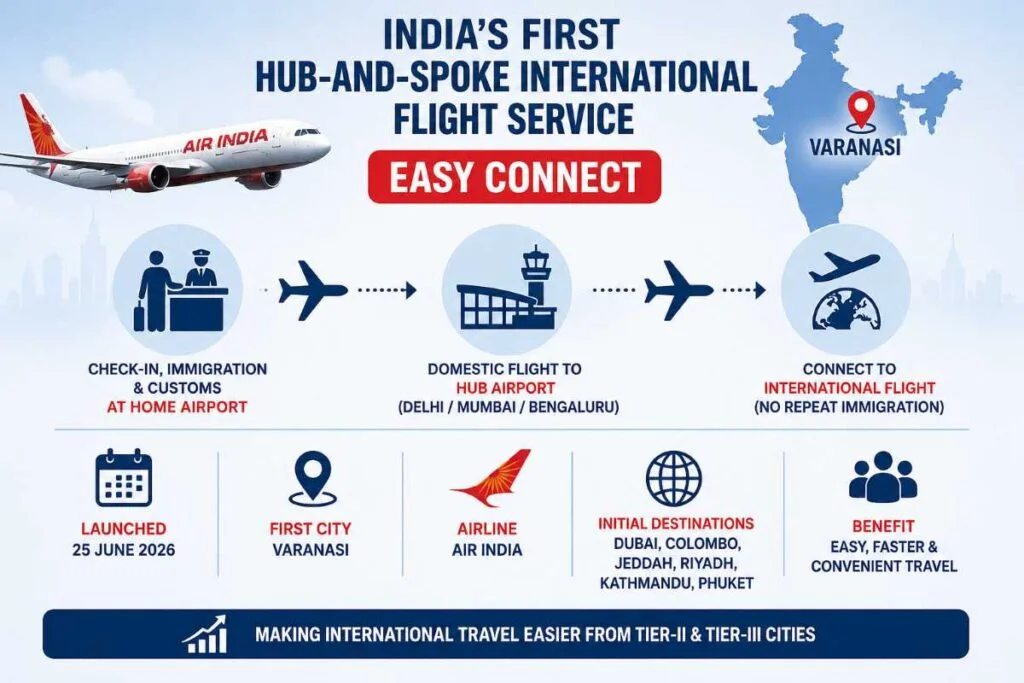
India has taken a significant step toward transforming international air travel with the launch of its first hub-and-spoke international connectivity model from Varanasi, allowing passengers from Tier-2 and Tier-3 cities to access global destinations more seamlessly. The initiative, introduced by the Government of India in partnership with Air India, aims to strengthen regional connectivity, reduce travel barriers, and position India as a global aviation hub by 2047.
The launch marks a major shift from the traditional metro-centric aviation model. Instead of requiring travelers from smaller cities to independently book multiple flights and manage lengthy layovers, the new system integrates domestic and international connections through designated hub airports, making overseas travel faster, smoother, and more accessible.
What Is the Hub-and-Spoke Model?
The hub-and-spoke model is widely used by leading global airlines to maximize connectivity. Under this system, passengers travel from regional airports—the “spokes”—to a major international hub, where they connect seamlessly to long-haul international flights.
For India, Varanasi becomes the first city to benefit from this new framework. Travelers from nearby Tier-2 and Tier-3 cities can now connect more efficiently to Air India’s international network without relying solely on metro airports like Delhi or Mumbai. The government also plans to simplify customs and immigration processes at the hub, creating a more convenient passenger experience.
Expanding Opportunities Beyond Metro Cities
Civil Aviation Minister K. Ram Mohan Naidu announced that Varanasi is only the beginning. Six additional cities are expected to be added to the hub-and-spoke network over the coming weeks, extending international accessibility to more regions across India.
The initiative is expected to benefit:
- Business travelers
- Students studying abroad
- Religious and cultural tourists
- Exporters and entrepreneurs
- Medical travelers
- Families living in smaller cities
Improved connectivity can significantly reduce overall travel time while encouraging greater participation in international trade, tourism, and education.
Strengthening India’s Aviation Vision
The launch aligns closely with India’s long-term aviation strategy, which aims to transform the country into a global aviation hub by 2047.
With rising passenger demand, rapid airport expansion, and investments in airline modernization, India has become one of the world’s fastest-growing aviation markets. Initiatives such as UDAN, new airport development, fleet expansion, and improved international connectivity are steadily reshaping the country’s aviation landscape.
Industry experts believe the hub-and-spoke model will improve aircraft utilization, increase passenger volumes, and strengthen India’s competitiveness against major global aviation hubs in the Middle East and Southeast Asia.
Why Varanasi Matters
Choosing Varanasi as the launch city carries strategic significance.
One of India’s oldest and most visited cities, Varanasi attracts millions of domestic and international visitors annually. Improved international connectivity is expected to strengthen religious tourism, cultural exchange, and regional economic development while making overseas travel easier for residents across eastern Uttar Pradesh and neighboring states.
The initiative also reflects the government’s broader objective of distributing economic opportunities beyond major metropolitan centers.
A Win for Regional India
For travelers from smaller cities, international journeys have traditionally involved long road trips, overnight stays, or multiple domestic connections before even reaching an international airport.
The new system simplifies that experience considerably.
By integrating domestic and international operations under a coordinated network, Air India and the Ministry of Civil Aviation are helping bring global connectivity closer to millions of Indians who previously depended on metro airports.
Conclusion
India’s first hub-and-spoke international flight from Varanasi represents more than an aviation milestone—it signals a broader transformation in how the country approaches regional connectivity. By linking Tier-2 and Tier-3 cities with global destinations through an integrated network, the initiative promises greater convenience, stronger economic opportunities, and wider access to international travel.
As additional cities join the network, the model could redefine India’s aviation ecosystem while supporting tourism, business, education, and trade across the country.
For more updates on business, startups, technology, infrastructure, sustainability, and global developments, visit NewsNowNation at https://newsnownation.com/.
Air India, hub-and-spoke model, Varanasi international flights, India aviation, Tier-2 cities, Tier-3 cities, Civil Aviation Ministry, K Ram Mohan Naidu, international connectivity, Air India international, Indian aviation, regional connectivity, global travel, aviation news India, NewsNowNation

