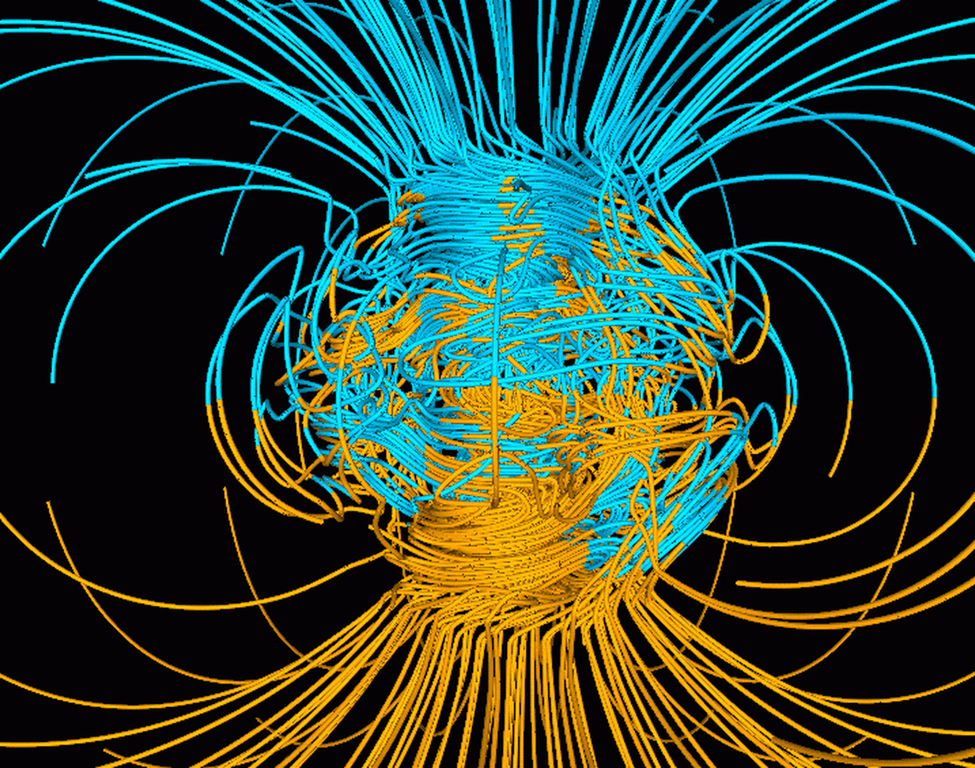
Earth’s magnetic field plays a critical role in protecting the planet from harmful solar radiation and charged particles from space. Scientists have long known that this protective magnetic shield is not permanent and occasionally reverses direction, causing the magnetic north and south poles to swap places. A new scientific study now suggests that these magnetic field reversals can take far longer than previously believed — potentially lasting as long as 70,000 years.
The findings provide new insight into the complex processes taking place deep within Earth’s core and help scientists better understand the planet’s geological and environmental history.
Understanding Earth’s Magnetic Field
Earth’s magnetic field is generated by the movement of molten iron and nickel within the planet’s outer core, located thousands of kilometres beneath the surface. These movements create electric currents that generate a powerful magnetic field surrounding the planet.
This magnetic shield, often referred to as the magnetosphere, protects Earth by deflecting harmful solar radiation and high-energy particles from space. Without it, life on Earth would be far more vulnerable to cosmic radiation and atmospheric erosion.
However, the magnetic field is not static. Over millions of years, the field has repeatedly reversed its polarity, meaning the magnetic north and south poles switch positions.
What Is a Geomagnetic Reversal?
A geomagnetic reversal occurs when the planet’s magnetic field weakens and eventually flips direction. During this process, the magnetic north pole becomes the south pole and vice versa.
Geological evidence shows that Earth’s magnetic poles have reversed many times in the past. Scientists estimate that more than 180 magnetic reversals have occurred during the past 83 million years.
These reversals are recorded in rocks and sediments, where magnetic minerals align with the Earth’s magnetic field at the time they were formed. By studying these geological records, researchers can reconstruct the history of Earth’s magnetic field over millions of years.
The most recent full reversal occurred around 780,000 years ago.
New Research Suggests Longer Reversal Periods
For many years, scientists believed that geomagnetic reversals typically took around 10,000 years to complete. However, new research suggests that some reversals may have lasted far longer.
Scientists from research institutions in the United States, France and Japan analyzed deep-sea sediment cores to study ancient magnetic field changes. Their analysis revealed that one reversal around 40 million years ago may have taken approximately 70,000 years to complete.
The study also identified another reversal that lasted roughly 18,000 years, showing that the duration of these events can vary significantly.
These findings challenge earlier assumptions about how quickly Earth’s magnetic field can change and suggest that some reversals may unfold much more gradually than previously believed.
Evidence Hidden in Ocean Sediments
The key evidence for this discovery came from sediment cores collected from the North Atlantic Ocean. These sediments contain microscopic magnetic minerals that preserve the direction of Earth’s magnetic field at the time they formed.
As layers of sediment accumulate over millions of years, they create a continuous record of magnetic field changes.
By analysing the orientation of magnetic particles within these sediment layers, scientists were able to track the gradual shift in magnetic polarity during ancient geomagnetic reversals.
This method provides one of the most reliable ways to study Earth’s magnetic history.
What Happens During a Magnetic Field Flip?
When a geomagnetic reversal occurs, the magnetic field does not suddenly flip overnight. Instead, the field gradually weakens and becomes unstable before reorganising in the opposite direction.
During this period, the strength of Earth’s magnetic shield can decrease significantly. Some researchers estimate that the field may weaken by as much as 90% before the reversal is complete.
A weaker magnetic field could allow more cosmic radiation to reach Earth’s atmosphere, potentially affecting atmospheric chemistry and increasing radiation exposure at the surface.
However, scientists emphasise that magnetic reversals are natural events that have occurred many times throughout Earth’s history without causing mass extinctions.
How Often Do Magnetic Reversals Occur?
Geomagnetic reversals do not follow a strict schedule. On average, they occur every few hundred thousand years, but the interval between reversals can vary widely.
Some periods in Earth’s history experienced frequent reversals, while others went millions of years without any change in polarity.
The last known reversal occurred around 780,000 years ago, meaning Earth’s magnetic field has remained stable for a relatively long period compared with some past cycles.
Despite this, scientists do not believe that a new reversal is imminent.
Why the Study Matters
Understanding how geomagnetic reversals occur helps scientists learn more about the dynamics of Earth’s core and the processes that generate the planet’s magnetic field.
These discoveries also help researchers assess how changes in the magnetic field might affect Earth’s atmosphere, climate and technological systems.
For example, a significantly weakened magnetic field could influence satellite operations, navigation systems and communication networks that depend on stable magnetic conditions.
By studying ancient reversals preserved in geological records, scientists can better predict how Earth’s magnetic field might behave in the future.
Looking Ahead
Although the possibility of a future magnetic reversal continues to interest scientists, experts emphasize that such events unfold over thousands of years, making them extremely gradual on human timescales.
The new findings showing that reversals can last up to 70,000 years provide an even clearer understanding of the slow and complex nature of Earth’s magnetic field changes.
Continued research into geomagnetism will help scientists uncover more details about our planet’s internal dynamics and the protective magnetic shield that makes life on Earth possible.
Follow for more updates regarding business related news in newsnownation.com.
