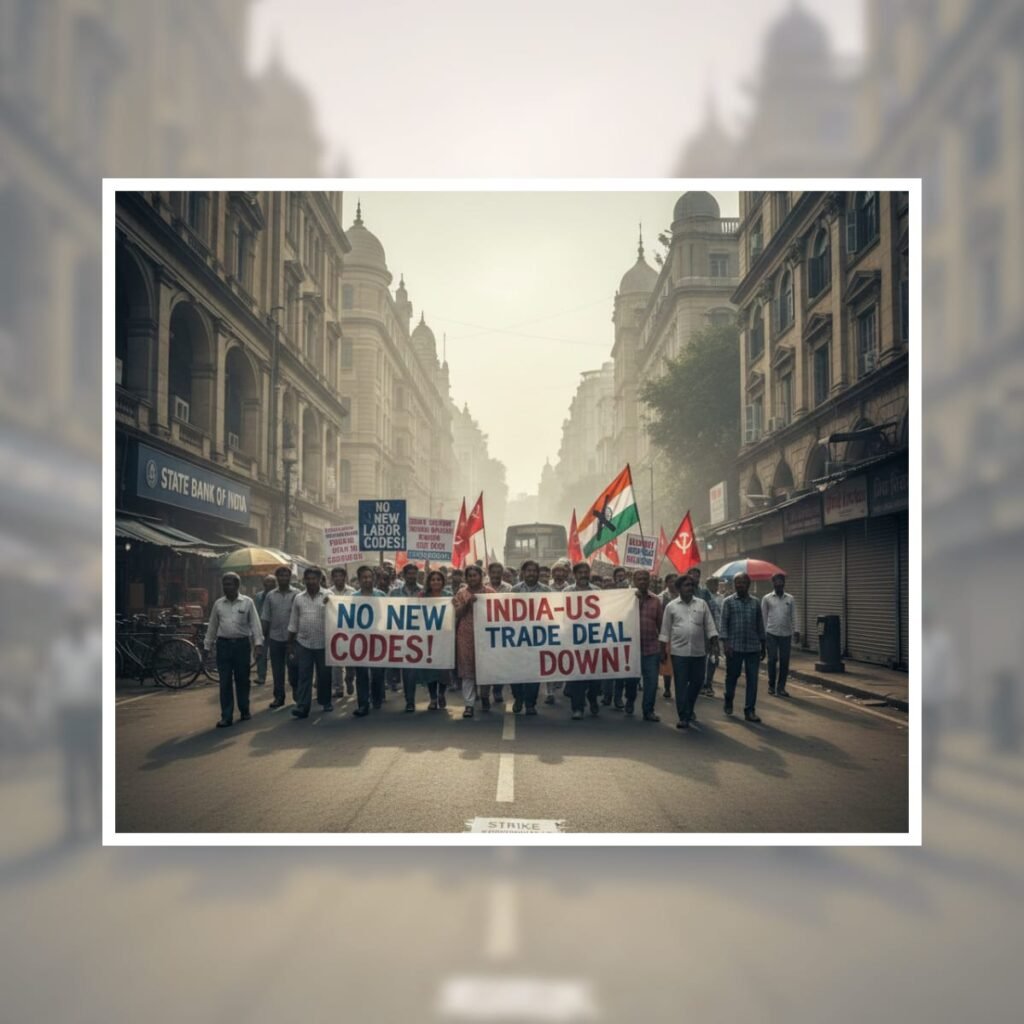
A nationwide strike sweeps across India, disrupting services, impacting banks, and sending a powerful message. Here’s why it’s happening and what you need to know.
Today, India witnessed a significant display of public sentiment as a massive nationwide general strike, or “Bharat Bandh,” took hold. Spearheaded by a coalition of 10 central trade unions and numerous farmers’ organizations, the strike has brought parts of the country to a standstill, impacting everything from banking services to public transport.
At the heart of this widespread protest are two main grievances:
New Labor Codes: Unions are vehemently opposing the four new Labor Codes introduced by the government, arguing that they undermine workers’ rights and weaken trade union power.
India-US Trade Deal: Farmers’ groups, in particular, are expressing deep concerns over the recently announced India-US trade agreement. They fear that the deal, which involves tariff reductions on goods, could negatively impact domestic agriculture and leave local farmers vulnerable to foreign competition.
The effects of the Bharat Bandh are being felt far and wide:
Banking Services: Major bank unions, including AIBEA, AIBOA, and BEFI, are active participants.
While banks are technically open, leading institutions like SBI and Bank of Baroda have issued warnings about potential service disruptions due to staff absenteeism. If you had banking errands today, you might have faced delays.
- Public Transport: Several regions are experiencing significant disruptions in public transport. Commuters in many cities have reported difficulties, though essential services like ambulances and emergency transport remain operational.
- Government Offices: Operations in various government offices are expected to be affected, with many employees joining the strike.
- Essential Services: Crucially, essential services such as hospitals, airports, and ATMs are largely functional, ensuring critical operations continue without major hitches.
This Bharat Bandh is more than just a disruption; it’s a powerful statement from a broad cross-section of Indian society. It underscores the deep-seated concerns regarding economic policies and international trade agreements, and how they are perceived to affect the livelihoods of millions. The sheer scale of participation highlights the collective desire for these voices to be heard by policymakers.
As the day progresses, the focus will shift to assessing the full economic impact of the strike and, more importantly, the government’s response to these significant public demands. The ongoing dialogue between unions, farmers, and the government will be crucial in determining the path forward.
Stay tuned to newsnownation.com for the latest updates on this evolving story and its long-term implications for India.
