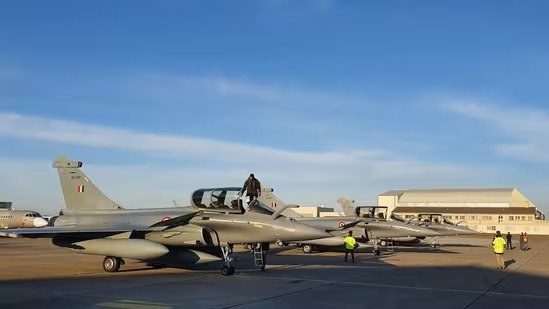
In a significant boost to its defence capabilities, the Indian government has approved a landmark defence procurement package worth approximately ₹3.60 lakh crore, with the purchase of 114 Rafale fighter jets from France as its centrepiece component, officials confirmed on Thursday. The Defence Acquisition Council (DAC), chaired by Defence Minister Rajnath Singh, accorded the key approvals that will strengthen the Indian Air Force (IAF) and modernise the armed forces across multiple operational domains.
The multi-billion-dollar decision follows long-pending deliberations and comes at a time when the IAF is operating with a reduced squadron strength, having retired older platforms such as the MiG-21 and facing the gradual phasing out of other legacy fighters. Under the approved plan, India will acquire 18 Rafale jets in fly-away condition from French aerospace major Dassault Aviation, while the remaining 96 aircraft are slated to be manufactured in India under strategic collaboration and technology transfer arrangements. This approach is expected to support the government’s broader Make in India objectives while enhancing domestic defence manufacturing.
Officials have highlighted that the deployment of additional Rafale jets is aimed at bolstering aerial combat and deterrence capabilities, equipping the Air Force with advanced multi-role platforms capable of air superiority, deep-strike missions and high-precision engagements. The new jets will complement existing squadrons already operating the Rafale, further enhancing India’s readiness amid evolving regional security dynamics.
In addition to the fighter jets, the DAC has cleared proposals for other critical defence assets, including advanced combat missiles and high-altitude surveillance systems, reinforcing the intent to modernise and integrate capabilities across the armed services. The package also includes acquisitions designed to improve the Indian Navy’s long-range reconnaissance and anti-submarine warfare capabilities, as well as upgrades for the Army’s armoured and artillery platforms.
The approvals granted by the DAC will now move to the Cabinet Committee on Security for final sanction, which is expected to firm up negotiations and formal contracts with international defence partners. The timing of this clearance, notably just ahead of French President Emmanuel Macron’s official visit to New Delhi, underscores the strategic significance of India-France defence cooperation.
This decision marks one of the largest defence procurement moves in recent Indian history and is likely to shape the country’s security landscape in the decades ahead, positioning the armed forces with cutting-edge capabilities as threats evolve along multiple fronts.
