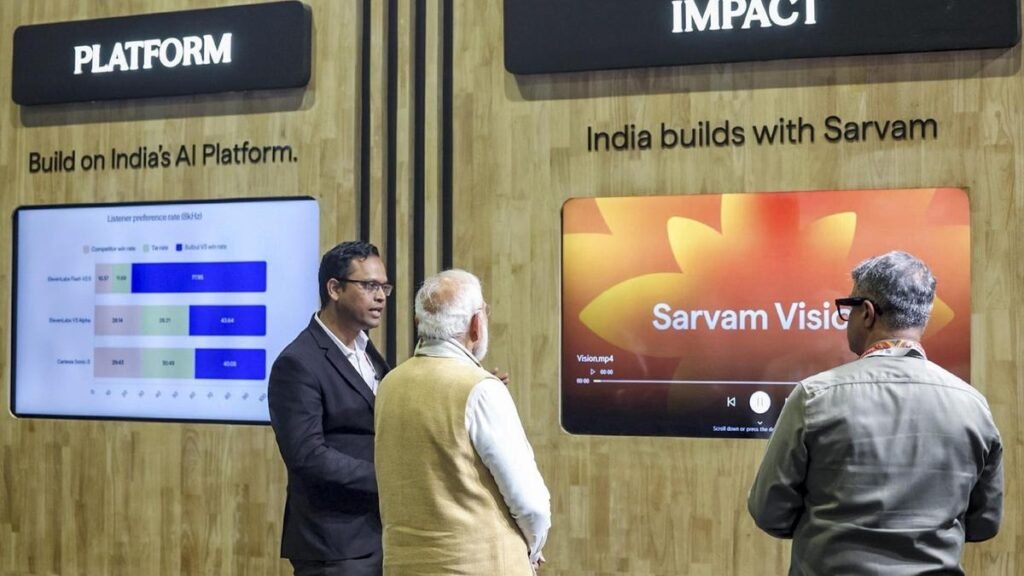
For years, the global AI landscape has been dominated by Western giants like OpenAI and Google . However, 2026 marks a historic pivot as Indian firms transition from being mere “consumers” of AI to “creators” of foundational models. At the recent AI Impact Summit 2026 in New Delhi, the spotlight shifted to indigenous Large Language Models (LLMs) that are not just trained in India, but are designed for India’s unique linguistic and cultural tapestry.
The biggest announcement came from Bengaluru-based Sarvam AI, which unveiled two landmark models: a 30-billion parameter model and a massive 105-billion parameter foundational model. Unlike general models that struggle with regional nuances, these were trained from scratch using domestic compute infrastructure under the IndiaAI Mission.
- Sarvam-30B: Optimised for long conversations and agentic workflows, supporting all 22 scheduled Indian languages.
- Sarvam-105B: Uses a “Mixture of Experts” (MoE) architecture, which significantly reduces inference costs while outperforming global benchmarks like Google Gemini Flash on specific Indian datasets.
How are Indian Firms Training these Models?
Training an LLM is a compute-intensive process that requires millions of dollars in GPU power. Indian firms are adopting several innovative strategies to overcome traditional hurdles:
- Sovereign Compute & Subsidies: Under the IndiaAI Mission, the government has commissioned over 38,000 GPUs, providing them to startups at subsidized rates (as low as ₹65/hour). Sarvam AI, for instance, utilized 4,096 GPUs with a government subsidy estimated at nearly ₹100 crore.
- The “Indic Data” Goldmine: The biggest challenge for Indian AI is the scarcity of high-quality digital text in regional languages. Firms are now using NVIDIA’s NeMo Curator and domestic datasets like AIKosh (which offers 7,500+ datasets) to fine-tune models for Hindi, Tamil, Telugu, and even dialects like Maithili.
- Efficiency over Scale: Instead of just chasing “bigger” models, Indian firms like Tech Mahindra and Gnani.AI are focusing on Small Language Models (SLMs) and specialized models for sectors like BFSI and healthcare.
Key Players in the Sovereign AI Push
Apart from Sarvam, other indigenous initiatives are making waves:
- BharatGen: India’s first government-funded multimodal LLM initiative (IIT Bombay-led) aimed at public services and defense.
- Gnani.AI: Launched Vachana, an enterprise-grade Indic speech-to-text model trained on over one million hours of real-world voice data.
- Reliance Industries: Mukesh Ambani announced a plan to invest ₹10 trillion to build scalable AI infrastructure across India.
While the momentum is high, challenges remain. Global giants possess vastly larger research budgets, and the shortage of specialized AI talent is a hurdle. However, India’s approach—prioritizing “developmental outcomes” over “existential risks”—positions the nation as a leader for the Global South.
India’s AI journey is no longer about catching up; it’s about setting a new standard for inclusive, multilingual, and affordable intelligence. By building “Sovereign AI,” Indian firms are ensuring that the digital future of 1.4 billion people is governed and powered by local innovation.
Stay tuned to NewsNowNation.com for exclusive deep-dives into India’s tech evolution.
