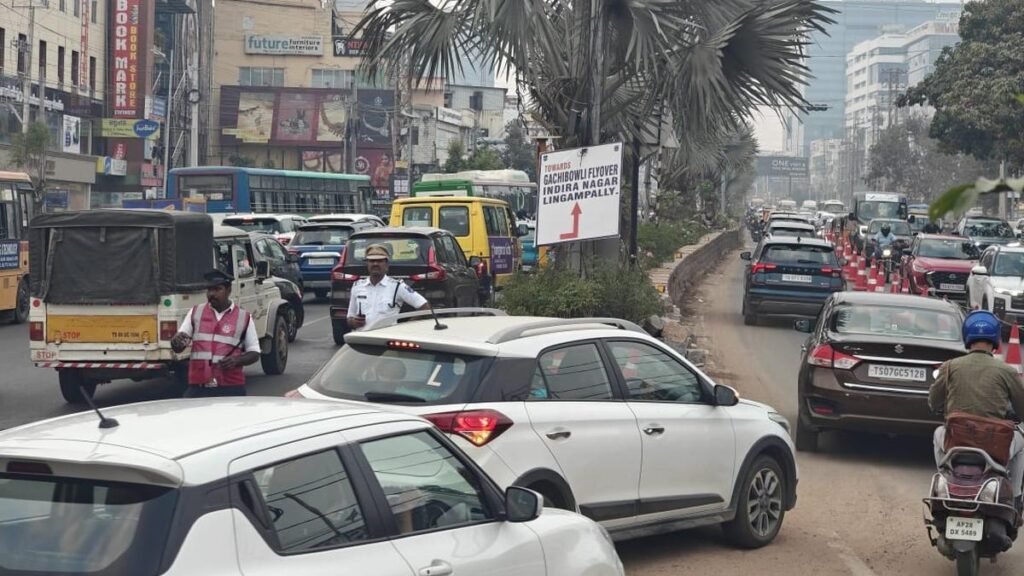
The persistent traffic woes of Hyderabad’s Cyberabad IT corridor are finally being addressed with a massive infrastructure push. The Greater Hyderabad Municipal Corporation (GHMC) has officially issued notices to property owners for the long-awaited road widening project on the crucial Gachibowli–Lingampally stretch. To facilitate immediate traffic movement, the central median near the Triple IT Junction has been opened, and service lanes have been pressed into use to minimize the impact of ongoing construction on daily commuters.
The Multi-Level Flyover Project
At the heart of this transformation is a ₹500 crore project aimed at turning the congested Triple IT Junction into a signal-free interchange. The plan involves the construction of three simultaneous flyovers:
Level 1: A bi-directional flyover connecting ISB Road to DLF Road.
Level 2: Semi-circular flyovers linking DLF Road to Gachibowli Stadium and ISB Road to Indira Nagar.
Underpass: An excavation across 21 meters of carriageway is planned to connect Indira Nagar and Gachibowli Stadium.
Road Widening and Land Acquisition
The success of these flyovers depends heavily on the alignment of the existing roads. GHMC officials have confirmed that property acquisition is underway to address bottlenecks, particularly on the DLF Road, which is currently misaligned and narrow. The widening of the old Mumbai Highway stretch between Mehdipatnam and Serilingampally is also being prioritized to ensure a smoother flow of traffic once the flyovers are operational.
Traffic Management During Construction
Acknowledging the potential for severe disruptions, the Cyberabad Traffic Police and GHMC have worked out a phased construction plan. Currently, pillars are being erected along the central median, requiring only a small margin of the carriageway to remain occupied for equipment. As work progresses to the core of the junction, traffic signals will temporarily disappear, and motorists will be required to take designated U-turns. To aid this, service roads and service lanes have already been activated to provide additional space for vehicles.
Impact on Future Urban Mobility
Once completed—with a target of May 2028—these flyovers will provide seamless access to the Kokapet Neopolis area and offer an alternative route to the Outer Ring Road (ORR). By eliminating signals at the Triple IT Junction, the project is expected to save thousands of man-hours daily for professionals working in the Financial District and surrounding IT hubs.
While the short-term inconvenience of construction is inevitable, the GHMC’s proactive measures—like opening the median and issuing timely widening notices—show a commitment to long-term urban efficiency. As Hyderabad continues to grow as a global technology hub, such infrastructure upgrades are essential to maintaining its competitive edge.
Stay tuned to NewsNowNation.com for real-time traffic advisories and project updates.
