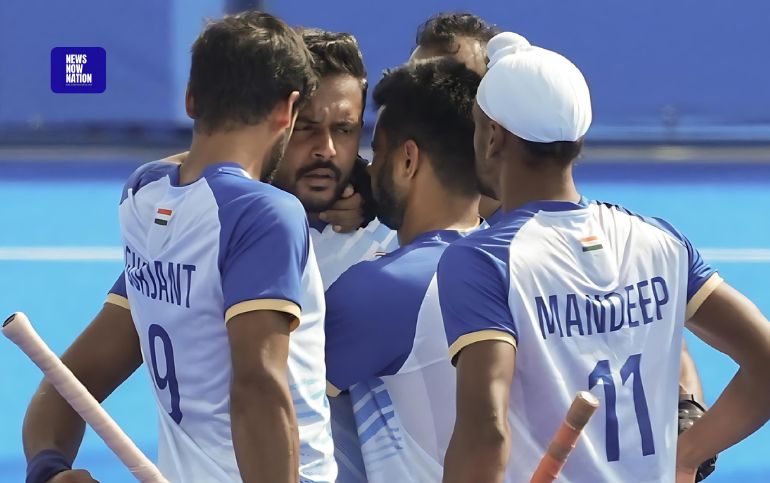
India’s hockey team has secured a place in the Olympic semifinals for the second consecutive time, clinching a dramatic victory against Great Britain in a penalty shoot-out. The match, played at the historic Stade Yves-du-Manoir in Paris, will be remembered for its intense action and high stakes, especially given that India was a man down for most of the game.
Stade Yves-du-Manoir holds a special place in Olympic history. Located about 10 km from Notre Dame, it was the site of some of the most memorable moments of the 1924 Paris Olympics, including the famous 100 and 400m races that were immortalized in the film “Chariots of Fire.” A hundred years later, the venue added another epic chapter to its legacy, with the Indian hockey team’s heroic performance.
On Sunday, India booked its spot in the semifinals in a fashion that will be talked about for years. They defeated Great Britain 4-2 in a penalty shoot-out after the match ended 1-1 in regulation time. The game was marred by a controversial red card given to Indian defender Amit Rohidas early in the second quarter. Rohidas was sent off for a high stick that struck British player Will Calnan on the head. The referee, after consulting the video umpire, deemed the action intentional, leading to Rohidas’ ejection from the game. Such incidents are extremely rare in hockey, making the Indian team’s subsequent performance even more remarkable.
Despite the disadvantage of playing with one fewer player for 43 minutes, the Indian team displayed extraordinary courage, tactical intelligence, and defensive mastery. Former captain Manpreet Singh, who is competing in his fourth Olympics, described the victory as the greatest he has enjoyed while playing for India. Coach Craig Fulton echoed this sentiment, calling it the toughest 60 minutes he has ever spent on a hockey field, given the high stakes.
The match began evenly, with both teams battling hard for possession. However, the dynamics changed dramatically after Rohidas’ red card. In the 17th minute, India’s situation seemed dire, but they quickly turned their setback into motivation. Five minutes after the red card, captain Harmanpreet Singh gave India the lead with a powerful drag-flick during a penalty corner. Great Britain managed to equalize two minutes before halftime, setting the stage for a nerve-wracking second half.
What followed was a defensive masterclass from the Indian team. They fought for every loose ball, maintaining their structure and composure despite relentless pressure from the British side, which launched 24 attacks, averaging one every two-and-a-half minutes. India’s defense, led by the experienced PR Sreejesh in goal, held firm. Even during a brief period in the fourth quarter when India was down to nine men, they managed to thwart every British attempt to score.
When the final hooter sounded after 60 minutes, the score was tied at 1-1. The Indian players celebrated the draw as if they had already won, knowing that the match would now be decided by a penalty shoot-out. This was familiar territory for Sreejesh, who had been involved in 22 shoot-outs, with India winning 12 of those. On this occasion, Sreejesh denied two British players, putting India in a commanding position. Olympics debutant Raj Kumar Pal then scored the decisive goal, sealing India’s victory and prompting joyous celebrations.
The victory was a significant highlight of India’s eighth day at the Olympics, which also saw shooter Manu Bhaker winning two bronze medals, including one in a team event with Sarabjot Singh. Swapnil Kusale added another bronze in the 50m rifle three-positions event. Despite setbacks in other sports, such as Lakshya Sen’s loss in badminton and Lovlina Borgohain’s exit in boxing, the hockey team’s success brought immense pride and joy to the nation.
Vice-captain Hardik Singh captured the sentiment perfectly, saying, “Today, we played for all those who believe that hockey is India’s own.” The team’s resilience and spirit were evident, and they received a standing ovation from the crowd as they left the field. Spectators from the Netherlands, Belgium, Britain, and India all applauded the team’s extraordinary effort.
As the players celebrated, coach Craig Fulton had a touching moment when he heard his daughter’s voice from behind a curtain separating the spectator area from the field. He rushed to the fence, saw her tiny feet on the other side, and bent to touch them, finding a brief moment of solitude amid the chaos.
This victory is a testament to the Indian hockey team’s determination and skill, and it adds a memorable chapter to the legacy of Stade Yves-du-Manoir. With the semifinal ahead, the team hopes to continue their winning streak and bring more glory to Indian hockey.
Stay tuned to NewsNowNation for updates and more news.
Follow us on social media for real-time news updates:

