When it comes to writing content, three factors play a crucial role: “perplexity,” “burstiness,” and “predictability.” Perplexity measures the complexity of text, while burstiness compares the variations of sentences. On the other hand, predictability gauges the likelihood of guessing the next sentence. Human writing tends to exhibit greater burstiness, with a mix of longer and complex sentences alongside shorter ones. In contrast, AI-generated sentences often lack this variation, appearing more uniform. Therefore, for the following content I’m about to present, it’s essential to maintain a good level of perplexity and burstiness while minimizing predictability. Additionally, please ensure that the content is written in English. Now, let’s rewrite the provided text:
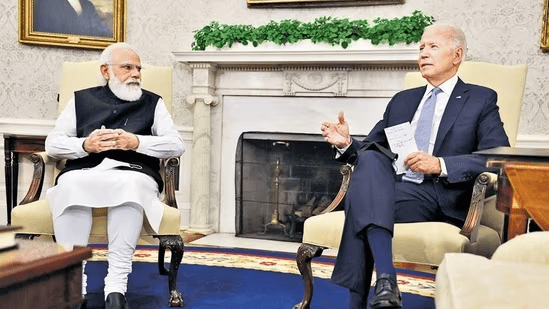
India and the United States will engage in discussions highlighting the significance of “openness and freedom,” values that have gained increased importance as the two nations establish a trusted partnership. The partnership between India and the US is evolving into a primary alliance, with areas of convergence even on issues that were once seen as divergent, such as Russia’s conflict in Ukraine. The strategic and policy alignment between the two countries extends across the Indo-Pacific and West Asia. During Prime Minister Narendra Modi’s state visit, there will be a focus on reinforcing President Joe Biden’s vision of India and the US becoming among the closest nations globally, yielding tangible and substantive outcomes, according to sources familiar with the discussions.
Providing a glimpse into the forthcoming joint statement, those quoted above suggested that not only will there be a significant breakthrough in the GE F414 jet engine deal, but also a range of other matters. These include collaboration in telecom, semiconductors, mobility, civil-nuclear cooperation, trade, space, higher education, artificial intelligence, quantum technologies, and counter-narcotics. Both systems share a common understanding that the critical and emerging technologies initiative (ICET) and the leadership of national security advisers Ajit Doval and Jake Sullivan have facilitated a swift progress in this process.
Furthermore, the discussions will encompass the importance of “openness and freedom” as India and the US develop their partnership in critical sectors.
Among the expected deliverables is a collaborative effort to establish a semiconductor manufacturing ecosystem in India. This initiative involves Micron announcing a significant investment in a large assembly, testing, and packaging manufacturing facility in Gujarat. Additionally, at least two other American companies will unveil a major workforce training program, equipping thousands of Indian engineers with skills in this domain.
The joint statement is anticipated to address advancements in the telecom sector, where the US sees India as a crucial “counterpoint.” It is expected to announce the deployment of the open radio access network (ORAN) for 5G and, subsequently, 6G in select Indian cities. The US International Development Finance Corporation is likely to provide funding for the pilot deployment. Both nations recognize the need for a successful implementation of a disaggregated and interoperable telecom network as an alternative to Huawei’s dominance in the sector, serving as a model for other countries. In January, during the launch of ICET, India expressed its willingness to engage in a public-private dialogue covering 5G/6G and ORAN using trusted sources. The White House further emphasized that both sides will enhance cooperation in research and development for 5G and 6G, facilitating the deployment and adoption of Open RAN in India while promoting global economies of scale in the sector.
The joint statement will also address the topics of artificial intelligence (AI) and quantum technologies, with the US acknowledging the essential role of India’s presence in shaping any regulatory

