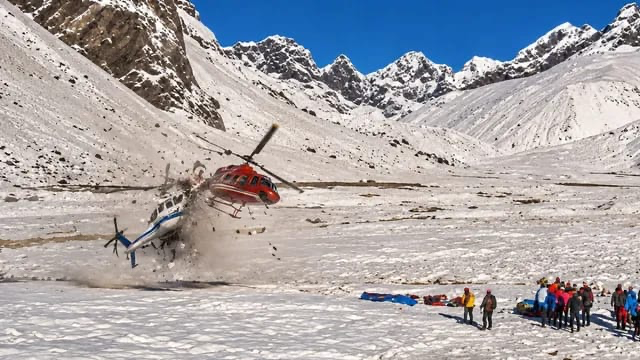
A tragic helicopter collision at Pheriche in Nepal’s Solukhumbu district has claimed the life of a 47-year-old Indian tourist and left three others injured, raising fresh concerns about aviation safety in the Himalayan region during the peak trekking season.
A tragic aviation accident near Mount Everest in Nepal has claimed the life of an Indian national after two helicopters collided while attempting to land at Pheriche on Tuesday morning, November 3, 2026. The incident also left three people injured, including a New Zealand resident of Indian origin and two Nepalese pilots. The accident took place along the popular Mount Everest Base Camp trekking route in the Solukhumbu district, an area where helicopters play an important role in transporting tourists, trekkers, rescue teams and essential supplies.
According to information released by Nepal Police, the collision occurred at approximately 8:11 AM local time at the helipad in Pheriche, Ward 4 of Khumbu Pasang Lhamu Rural Municipality. The two helicopters involved in the incident were operated by Fishtail Air and Air Dynasty, two aviation companies providing helicopter services in Nepal’s mountainous regions. Both aircraft were reportedly attempting to land at the same location when the collision occurred.
The deceased Indian national was identified as 47-year-old Vasanth Kumar Balaramaramadu, who was travelling aboard the Fishtail Air helicopter. He reportedly died at the accident site. Following the incident, his body was transported by helicopter to Lukla, where further official procedures were expected to take place.
The accident also injured Shailesh Krishna Patel, a 49-year-old New Zealand resident of Indian origin who was travelling in the Fishtail Air helicopter. He was rescued and airlifted to Mediciti Hospital in Kathmandu for medical treatment. The two pilots involved in the collision, Rabindra Prajapati of Fishtail Air and Prajal K.C. of Air Dynasty, also sustained injuries. They were evacuated for medical assistance following the accident.
Initial information indicates that the helicopters were operating in the Everest region when the incident occurred. Reports suggest that one aircraft was travelling from the Lukla side, while the other was operating in the Gorakshep-Pheriche sector. The aircraft were involved in landing operations at the same helipad, resulting in the collision. Authorities are examining the circumstances surrounding the incident to establish the exact sequence of events.
Pheriche is an important settlement along the route to Mount Everest Base Camp. Situated at an altitude of approximately 4,200 metres above sea level, the location is frequently used by trekkers, mountaineers and support teams travelling through the Everest region. Due to its geographical location and the absence of conventional road connectivity, helicopter services remain an essential part of transportation and emergency response operations in this part of Nepal.
Helicopters are commonly used in the Everest region for several purposes, including passenger transportation, medical evacuations, search-and-rescue operations and the movement of equipment and supplies. Trekkers experiencing altitude sickness, exhaustion or other medical emergencies often depend on helicopter services to reach medical facilities at lower elevations. These services are particularly important during the busy climbing and trekking seasons when thousands of visitors travel through the Himalayan region.
The accident has once again drawn attention to the operational challenges associated with helicopter flights in high-altitude environments. Landing at locations such as Pheriche requires careful coordination, accurate communication between pilots and ground personnel, and close attention to changing weather conditions. Limited landing space, difficult terrain and unpredictable atmospheric conditions can make helicopter operations particularly demanding.
The Everest region is known for rapidly changing weather patterns. Snowfall, strong winds, reduced visibility and variations in atmospheric conditions can affect aviation operations within a short period. At high altitudes, helicopters also operate under different performance conditions because the lower air density can influence engine performance, rotor efficiency and aircraft handling. These factors make proper flight planning and landing coordination especially important.
However, the exact cause of Tuesday’s collision has not yet been officially established. It would be premature to attribute the accident to weather, pilot error, technical failure or any other specific factor before the investigation is completed. Nepalese aviation authorities and local officials are expected to examine the circumstances surrounding the collision, including the flight movements, landing procedures and operational coordination between the two aircraft.
The incident comes during Nepal’s autumn trekking season, one of the busiest periods for tourism in the Himalayan country. The months following the monsoon season generally attract international travellers, adventure enthusiasts and mountaineers because of comparatively favourable trekking conditions. The Everest region, in particular, witnesses significant movement of tourists travelling towards Everest Base Camp and other popular destinations.
Helicopter operators experience considerable demand during this period. While many tourists use helicopter services to save travel time or experience aerial views of the Himalayas, the aircraft also provide essential support to trekking agencies, mountain guides and emergency response teams. Their role becomes even more significant in remote settlements where access to hospitals and other infrastructure is limited.
The collision also highlights the importance of maintaining strict aviation safety procedures at high-altitude helipads. Proper communication between aircraft, landing clearance, ground coordination and adherence to aviation regulations are essential for reducing operational risks. As helicopter traffic increases in popular tourist destinations, ensuring that flight operations remain properly coordinated becomes an important responsibility for operators and aviation authorities.
For Nepal, tourism is an important contributor to economic activity, employment and international recognition. The country’s mountains attract visitors from across the world, with Mount Everest remaining one of its most prominent international attractions. Aviation services support this tourism ecosystem by connecting remote destinations and providing access to areas that are otherwise difficult to reach.
At the same time, accidents involving tourist and rescue helicopters can have serious consequences for travellers, aviation companies and the wider tourism industry. Such incidents can also influence public confidence in mountain aviation services, making transparent investigations and effective safety measures particularly important.
The loss of an Indian tourist in the accident has also brought attention to the safety of international visitors travelling to Nepal’s mountain destinations. The injured individuals are receiving medical attention, while authorities continue to gather information about the incident. Further details regarding the investigation and the precise circumstances of the collision are awaited.
As Nepal continues to attract international tourists during its peak trekking season, the incident serves as a reminder of the complexities involved in operating aircraft in mountainous terrain. Ensuring passenger safety, improving coordination between helicopter operators and maintaining effective emergency response systems will remain essential for the country’s aviation and tourism sectors.
The investigation into the Pheriche helicopter collision is expected to provide greater clarity about what happened during the landing operations on Tuesday morning. Until the authorities establish the cause, the focus remains on the recovery of the injured, the formal investigation and the safety of aviation operations across Nepal’s Everest region.
Follow NewsNowNation.com for more updates regarding business, aviation, tourism and other important developments from India and around the world.
