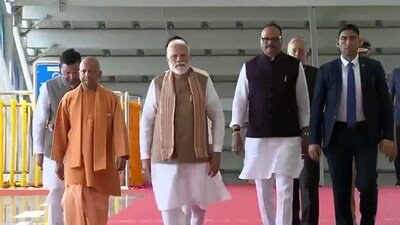
In a significant leap toward modernizing India’s regional connectivity, Prime Minister Narendra Modi visited Meerut today, February 22, 2026, to dedicate the entire 82-km Delhi-Meerut Namo Bharat Corridor to the nation. Alongside Chief Minister Yogi Adityanath, the PM flagged off the Namo Bharat train and the Meerut Metro at the Shatabdi Nagar station, marking the full operationalization of India’s first Regional Rapid Transit System (RRTS).
A Landmark Achievement in Integrated Transit
For the first time in India, two distinct transit services—the regional Namo Bharat RRTS and the intra-city Meerut Metro—will operate on the same shared infrastructure. This integrated model is designed to provide seamless high-speed intercity travel alongside efficient city movement. The Meerut Metro has been recognized as India’s fastest metro system, capable of reaching speeds of up to 120 kmph, allowing it to cover its 23-km stretch in just 30 minutes.
Expanding the 82-km Corridor
Today’s inauguration included the final segments of the 82-km corridor:
Delhi Section: A 5-km stretch between Sarai Kale Khan and New Ashok Nagar.
Meerut Section: A 21-km stretch extending from Meerut South to Modipuram.
With the entire corridor now open, the travel time between Delhi’s Sarai Kale Khan and Meerut’s Modipuram has been slashed to just 55 minutes, a journey that previously took significantly longer by road.
Following the flag-off, the Prime Minister and Chief Minister took a symbolic metro ride from Shatabdi Nagar to Meerut South station. Beyond the trains, PM Modi inaugurated and laid the foundation stones for additional developmental projects in Meerut worth approximately ₹12,930 crore. These projects underscore the government’s focus on sustainable urban mobility, reducing road congestion, and lowering vehicular carbon emissions.
The Sarai Kale Khan station now serves as a major multi-modal hub, seamlessly connecting the RRTS with Hazrat Nizamuddin Railway Station, the Delhi Metro Pink Line, and interstate bus terminals (ISBT). In Meerut, newly commissioned stations like Shatabdi Nagar, Begumpul, and Modipuram are set to become vital nodes for the city’s economy.
The completion of the Delhi-Meerut RRTS is more than just a transportation project; it is a blueprint for the future of “New Uttar Pradesh” and urban India. By integrating high-speed rail with local metro services, the government has set a global benchmark for regional transit, promising a faster, greener, and more comfortable commute for millions.
