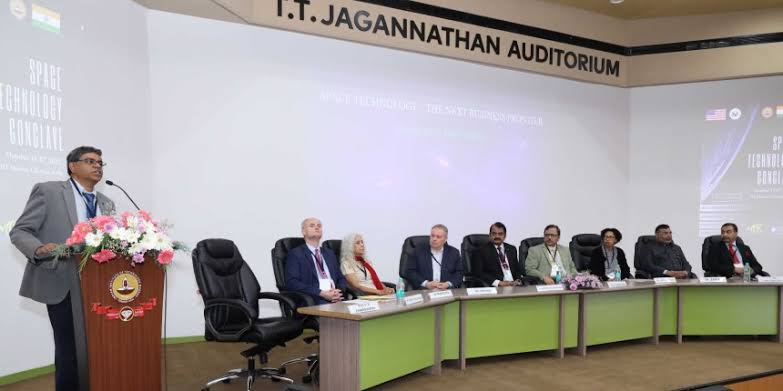
The Indian Institute of Technology Madras (IIT Madras), the US Consulate General Chennai and Indian Space Association are organizing a three-day Space Technology Conclave starting today October 15 until October 17, 2022.
The Space Technology conclave will focus on four key themes: space policy, international collaboration, scientific research and development, space entrepreneurship and business.
A key outcome of this conclave will be establishing the ‘Association of Space Entrepreneurs in the Indo-Pacific’ (ASEIP). A White Paper will also be shared with stakeholders in India, the U.S., and other Indo-Pacific countries.
Titled ‘Space Technology: The Next Business Frontier,’ the conclave will explore ways to optimize business opportunities and collaboration across the Indo-Pacific region,” the press release states.
Working Group members from this conclave are analysing challenges, risks and opportunities for entrepreneurs investing in the sector. A key outcome of this conclave will be establishing the ‘Association of Space Entrepreneurs in the Indo-Pacific’ (ASEIP).
A White Paper will also be shared with stakeholders in India, the US, and other Indo-Pacific countries,” IIT Madras said.
Addressing the inaugural session, Rajeev Jyoti, scientist and director (Technical) of Indian National Space Promotion and Authorization Center (IN-SPACe), said, “Instead of ISRO only being an integrator of the entire space ecosystem, the space sector must be taken forward by entrepreneurs and space businesses.
While technology innovation is the main thing for any business, space or otherwise, we need innovation and finance as well, among other things. Space, in the next 10 years, is shifting from geo-satellites to constellation of satellites.
There are estimates that 10,000 satellites are likely to be launched in the near future…Today, when we talk about space exploration, we also talk about ‘space tourism’.”
Further, Rajeev Jyoti said, “According to a newly-announced policy, if a space object is not functionally working, it has to be removed within 5 years in order to avoid space debris in place of the earlier 25 years.
We have to develop technologies for active space debris removal. There are many scenarios where AI is being used for building satellites, quantum technologies and other areas.”
Working groups have been formed to explore the four themes, and more than 70 invited working group members along with the four chairpersons from more than 15 countries including India, USA, Japan, Australia, New Zealand, Singapore, South Korea, Germany, Malaysia, the Philippines and Indonesia, among others, will be participating in this conclave.
Delivering an address on the ‘Conclave from a Government Perspective,’ Drew Schufletowski, Minister Counselor for Economic, Environment, Science and Technology Affairs, US Embassy, New Delhi, said, “Bilateral trade between India and the US is at a higher level than ever before and I see the potential for collaboration in many areas. I believe India and the US are natural partners in the space sector. I see immense opportunities for expanding bilateral and multilateral collaboration in space sector, particularly the space entrepreneurship. Back in 1963, NASA and ISRO worked together to launch the first Indian sounding rocket. Since then, the two space agencies have collaborated on numerous projects including moon exploration.”
Currently, NASA and ISRO are collaborating on one of NASA’s biggest project – the NASA-ISRO SAR Mission (NISAR), a joint Earth-observing mission. I envisage the collaboration between the two agencies to continue to expand. Where I see the greatest collaboration involves the space sector,” he added.
Government space agencies participating include the Indian Space Research Organization (ISRO), NASA (National Aeronautics and Space Administration), JAXA (Japan Aerospace Exploration Agency), and the Australian Space Agency (ASA).

