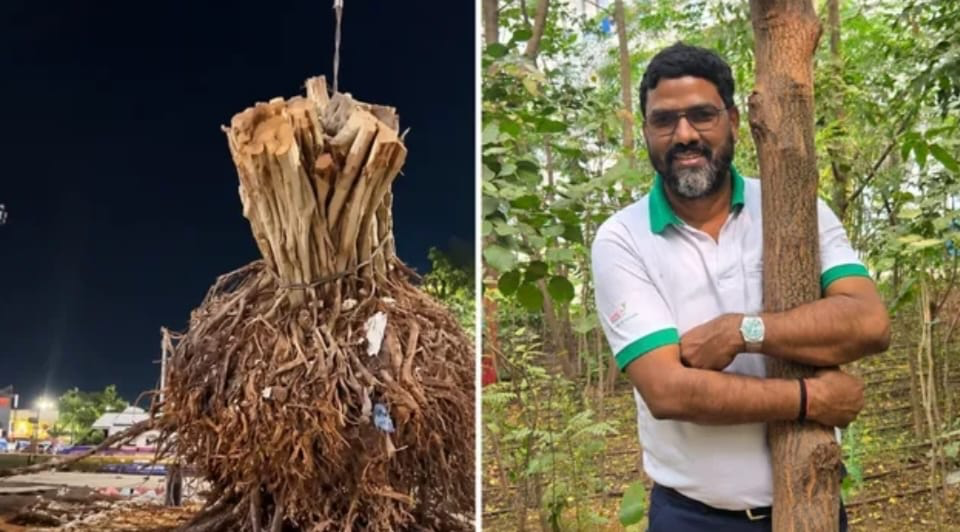
Bharat Sisodia’s remarkable tree transplantation effort shows how mature trees can be saved through determination, technology and long-term environmental care.
In a time when rapid urbanisation is changing the landscape of Indian cities, stories of environmental conservation offer a much-needed reminder that development and nature do not always have to stand against each other. An inspiring example has emerged from Ahmedabad, Gujarat, where a century-old peepal tree has been given another chance at life through an extraordinary transplantation effort led by tree-transplantation expert Bharat Sisodia.
The tree, which had stood for nearly 100 years, had already been cut down when Bharat Sisodia and his team reached the location in November 2022. Only around six to seven feet of its trunk remained above the ground. For many, the tree might have appeared beyond recovery. However, instead of accepting its condition as the end of its journey, Bharat decided to examine whether its roots were still alive and whether the remaining structure could be rescued.
What followed was an ambitious operation involving specialised equipment, careful excavation and a 50-tonne crane. The team dug around the remaining structure, carefully worked to preserve its surviving root system and eventually transported it nearly two kilometres to a new location. A specially prepared pit was ready at the destination, where the tree was replanted with the necessary soil treatment and nutrients to support its recovery. The effort has reportedly started showing positive results, with the old peepal tree displaying signs of fresh growth.
The rescue is more than an unusual transplantation story. It highlights the importance of protecting mature trees, particularly in rapidly developing urban areas where construction, road expansion and infrastructure projects frequently put existing green cover at risk.
For Bharat Sisodia, the work is connected to an approach he calls ‘plantenance’, combining planting and maintenance. His philosophy focuses not just on putting a tree into the ground but also on ensuring that it receives the attention and care required to survive for years. Since 2014, he has been working towards promoting this approach, highlighting the responsibility that comes after plantation and transplantation.
Tree transplantation is not as simple as moving a plant from one location to another. Mature trees have extensive root systems that develop over decades, and disturbing them can create serious challenges for their survival. The success of such an operation depends on several factors, including the health of the roots, the condition of the tree, the surrounding soil, weather conditions and the suitability of the new location.
In the Ahmedabad operation, the team reportedly dug a trench approximately six feet deep around the tree. Water was used to soften the surrounding soil, allowing the roots to be carefully freed. Considering the size and weight of the remaining tree structure, heavy machinery was essential. A 50-tonne crane was brought in to lift and transport it safely.
However, lifting the tree was only one part of the challenge. Once it reached its new location, the team had to ensure that the prepared ground could support its recovery. Soil treatment and nutrients were used to create suitable growing conditions. The tree then required continued monitoring and maintenance so that its roots could gradually adjust to the new environment.
According to Bharat, the recovery of a transplanted tree depends significantly on the condition of its root system. If the important roots are damaged during excavation or transportation, the chances of survival can decrease. The process also requires careful consideration of the season, temperature and moisture conditions. Favourable monsoon conditions can support recovery, while the roots may need at least two months to begin rebuilding, depending on the extent of damage.
Bharat and his team generally prefer to transplant trees within the same region and as close as possible to their original locations. Depending on the circumstances, trees may be moved around 10 kilometres, while some operations can involve distances of 15 to 20 kilometres. Selecting an appropriate destination is essential because the new location must provide enough space, suitable soil and favourable environmental conditions for the tree to establish itself again.
His work also highlights another important environmental issue that often receives less attention: the condition of the ground surrounding mature trees. In Ahmedabad, Bharat recalls an incident involving a banyan tree that had fallen on Airport Road. The team observed that the cemented surroundings had restricted the development of the tree’s aerial roots. These roots normally grow downwards from the branches and can eventually develop into additional supporting trunks.
When the surrounding ground is covered with concrete, the natural development of these roots can be affected. Compacted soil and insufficient space may also create difficulties for the tree’s long-term health and stability. This demonstrates why urban development projects need to consider the underground requirements of trees, rather than focusing only on their visible branches and leaves.
Bharat’s environmental efforts have also extended beyond Ahmedabad. In Vasai, Maharashtra, his team reportedly helped relocate nearly 50 trees that were facing removal in connection with work by the National Highways Authority of India. The operation involved machinery, manpower and the participation of local residents and community leaders.
Community participation played an important role in the effort. Local people were involved in the transplantation work, and members of the community were hired to assist with the operation. Such involvement demonstrates how environmental conservation can become a shared responsibility rather than remaining limited to experts and organisations.
The larger message behind these efforts is particularly relevant for India’s growing cities. Infrastructure development, highways, commercial buildings and residential projects are important for economic progress. However, mature trees are valuable environmental assets that cannot be replaced immediately. A tree that has taken several decades to grow provides shade, supports biodiversity, offers shelter to birds and other wildlife, and contributes to the environmental quality of its surroundings.
Planting new saplings is certainly important, but it does not provide an immediate replacement for the ecological contribution of a century-old tree. A newly planted sapling requires years of growth before it can develop a comparable canopy and root system. Even successful transplantation does not guarantee that every environmental benefit of the original location will be preserved.
This is why experts emphasise the importance of protecting existing trees before they reach a stage where relocation becomes necessary. Better infrastructure planning, adequate space for root development, responsible construction practices and regular maintenance can significantly contribute to urban environmental conservation.
Bharat Sisodia’s work offers an encouraging example of how determination and appropriate technology can create opportunities to save trees that might otherwise be considered lost. At the same time, tree transplantation should not become an excuse for unnecessary tree cutting. Protecting mature trees in their original locations should remain the priority wherever possible.
The century-old peepal tree in Ahmedabad has received an unexpected second chance. Its journey from a cut-down stump to a newly replanted tree reflects an important environmental lesson: saving nature requires more than occasional plantation drives. It demands consistent action, technical understanding and long-term responsibility.
As Indian cities continue to expand, initiatives like these can encourage authorities, developers, communities and citizens to reconsider how they approach urban development. Sometimes, progress is not just about building something new. It is also about finding ways to protect what has taken generations to grow.
SEO Keywords: Bharat Sisodia, 100-year-old peepal tree, Ahmedabad tree transplantation, 50-tonne crane tree rescue, tree transplantation in India, environmental conservation India, save old trees, urban tree conservation, tree plantation and maintenance, sustainable urban development, mature tree transplantation, Gujarat environmental news.
Follow NewsNowNation.com for more updates on business, entrepreneurship, corporate developments and important news from across India.
