Author: Naitik Verma

In a traditional economy, financial interactions are anonymous to institutions as cash is merely an
intermediary of exchange. However, in a cashless economy, every transaction leaves a trace– a
unit of monetary exchange, a decision recorded permanently which, now these concerned
institutions can access and act upon in real time. In a cashless economy, informational inputs are
an extremely important factor as it acts as a comprehensive record for consumer behaviour. The
definitive meaning of the above contrast is as such; in a cashless economy, these financial
decisions are recorded in a scalable data-set, easily accessible to two structural institutions– the
firm, which exploits this user-generated information for commercial advantage and the
government which can leverage credit and macroeconomic control.
Therefore, there is a causal need to reframe the question, should we fear a cashless economy, or
should we fear the structural market and credit changes it brings with it; should we fear a
scenario that favours data-rich institutions through compounded informational advantage. Hence
this essay argues that while a cashless society need not be inherently feared, it fundamentally
transforms economic payments into continuous sources of data, where each exchange feeds large
scale systems of data analysis . Therefore, it shifts the market structure in a way that boosts
economic legibility, granting firms the power to predict and influence consumer trajectories
with increasing precision. In doing so, it deepens informational asymmetry, allowing data-rich
institutions to evaluate individual customers, thereby facilitating algorithmic systems of price
determination that evolve into increasingly precise forms of price discrimination.
Cashless economies are institutionally appealing due to the permanence and traceability of
financial transactions. Financial activities can easily be tracked and recorded, hence
strengthening financial transparency. However, a trade-off is generated,one major consequence
of recorded monetary exchanges is heightened economic legibility. In traditional markets,money
is merely used as a medium of exchange and hence trans are not recorded as largely, and the
market is studied by analysing the overall behavior of the environment; not the fine grained
details. This means that the firms do not possess knowledge on every consumer segment or
individual to such great detail. Instead, they rely on traditional economic indicators to understand
where the economic landscape is headed towards. In contrast to the traditional economy, cashless
economies alter this equilibrium, by transforming financial transactions into large, scalable data
sets. Money no longer facilitates exchange; it simultaneously functions as a mechanism of
information extraction.
Organisations in cashless economies constantly analyse recorded economic activity to project
economic decisions with greater precision, reducing informational uncertainty in previously
unachievable ways within conventional commercial spaces. This helps the firms in identifying
spending habits, purchasing urgencies and price responsiveness as consumers share different
preferences at different times in different valuations. Therefore, this reduces uncertainty for
firms, allowing them to algorithmically determine demand with greater accuracy. Such trading
environments inherently favour producers, since firms possessing greater behavioural evidence
are better positioned to make decisions to maximise profits.
Empirical evidence demonstrates the predictive value of transactional data.A large-scale study
analysing approximately 60 million debit transactions found that fine-grained transactional
histories significantly improved the ability of firms to forecast consumer outcomes and
behavioural patterns. Such findings suggest that transaction records no longer function merely as
evidence of exchange, but increasingly as tools through which firms reduce uncertainty and
forecast demand with greater precision.
One significant consequence of this informational imbalance is the increasing extraction of
consumer surplus. When producers possess more data insight on a comparison to consumers,
strategies are formulated to favour profitable motives. This is an important trade-off in welfare
economics in a cashless economy.
George Akerlof in his theory of adverse selection pointed out how informational
asymmetry could lead to inefficient outcomes. Within cashless systems, firms possessing
disproportionately greater behavioural knowledge may similarly influence the market
outcomes to favour data rich institutions, this leaves us with the question how do firms
utilize this benefit- and one approach may be through price discrimination.
The vast quantities of personal records available to firms today have enormous economic
potential. These digital traces represent valuable business assets when firms use them to target
decisions, like advertising and rates, differentially across individuals.
Reduced uncertainty enables firms to rely on algorithms to translate market actor behavior
and thus, adjust pricing strategies accordingly. Firms can now compare elasticities on
products to capture consumer surplus. The accelerating reliance on behavioral finance is already
visible within modern credit systems. Empirical evidence realistically supports the predictive
power of behavioural transaction inputs. . A large-scale study analysing over 6 million lending
applications found that consumers with stronger digital behavioural scores consistently showed
lower default risk, demonstrating how transaction histories are now used as inferrable economic
tools rather than simple records of exchange.
As firms continue to analyse a consumer’s willingness to pay, traditional pricing begins to
falter as it would in a conventional economic setting, because now the firms know what is
the best charges that can be offered to achieve the greatest demand at the number which
offers the greatest profit. Now, firms would largely rely on records to adjust prices on
the basis of algorithmic data to segment consumers according to habitual tendencies.
In theory, the concept runs down to a standard equilibrium graph, where the consumer
surplus area transfers to the producer surplus area.
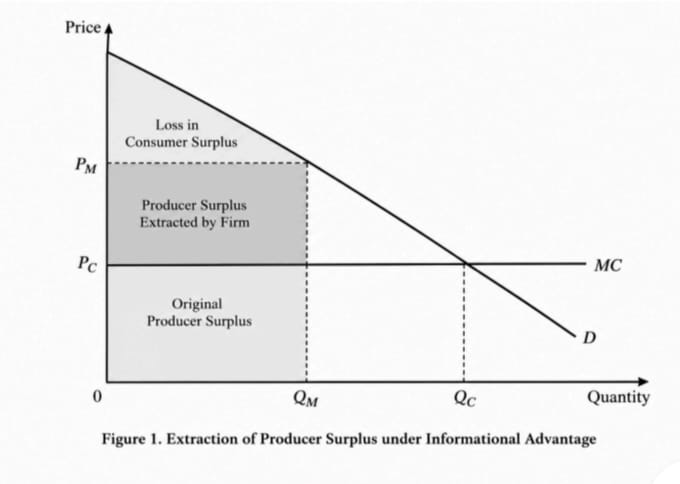
When a firm possesses superior signals about consumer’s willingness to pay, it can charge
a higher price (PM) than the competitive price (PC). Quantity falls from QC to QM,
consumer surplus declines, and part of this surplus is transferred to the firm. Total surplus
is unchanged, but its distribution shifts in favour of the producer.
Owing to network effects, cashless exchanges skyrocketed in popularity. Thus, firms gain
the ability to adjust their approaches towards consumers because of the abundance of data.
Advantageous as this ability is, firms can now categorise buyers and introduce personally
tailored pricing structures. As behavioural financial data becomes expansively central to
institutional decision-making, customers may gradually encounter differentiated access to
credit, insurance, and financial services on the basis of how the algorithm judges them. So,
credit may be rationed according to how safe a consumer is according to the language
spoken by the numbers.
A large-scale research conducted by National Bureau of Economics Research found that
personalized costing escalated the firm’s profits by 19% while reducing consumer surplus
In theory, the concept runs down to a standard equilibrium graph, where the consumer
surplus area transfers to the producer surplus area.
When a firm possesses superior signals about consumer’s willingness to pay, it can charge
a higher price (PM) than the competitive price (PC). Quantity falls from QC to QM,
consumer surplus declines, and part of this surplus is transferred to the firm. Total surplus
is unchanged, but its distribution shifts in favour of the producer.
Owing to network effects, cashless exchanges skyrocketed in popularity. Thus, firms gain
the ability to adjust their approaches towards consumers because of the abundance of data.
Advantageous as this ability is, firms can now categorise buyers and introduce personally
tailored pricing structures. As behavioural financial data becomes expansively central to
institutional decision-making, customers may gradually encounter differentiated access to
credit, insurance, and financial services on the basis of how the algorithm judges them. So,
credit may be rationed according to how safe a consumer is according to the language
spoken by the numbers.
A large-scale research conducted by National Bureau of Economics Research found that
personalized costing escalated the firm’s profits by 19% while reducing consumer surplus
gradually losing their informational advantage as data-rich institutions begin to expand
into payment systems, lending and other financial services.
Ant group, a company based in China, was primarily in the AliBaba E-commerce family.
It functioned as a payment interface, and using Alipay, it gradually accumulated large
volumes of recorded sets. Researchers have argued that this informational advantage
later enabled Ant Financial to expand into consumer finance, credit assessment, and
lending services, illustrating how transaction behavior itself risingly favours
data-rich institutions.
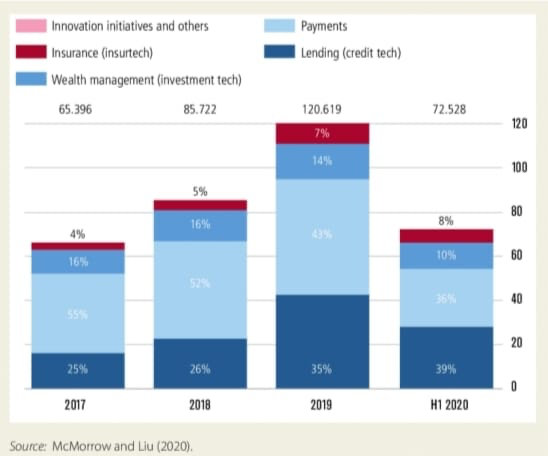
The illustration shows the revenue breakdown for Ant group. Evident from the data, Ant
Group expanded more into financial services as the revenue derived by credit, insurance
and wealth management intensified annually.
Nevertheless, it cannot be denied that a cashless economy generates substantial economic
efficiencies. Traceable payments can improve fiscal monetary and impose restrictions on
the formulation and operation of shadow economies. Furthermore, a cashless economy
brings with it, the opportunity for greater financial inclusion, expanding the access to
banking infrastructure for previously excluded segments of the population. The
introduction of mobile payments, utilizes network effects to maximise inclusion. Financial
transactions promise and initialize lower transaction costs due to the reduced friction in
interchanges owing to easily accessible insights and computable storage.
But economic efficiencies do not eliminate the structural imbalances created by large-scale
data accumulation. While transactional transparency may be a benefit, it is important to
understand that these benefits naturally weigh towards producers as each transaction
simultaneously expands the informational capacity of a firm. Consequently the debate
regarding cashless economies extends beyond the scope of convenience and talks about a
broader picture of structural changes. Hence, there are growing concerns of predictive
economic institutions.
Thus, the central concern is not the existence of cashless systems itself, the primary
concern is the gradual re-structuring of price relationships, pricings and economic
participation.
In conclusion, we return to the question- should we fear a cashless economy? The answer
to this lies in the observation that money now no longer only exists as a medium of
exchange, it simultaneously functions as a medium of information. Economic legibility,
Price discrimination and financial concentration are manifestations of this one underlying
narrative. Transactional intelligence therefore is the medium which possesses the ability to
influence pre-existing traditional structures and shape financial accessibility.
